Cantonese
Cantonese (廣東話 / Gwóngdūngwá) is a prominent variety of the Yue Chinese languages, belonging to the Sinitic branch of the Sino-Tibetan language family. Known for its rich tonal system and historical depth, it serves as a primary language in Hong Kong and Macau, and remains a powerful cultural force across southeastern China and global overseas Chinese communities.
The language is often referred to as "Canton speech" or "Guangzhou speech" (廣州話 / Gwóngjāuwá), reflecting its roots in the administrative and cultural hub of Guangzhou.
Key Facts
- Official Status: Official language in Hong Kong and Macau.
- Family: Sino-Tibetan > Sinitic > Chinese > Yue.
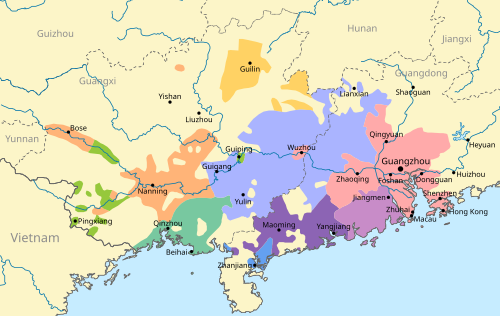
- Geographic Core: Guangdong and eastern Guangxi provinces in China.
- Global Presence: Dominant Chinese variety in many Western diaspora communities, particularly in Canada.
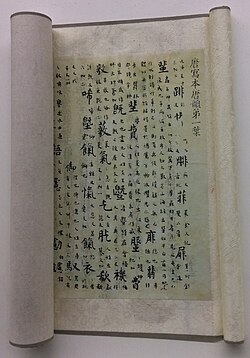
- Writing: Uses Chinese characters, with specialized "Written Cantonese" for vernacular text.
History and Evolution
The modern distribution of Cantonese was heavily influenced by migration patterns during the 19th and 20th centuries. As Hong Kong and Macau were ceded to Britain and Portugal, a massive influx of migrants from Guangzhou and surrounding areas established Cantonese as the dominant tongue. In Hong Kong, this process supplanted other local Yue varieties, as well as Hakka and Southern Min languages.
While native Cantonese speakers made up less than 50% of Hong Kong's population as late as the 1950s, that figure surged to over 90% by the 1970s. In Macau, the indigenous Yue variety was closely tied to Zhongshan, which continues to influence the region's tonal phonology.
Geographic Distribution
China, Hong Kong, and Macau
In mainland China, Cantonese served as the lingua franca (a bridge language used between speakers of different native tongues) of Guangdong and Guangxi. Even after the Qing dynasty established Mandarin as the official government language in the early 1900s, Cantonese remained influential. Following the establishment of the People's Republic of China in 1949, Standard Mandarin was promoted as the sole official national language, though Cantonese remains strong in its home region.
Global Diaspora
Cantonese has historically been the dominant Chinese variant in the Western world due to early migration from Guangdong.
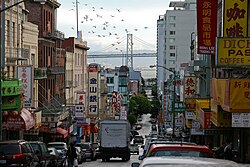
- Canada: It is the most common Chinese variety spoken in the country. According to the 2016 census, 565,275 residents reported it as their native language, with significant concentrations in Metro Vancouver and the Greater Toronto Area.
- United States: Early immigrants from Guangdong in the late 19th century established the language's presence, later bolstered by waves of migrants from Hong Kong and Southeast Asian conflict zones (such as Vietnam) in the 1970s and 80s.
- Australia: Cantonese was the dominant Chinese language from the 1850s until the mid-2000s, when increased Mandarin-speaking immigration shifted the balance. It remains the third most-spoken language in Australia.
Cultural Impact
Cantonese has a storied history in cinema. The first Cantonese "talkie" (a film with synchronized sound), White Gold Dragon, was released in 1932. Despite bans by the Nanjing authority in the 1930s, production flourished in British-ruled Hong Kong. Between the mid-1970s and 1990s, Hong Kong cinema became a global phenomenon, exporting Cantonese culture across the Chinese-speaking world.
Linguistic Structure
Phonology and Tones
Cantonese is renowned for its complex tonal system, which distinguishes meaning between words that otherwise sound identical. It utilizes a series of "dark" (陰) and "light" (陽) tones, as well as "checked" tones.
| Tone Name | Description | Jyutping/Yale Number | Example |
|---|---|---|---|
| Dark Flat (陰平) | High falling, high level | 1 | 詩 |
| Dark Rising (陰上) | Medium rising | 2 | 史 |
| Dark Departing (陰去) | Medium level | 3 | 試 |
| Light Flat (陽平) | Low falling, very low level | 4 | 時 |
| Light Rising (陽上) | Low rising | 5 | 市 |
| Light Departing (陽去) | Low level | 6 | 是 |
Writing and Romanization
While Cantonese uses Chinese characters, it also employs Written Cantonese to capture the spoken vernacular. To help non-native speakers and linguists, several romanization systems (transcribing sounds into the Latin alphabet) are used:
- Jyutping: A widely used standard for transcription.
- Yale Romanization: A common system used in academic and dictionary contexts.
- Cantonese Transliteration Scheme: Used for official purposes.
Frequently Asked Questions
Is Cantonese a dialect or a language?
Linguistically, Cantonese is a variety of the Yue Chinese language family. While often called a "dialect" in a political or cultural context within China, it is mutually unintelligible with Standard Mandarin, functioning as a distinct language in practice.
Where is Cantonese officially recognized?
Cantonese holds official status in the Special Administrative Regions of Hong Kong and Macau.
How does Cantonese differ from Mandarin?
Beyond different vocabularies, the most striking difference is the tonal system; Cantonese generally has more tones than Mandarin. It also preserves certain terminal consonants from Middle Chinese that Mandarin has lost.
Why is Cantonese common in North American Chinatowns?
This is due to the historical origins of early Chinese immigrants to North America, the vast majority of whom arrived from the Guangdong province during the 19th century.