Understanding Candaulism: History, Psychology, and Real-World Instances
In the study of human sexuality, certain behaviors fall into the category of paraphilias—intense and persistent sexual interests outside of conventional norms. One such phenomenon is candaulism (sometimes spelled candaulesism). This practice involves an individual exposing their partner, or images of their partner, to others for the purpose of voyeuristic pleasure or to satisfy the partner's own desires.
Candaulism is closely linked to two other psychological concepts: voyeurism (the practice of gaining sexual pleasure from watching others) and exhibitionism (the practice of gaining pleasure from exposing oneself or others to view). While it can manifest as a consensual fantasy, the term also encompasses unethical or illegal behaviors, such as the non-consensual sharing of private images.
Key Facts
- Definition: A practice where one person exposes their partner to others for sexual gratification.
- Etymology: Derived from the legend of King Candaules of ancient Lydia.
- Psychological Link: Often associated with voyeurism and exhibitionism.
- Scope: Can include undressing a partner, encouraging revealing clothing, or sharing explicit images.
- Legal Note: Non-consensual exposure or image sharing is unethical and illegal.
The Historical Origins of the Term
The term finds its roots in classical antiquity, specifically within the writings of the Greek historian Herodotus. According to his accounts in The Histories, King Candaules of ancient Lydia devised a plot to show his naked wife to his servant, Gyges.
The story concludes with a dramatic confrontation: upon discovering that Gyges had been watching her, the Queen demanded that Gyges choose between committing suicide or killing the King to rectify the breach of privacy and honor.
Psychological Perspectives
Psychologists have attempted to decode the underlying motivations behind candaulism. Isidor Sadger proposed a theory of identification, suggesting that a candaulist may psychologically identify so completely with their partner's body that, in their own mind, they are the ones being displayed.
Beyond this identification theory, some definitions suggest a broader application of the term. In these instances, candaulism may refer to a practice where one person observes—often from a concealed position—two other people engaging in sexual relations.
Historical and Modern Instances
Candaulism has appeared in legal records, art criticism, and even criminal investigations throughout history.
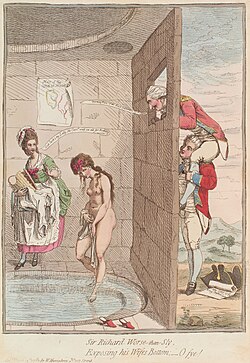
The Case of Sir Richard Worsley
In 1782, a legal case involving Sir Richard Worsley and George Bissett highlighted a historical instance of this behavior. The case, centered on "criminal conversation" (a legal term for adultery involving Lady Worsley), revealed that Sir Richard had actively assisted Bissett in spying on his wife while she was bathing.
Art and Influence
The concept has also been noted in the realm of art history. Collector Charles Saatchi has suggested that candaulism may have influenced the work of the surrealist artist Salvador Dalí. Biographers of Dalí have recorded episodes where his wife, Gala, was displayed to other men.
The Robert Hanssen Case
A modern and more extreme example occurred with Robert Hanssen, an FBI agent arrested in 2001 for espionage. Investigations revealed that Hanssen had taken explicit photographs of his wife to send to a friend. He further facilitated voyeurism by inviting the friend to watch him and his wife engage in sexual activity, eventually using stolen FBI closed-circuit television equipment to allow the friend to watch from a guest bedroom.
Summary of Candaulism Concepts
| Aspect | Description |
|---|---|
| Primary Action | Exposing a partner or their images to others. |
| Associated Behaviors | Encouraging revealing clothing (e.g., microskirts, see-through fabrics). |
| Psychological Drivers | Voyeurism, exhibitionism, and partner identification. |
| Legal Status | Consensual practices vary; non-consensual acts are illegal. |
Frequently Asked Questions
What is the difference between candaulism and voyeurism?
Voyeurism is the act of watching others for sexual pleasure. Candaulism is a specific subset where a person actively facilitates the exposure of their own partner to be watched.
Can candaulism involve clothing?
Yes. The term can apply to urging a partner to wear clothing that reveals their physical attractiveness to others, such as low-cut tops, tight-fitting garments, or minimal-coverage swimwear.
Is candaulism always consensual?
No. While it can be a consensual fantasy between partners, the non-consensual posting of a partner's images or exposing them without their permission is considered unethical and illegal.
Where does the name "Candaulism" come from?
The name is derived from the historical account of King Candaules of Lydia, who attempted to show his wife to his servant as described by Herodotus.
How does psychology explain the urge to expose a partner?
One hypothesis by Isidor Sadger suggests that the person performing the exposure is actually experiencing a form of psychological identification with their partner's body.