Cabinet des Médailles: France's Oldest Museum of Antiquities
Located at 58 rue Richelieu in Paris, the Cabinet des Médailles stands as the oldest museum in France. This prestigious institution houses internationally significant collections of coins, engraved gems, and antiquities. While its roots lie in the private treasuries of the medieval French kings, it has evolved from a royal curiosity into a vital national asset for scholars and the public alike.
The Evolution of a Royal Treasury
The collection's early history was marked by instability. For instance, the first royal library assembled by Charles V at the Palais du Louvre—which held 973 volumes by 1373—was dispersed within a century. To prevent similar losses, Charles IX (1560–1574) responded to the disruptions of the Wars of Religion by establishing the role of garde particulier des médailles et antiques du roi (Special guardian of the King's medals and antiques).
Under Henry IV, the "cabinet" took on a stable form. In this context, a cabinet referred not to a piece of furniture, but to a small, private room designed for the conservation of intimate artworks and private conversation. Henry IV appointed the connoisseur Rascas de Bagarris to the role of special guardian, ensuring the collection remained intact and curated.
Expansion and the Shift to National Property
The collection grew significantly through the acquisitive nature of later monarchs. Louis XIV expanded the holdings by acquiring the cabinet of curiosities from his uncle, Gaston d'Orléans, and the collection of Hippolyte de Béthune. To keep these treasures closer, Louis XIV moved them from the old royal library in Paris to the Palace of Versailles.
In 1724, during the reign of Louis XV, the Cabinet returned to Paris. It was housed in a space within the royal library designed by Jules-Robert de Cotte. This period also saw the addition of exquisite furniture, including a 1739 medal-cabinet by the ébéniste du roi (king's cabinetmaker) Antoine Gaudreau, as well as pieces by André-Charles Boulle. The museum still preserves paintings by Natoire, Van Loo, and Boucher.
The French Revolution marked a pivotal turning point when the royal collection was declared a bien national (national property). Following the Revolution, the collection was further enriched by precious objects from the Treasury of Saint-Denis.
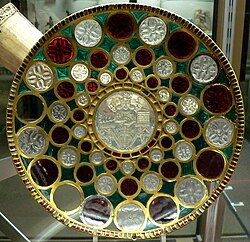
Throughout the 19th century, the museum continued to grow through strategic bequests. The pioneering archaeologist comte de Caylus donated his antiquities to ensure they remained accessible to scholars. In 1862, the duc de Luynes contributed his Greek coins, viewing the institution as a national rather than merely an imperial collection. The State also added significant finds, such as the early sixth-century gold Treasure of Gourdon in 1846.
Curatorship and Scholarship
The preservation of the Cabinet des Médailles is due in large part to dedicated scholars. Théophile Marion Dumersan, who joined the staff in 1795 at age sixteen, played a critical role in protecting the collection from being dispersed by allies following Napoleon's defeat. In 1838, Dumersan published a history and description of the collection, which he had rearranged according to historical principles.
Other scholars contributed to the documentation of the treasury. Pierre-Jean Mariette, encouraged by the comte de Caylus, published a selection of the royal carved hardstones in the second volume of his Traité des pierres gravées.
Key Facts
- Status: Recognized as the oldest museum in France.
- Location: Former building of the Bibliothèque Nationale, 58 rue Richelieu, Paris II.
- Core Collections: Coins, engraved gems, and various antiquities.
- Key Transition: Changed from royal property to bien national during the French Revolution.
- Notable Additions: The Treasure of Gourdon (1846) and the Greek coins of the duc de Luynes (1862).
Collection Summary
| Category | Details |
|---|---|
| Primary Artifacts | Coins, engraved gems, antiquities, and paintings |
| Notable Furniture | Cabinets by Antoine Gaudreau and André-Charles Boulle |
| Key Figures | Charles IX, Henry IV, Louis XIV, Théophile Marion Dumersan |
| Major Bequests | Comte de Caylus, Duc de Luynes |
Frequently Asked Questions
What is the Cabinet des Médailles?
It is a museum in Paris containing internationally important collections of coins, engraved gems, and antiquities, and is considered the oldest museum in France.
Where is the museum located?
The museum is located in the former building of the Bibliothèque Nationale at 58 rue Richelieu, Paris II.
How did the collection become a national property?
The royal collection was declared a bien national (national property) during the French Revolution, transitioning from the personal property of the king to the state.
Who was Théophile Marion Dumersan?
He was an outstanding scholar and curator who began working at the museum in 1795. He is credited with protecting the collection from dispersal after Napoleon's defeat and rearranging it based on historical principles.
What does the term "cabinet" mean in the context of this museum?
In this historical context, a cabinet refers to a small private room used for the conservation and display of art and for private conversations, rather than a piece of furniture.