Bulbuls: A Comprehensive Look at the Pycnonotidae Family
Bulbuls are medium-sized passerine (perching) songbirds belonging to the family Pycnonotidae. This diverse group includes not only the typical bulbuls but also greenbuls, brownbuls, leafloves, and bristlebills. These birds are widely distributed across Africa, the Middle East, and tropical Asia, extending as far north as Japan and inhabiting various tropical islands in the Indian Ocean.
While they share a common family, their habitats vary by region. African species are predominantly found in rainforests, whereas their Asian counterparts typically prefer more open environments.
Key Facts
- Species Count: 161 species across 28 genera.
- Distribution: Africa, Middle East, tropical Asia, and Japan.
- Diet: Primarily frugivorous (fruit-eating), though many supplement with insects.
- Physical Traits: Short necks, long tails, and slightly hooked bills.
- Social Structure: Generally monogamous, with some species practicing alloparenting.
Taxonomy and Classification
The family Pycnonotidae was first introduced in 1840 by English zoologist George Robert Gray, who originally classified them as a subfamily of the thrush family (Turdidae). Over time, scientific understanding has evolved through molecular research.
Recent genetic studies have led to significant reclassifications. For example, a 2007 study by Ulf Johansson and colleagues revealed that the genus Andropadus was non-monophyletic (not descending from a single common ancestor), leading to the resurrection of the genera Arizelocichla, Stelgidillas, and Eurillas. Similarly, a 2017 study by Subir Shakya and Frederick Shelden split the large genus Pycnonotus into several divergent clades.
Today, the family is divided into two primary clades: one consisting almost entirely of African species (many of which are called greenbuls) and another consisting mostly of Asian species, with a few African representatives.
Summary of Pycnonotidae Classification
| Category | Details |
|---|---|
| Scientific Family | Pycnonotidae |
| Total Species | 161 |
| Total Genera | 28 |
| Primary Regions | Africa, Middle East, Tropical Asia |
| Key Groups | Bulbuls, Greenbuls, Brownbuls, Leafloves, Bristlebills |
Physical Characteristics
Bulbuls are characterized by their slender build, short necks, and rounded wings. Their bills are typically elongated and feature a slight hook at the tip. Size varies significantly across the family; the tiny greenbul measures only 13 cm and 13.3 g, while the straw-headed bulbul can reach 29 cm and 93 g.
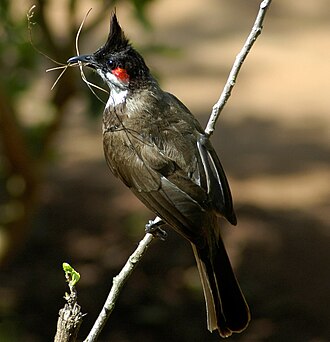
Most species possess drab olive-brown to black plumage, though some exhibit vibrant colors on their cheeks, throats, or vents in shades of yellow, red, or orange. Some species are distinguished by prominent crests or contrasting eyerings. While males and females generally look alike, females are often slightly smaller.
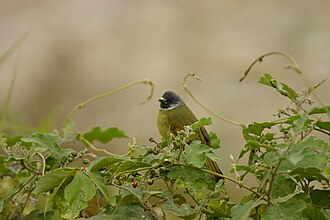
Their vocalizations are a defining trait, often described as nasal or gravelly. The brown-eared bulbul, for instance, is noted for having a particularly unattractive song.
Behavior and Ecology
Breeding and Social Structure
Most bulbuls are monogamous. However, the yellow-whiskered greenbul is a notable exception, appearing to be polygamous and utilizing a lekking system (where males gather to display for females). Some species also engage in alloparenting, where offspring from previous clutches help the dominant pair raise new chicks.
Females typically lay up to five speckled eggs in open tree nests. The incubation period lasts between 11 and 14 days, and the chicks usually fledge within 12 to 16 days.
Diet and Foraging
Bulbuls are generalists with a wide diet. While the majority are frugivorous, they also consume seeds, nectar, small insects, arthropods, and occasionally small vertebrates. Species in the genus Criniger and bristlebills (genus Bleda) are known to join mixed-species feeding flocks.
Relationship with Humans
Certain species, such as the red-whiskered and red-vented bulbuls, have become popular in the pet trade. This has led to their introduction in non-native regions, including Hawaii, Australia, Fiji, and southern Florida. While many bulbuls are tolerant of human-disturbed habitats, some are viewed as pests in orchards.
Conservation status varies; while the family is generally resilient, approximately 13 species are currently threatened by human activity, primarily due to the loss of specialized forest habitats.
Frequently Asked Questions
What is the difference between a bulbul and a greenbul?
The distinction is largely taxonomic and geographic. Greenbuls are members of the Pycnonotidae family primarily found in the African clade, whereas bulbuls are more commonly associated with the Asian clade, though some overlap exists.
What do bulbuls eat?
Bulbuls are primarily fruit-eaters (frugivores), but they are opportunistic and also eat insects, seeds, nectar, and occasionally small vertebrates.
Are bulbuls found in the wild in the United States?
They are not native to the U.S., but red-whiskered and red-vented bulbuls have been introduced to areas like southern Florida through the pet trade.
How do bulbuls raise their young?
Most form monogamous pairs and build open nests in trees. Some species exhibit alloparenting, where older siblings help the parents raise the new brood.
Why are some bulbul species threatened?
About 13 species are threatened mainly because they are forest specialists. When their specific rainforest habitats are destroyed by human activity, their populations decline.