Buddy Rich: The Life and Legacy of the Drum Wonder
Bernard "Buddy" Rich was more than just a musician; he was a force of nature behind the drum kit. Widely regarded as one of the most influential drummers in history, Rich blended unmatched technical precision with an explosive energy that defined the big band and swing eras. From his beginnings as a child prodigy to his tenure as a world-renowned bandleader, Rich's career spanned over six decades of musical innovation.
Key Facts
- Born: September 30, 1917, in Brooklyn, New York.
- Early Start: Began drumming at age two and headlined Broadway by age four.
- Military Service: Served as a Judo instructor in the U.S. Marines (1942–1944).
- Major Collaborations: Worked with legends like Tommy Dorsey, Harry James, and Count Basie.
- Signature Work: Famous for his complex big-band arrangement of West Side Story.
- Legacy: Ranked among the greatest drummers of all time by Rolling Stone.
Early Life: The Rise of "Baby Traps"
Born to Jewish parents Bess Skolnik and Robert Rich, both of whom were vaudevillians, Buddy Rich was immersed in entertainment from birth. By the age of 18 months, he was already performing in his parents' act, playing "The Stars and Stripes Forever" before finishing with a tap-dance routine. This early exposure led to him headlining Broadway at age four, where he was billed as "Baby Traps the Drum Wonder."
Rich's talent was not merely a novelty. By his teens, he was touring the United States and Australia, earning a weekly salary of $1,000—making him the second-highest-paid child entertainer of the 1930s. During this time, he began sneaking into jazz clubs, where he developed a deep passion for the genre that would define his professional life.
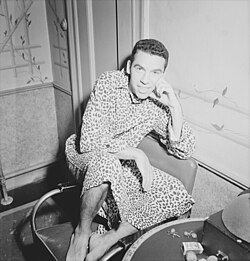
Professional Career and Jazz Mastery
Rich's professional jazz journey accelerated in 1937. He became a staple of the big band scene, joining the Tommy Dorsey band in 1939. His career was briefly interrupted from 1942 to 1944 when he served in the U.S. Marine Corps as a Judo instructor, though he returned to the Dorsey band shortly after his medical discharge.
Throughout the 1940s and 50s, Rich collaborated with a roster of jazz royalty, including Benny Carter, Harry James, and Charlie Parker. In 1946, with financial backing from Frank Sinatra, he formed his own orchestra, marking the beginning of his journey as a conductor and bandleader.
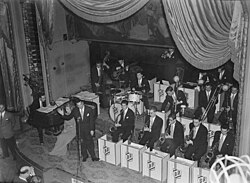
The Big Band Machine and West Side Story
In 1966, Rich achieved lasting success with the formation of the Buddy Rich Big Band, also known as "The Big Band Machine." One of the most significant milestones of this era was his arrangement of Leonard Bernstein's West Side Story. The medley was notoriously challenging, requiring nearly a month of constant rehearsal to perfect, but it eventually became a centerpiece of his live performances and a testament to his ability to integrate complex drumming into a full orchestral sound.
Television and Public Influence
Buddy Rich brought the art of drumming to the masses through several high-profile television appearances. A 1973 PBS broadcast of his performance at the Top of the Plaza in Rochester, New York, is credited with influencing thousands of aspiring drummers. He was also well-known for his "drum battles," engaging in high-energy musical duels with peers like Gene Krupa and Louie Bellson.
One of his most culturally enduring moments occurred in 1981 on The Muppet Show, where he faced off against the chaotic Muppet drummer, Animal. He also appeared in the 1970 episode of Here's Lucy titled "Lucy And The Drum Contest."
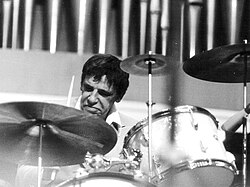
Personal Life and Challenges
Rich married dancer and showgirl Marie Allison in 1953, and they had a daughter, Cathy, in 1954. Cathy eventually became a vocalist and continued her father's musical legacy by leading his band. Despite his professional success, Rich faced significant financial hardships. In the late 1960s, he was convicted of failing to report income, leading to heavy fines, a tax lien from the IRS, and an eventual bankruptcy that resulted in the seizure of his Las Vegas home.
Summary of Career Highlights
| Category | Details |
|---|---|
| Primary Instruments | Drums, Vocals |
| Key Eras | Swing, Big Band, Jazz |
| Notable Bands | The Buddy Rich Big Band, Tommy Dorsey Orchestra, Harry James Orchestra |
| Major Labels | Verve, RCA, Blue Note, Pacific Jazz, Groove Merchant |
| Key Honors | Ranked #6 (2011) and #15 (2016) in Rolling Stone's Greatest Drummers |
Frequently Asked Questions
When did Buddy Rich start drumming?
Buddy Rich began drumming at the age of two and was already performing as a child prodigy in vaudeville by 18 months old.
What was Buddy Rich's role in the U.S. Marines?
From 1942 to 1944, Rich served in the U.S. Marine Corps, where he worked as a Judo instructor. He did not see combat and was discharged for medical reasons.
Which musical piece is most associated with Buddy Rich's big band?
The "West Side Story Medley," arranged by Bill Reddie, is one of his most famous recordings and live staples, showcasing his technical skill and band leadership.
Who was the Muppet that Buddy Rich had a drum battle with?
Buddy Rich engaged in a famous televised drum battle with Animal on The Muppet Show in 1981.
How did Buddy Rich influence future drummers?
Through his unmatched technical proficiency and widely viewed television performances—particularly the 1973 PBS broadcast—Rich set a gold standard for jazz drumming and big band leadership.