Bubo Genus: The Horned Owls and Eagle-Owls of the World
The genus Bubo encompasses some of the most formidable avian predators on Earth, comprising the horned owls of the Americas and the eagle-owls of the Old World. Derived from the Latin word for owl, this genus includes some of the largest living members of the order Strigiformes (owls). While these birds were traditionally categorized by the presence of ear-tufts, modern classification relies on more complex biological data.
These powerful nocturnal hunters are distributed across diverse global habitats, from the frozen reaches of the Arctic to the tropical forests of Africa and Asia.
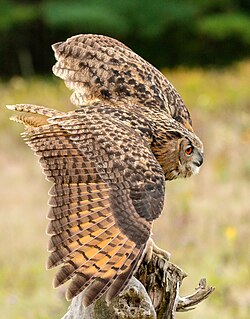
Key Facts
- Genus Name: Bubo (Latin for owl).
- Species Count: 10 extant species.
- Temporal Range: Late Pliocene to the present.
- Type Species: The Eurasian eagle-owl (Bubo bubo).
- Defining Traits: Includes some of the largest living owl species.
Taxonomy and Classification
The genus Bubo was established in 1805 by French zoologist André Duméril. The type species, the Eurasian eagle-owl, was originally named by Carl Linnaeus in 1758. Over time, the classification of these birds has evolved as scientific methods have improved.
In 2020, a molecular phylogenetic study—the analysis of evolutionary relationships using DNA—revealed that the genus was paraphyletic, meaning it did not include all descendants of a common ancestor. Specifically, the genera Scotopelia and Ketupa were found to be embedded within the Bubo clade. To ensure the genera were monophyletic (consisting of an ancestor and all its descendants), nine species were moved from Bubo to the genus Ketupa.
Extant Species of Bubo
There are currently 10 recognized species within the genus Bubo, distributed across several continents:
- Snowy owl (Bubo scandiacus): Found across north North America and the north Palearctic.
- Great horned owl (Bubo virginianus): Widespread throughout the Americas.
- Lesser horned owl (Bubo magellanicus): Ranges from central Peru to Tierra del Fuego.
- Eurasian eagle-owl (Bubo bubo): Widespread across the Palearctic.
- Indian eagle-owl (Bubo bengalensis): Native to the Indian subcontinent.
- Pharaoh eagle-owl (Bubo ascalaphus): Found from northwest Africa to the Arabian Peninsula.
- Cape eagle-owl (Bubo capensis): Located in south, southeast, and east Africa.
- Arabian eagle-owl (Bubo milesi): Found in the south Arabian Peninsula.
- Greyish eagle-owl (Bubo cinerascens): Ranges from Senegal and Gambia to Ethiopia and north Kenya.
- Spotted eagle-owl (Bubo africanus): Found in Africa south of the Equator.
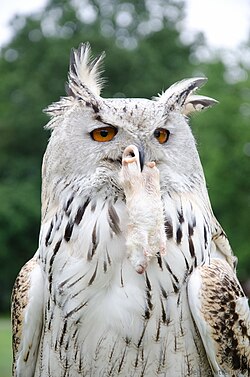
Related Genera
Certain species are occasionally associated with Bubo but are now primarily classified under Ketupa (such as the Brown fish owl and Blakiston's fish owl) or Scotopelia (such as the Pel's fishing owl).
Fossil Record and Prehistoric Species
The evolutionary history of Bubo is documented through various fossil finds dating back to the Late Pliocene. Several distinct extinct species have been identified, including Bubo leakeyae from the Early Pleistocene of Tanzania and Bubo osvaldoi from the Pleistocene of Cuba.
Paleontologists have also analyzed fragmentary remains, such as a Late Pliocene coracoid (shoulder bone) from Kansas, though some specimens remain difficult to assign definitively to either Bubo or the genus Strix. Interestingly, some fossils previously attributed to Bubo have been reclassified into other genera, such as Nocturnavis, Necrobyas, and Mioglaux.
Human Interactions
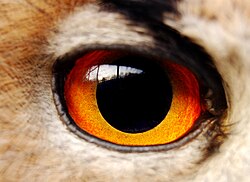
Due to their nocturnal nature, Bubo species rarely interact with humans. However, rare incidents occur. In 2015, a notable case in Purmerend, Netherlands, involved an eagle owl that attacked approximately 50 people before being captured by a professional falconer.
Summary of Bubo Classification
| Category | Details |
|---|---|
| Kingdom | Animalia |
| Order | Strigiformes |
| Family | Strigidae |
| Genus | Bubo |
| Number of Species | 10 extant species |
| Temporal Range | Late Pliocene to present |
Frequently Asked Questions
What does the name Bubo mean?
The name Bubo is Latin for owl, and it was specifically used by Carl Linnaeus in 1758 as the specific epithet for the Eurasian eagle-owl.
Why were some species moved out of the Bubo genus?
A 2020 molecular phylogenetic study found that the genus was paraphyletic. To create monophyletic groups based on actual evolutionary descent, nine species were moved to the genus Ketupa.
Are all Bubo owls characterized by ear-tufts?
While it was traditionally believed that only owls with ear-tufts belonged in this genus, this is no longer the primary requirement for classification.
Which Bubo species is the largest?
The genus Bubo contains some of the largest living members of the order Strigiformes, with the Eurasian eagle-owl serving as the type species for the group.
Is there a fossil record for these owls?
Yes, the fossil record extends to the Late Pliocene, with named species such as Bubo leakeyae and Bubo binagadensis providing insight into their prehistoric distribution.