Brighton Station: A History of Engineering and Evolution
Established in the early 1840s, Brighton station stands as a testament to Victorian engineering and the rapid expansion of the British rail network. Built by the London & Brighton Railway (L&BR), the station was constructed on a challenging site on the northern edge of the city. To create a viable gradient from the Patcham Tunnel, engineers had to perform extensive excavations on land situated 70 feet (21 m) above the seashore and half a mile inland.
The station's connectivity grew rapidly. It first linked Brighton to Shoreham-by-Sea in May 1840, followed by an inland extension to Haywards Heath and London Bridge via the Clayton Tunnel in September 1841. By 1846, the line reached Lewes via the London Road Viaduct. That same year, the L&BR merged with other companies to become the London, Brighton & South Coast Railway (LB&SCR), expanding its reach toward Portsmouth and Hastings.
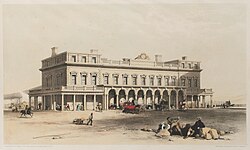
The Passenger Station and Architecture
Designed by David Mocatta in 1839–40, the original passenger station was a three-storey Italianate building that also served as the railway company's head office. While later additions have largely obscured the original facade, the building remains standing. Architectural historians note its similarities to the Nine Elms station of the London and Southampton Railway. The construction of the station building, completed by Baker & Son between May and August 1841, cost £9,766 15s.
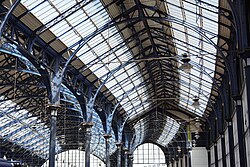
The platform area, designed by John Urpeth Rastrick, originally featured four pitched roofs, each 250 feet (76 m) long. Due to the sloping nature of the site, expanding the station was difficult. By the late 1870s, the facility struggled to handle increasing traffic, leading to the lengthening of platforms and the replacement of the separate roofs with a single overall roof between 1882 and 1883.
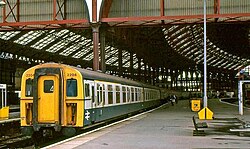
Today, the station is defined by its impressive double-spanned curved glass and iron roof, which underwent substantial renovation in 1999 and 2000.
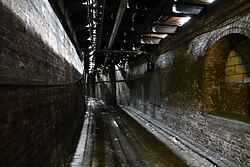
Hidden Infrastructure: The Cab Run
Beneath the station lies a fascinating piece of history: a tunnel that once served as an open-air cab run (a dedicated path for horse-drawn taxi carriages). This route provided a shallower gradient than the nearby Trafalgar Street. When the station was extended above it using cast iron columns, the run was covered, becoming a tunnel. While the station end is now sealed with concrete and used for storage, the structure remains in situ.
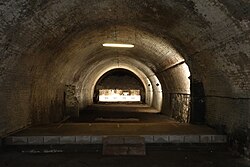
Goods, Locomotives, and Industrial Works
The station was more than just a passenger hub; it was a massive industrial complex. A goods station and yard were built on the eastern side, situated 30 feet (9.1 m) lower than the passenger platforms. Access was initially provided via a second tunnel under the station. While much of the goods yard has been redeveloped into the New England Quarter, a portion of the old tunnel is still used today by a local rifle club.
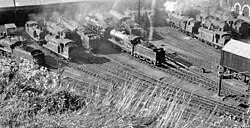
To the north, the railway operated locomotive and carriage works starting in 1841. The carriage works moved to Lancing in 1911, and the locomotive works closed in 1957, briefly serving as a production site for Isetta cars. The locomotive depot also evolved; in 1861, locomotive superintendent John Chester Craven oversaw the removal of a large chalk hill to make room for an enlarged motive power depot. This facility was later reduced in size during the electrification of the lines in the 1930s, eventually closing in 1961 and being demolished in 1966.
Key Facts
- Listed Status: The station was designated as a Grade II* listed building on April 30, 1973.
- Architectural Style: The original 1840 building was designed in the Italianate style by David Mocatta.
- Major Renovations: The iconic curved glass and iron roof was renovated in 1999 and 2000.
- Historical Figure: The 2nd Duke of Wellington passed away at the station on August 13, 1884.
- Industrial Legacy: The site once housed locomotive works and a motive power depot before the shift to electrification.
Station Operations and Service Evolution
| Era/Company | Key Developments / Services |
|---|---|
| London & Brighton Railway | Initial construction (1840–41); first links to Shoreham and London. |
| LB&SCR | Merger in 1846; expansion to Lewes, Portsmouth, and Hastings. |
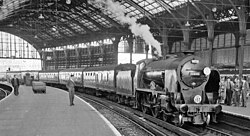
| Southern Railway / British Rail | Electrification in the 1930s; transition from steam to electric power. |
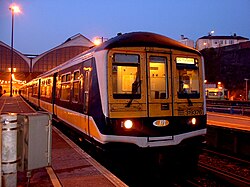
| Modern Era | Services by Thameslink, Great Western Railway, and others. |
Over the decades, the station has been served by numerous operators, including Southern Railway, British Rail, and more recently, Thameslink and First Capital Connect. Long-distance services have also shifted; for example, a service to Birkenhead Woodside operated until 1967, and services to Bristol Temple Meads via Great Western Railway ended in May 2022.
Accidents and Incidents
The station's history includes several notable mishaps. In August 1909, a train hauled by Terrier no. 83 Earlswood collided with the buffers due to driver error, injuring 19 people. In September 1922, a steam engine lost control at the engine shed, derailed at the turntable, and crashed through a brick wall into the street, injuring a passer-by.
Frequently Asked Questions
When did Brighton station first open?
The station opened for trains to Shoreham-by-Sea on May 12, 1840, and later opened for services to London on September 21, 1841.
What is the architectural significance of the station?
The station is Grade II* listed and features an original Italianate building by David Mocatta, as well as a large, renovated double-spanned curved glass and iron roof.
What happened to the old locomotive works?
The carriage works moved to Lancing in 1911, and the locomotive works closed in 1957. A portion of the site was briefly used to build Isetta cars.
Is there any part of the old goods station still in use?
Yes, while much of the goods yard is now the New England Quarter, a portion of the old tunnel is currently used by a local rifle club.
Which famous person died at the station?
Arthur Wellesley, the 2nd Duke of Wellington, died at Brighton station on August 13, 1884.