Bradford-on-Avon: A Journey Through History and Industry
Nestled along the banks of the River Avon, Bradford-on-Avon is a town where ancient heritage and industrial ambition converge. From its origins as a strategic crossing point to its era as a powerhouse of the English textile trade, the town's architecture and landmarks tell a story of continuous evolution over two millennia.
Ancient Roots and the Town Bridge
The earliest signs of human habitation in the area date back to the Roman period. Archaeological excavations on the playing fields of St Laurence School have uncovered the remains of a substantial Roman villa, featuring a remarkably well-preserved mosaic.
The town's name, meaning "Broad-Ford," is derived from the original crossing point of the River Avon. This ford was later supplemented by a stone bridge during the Norman era. The bridge is a Grade I listed building characterized by a blend of architectural styles: the upstream Norman side features pointed arches, while the newer western side, widened in the 17th century, utilizes curved arches. Originally serving as a packhorse bridge—a narrow bridge designed for horses carrying loads—it later became a site of military conflict on July 2, 1643, when Royalists seized it during a skirmish in the English Civil War on their way to the Battle of Lansdowne.
A unique feature of the bridge is a small building that transitioned from a chapel to a town lock-up. It is topped with a weathervane in the shape of a gudgeon (a type of fish and early Christian symbol). This has inspired the local phrase "under the fish and over the water." While the fish is technically a gilded perch, it is referred to locally as a Bradford gudgeon.
The Rise and Fall of the Woolen Industry
The River Avon was more than a crossing point; it was the engine of the town's economy. The river provided the necessary power for wool mills, fueling a period of immense wealth. During the 17th century, the textile industry flourished, leaving behind a legacy of weavers' cottages, the best of which can still be seen on Tory Terraces, Middle Rank, and Newtown.
The scale of this prosperity was noted by Daniel Defoe in the early 18th century. He observed that some clothiers in the region possessed fortunes ranging from £10,000 to £40,000 (estimated at £1.3M to £5.3M in 2007 values), noting that many gentry families had their origins in this "noble manufacture."
As the Industrial Revolution introduced mechanization, production shifted from domestic cottages to large, purpose-built woolen mills. Approximately 30 mills were established along the river, utilizing water and steam to power looms. This industrial boom continued until the late 19th century, when the center of the English woolen industry shifted to Yorkshire. The final local mill closed its doors in 1905.
Architectural Landmarks and Modern Life
One of the town's most striking structures is the 14th-century tithe barn, now part of Barton Farm Country Park. This Grade I listed building measures 180 feet in length and 30 feet in width. Historically, it served as a collection point for taxes paid in goods to fund the church.
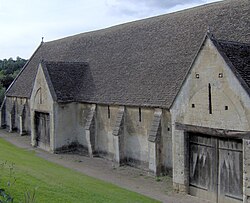
The town center retains several notable buildings. While many former factories have been converted into modern apartments—such as the Kingston Mills site, which received planning permission in 2007—some maintain their original purpose. The Swan, a 17th-century public house and hotel, retains its original stone flag floors, with records indicating a pub has existed on that site since the 1500s. Additionally, The Hall is a Jacobean mansion built around 1610 for mill-owner John Hall; it was later purchased by Stephen Moulton in 1848 and is currently managed by the Alex Moulton Charitable Trust.
In more recent years, the town has embraced culture and ethics. The Wiltshire Music Centre opened in 1998 on the grounds of St Laurence School, and a millennium sculpture known as "Millie" was unveiled in 2000. Furthermore, on October 8, 2003, Bradford-on-Avon was officially granted Fairtrade Town status.
Key Facts
- Roman Heritage: A large villa with a preserved mosaic was found at St Laurence School.
- The Bridge: A Grade I listed structure that evolved from a packhorse bridge to a widened crossing.
- Industrial Peak: Approximately 30 water and steam-powered mills once operated in the town.
- Tithe Barn: A 14th-century structure 180 feet long used for church tax collection.
- Economic Shift: The local wool industry declined as production moved to Yorkshire, with the last mill closing in 1905.
| Landmark | Period/Date | Significance |
|---|---|---|
| Roman Villa | Roman Era | Earliest evidence of habitation; features a mosaic. |
| Town Bridge | Norman/17th Century | Grade I listed; site of English Civil War skirmish. |
| Tithe Barn | 14th Century | Used for collecting church taxes in goods. |
| The Hall | c. 1610 | Jacobean mansion built for mill-owner John Hall. |
| The Swan | 1500s/17th Century | One of the few buildings still used in its original role. |
Frequently Asked Questions
What is the origin of the name Bradford-on-Avon?
The name comes from the "Broad-Ford," referring to the wide crossing point over the River Avon around which the town center developed.
What was the purpose of the tithe barn?
The tithe barn was used in the 14th century to collect taxes, which were paid in the form of goods, to provide funding for the church.
Why did the wool industry decline in Bradford-on-Avon?
The industry declined in the late 19th century as the center of power for English woolen manufacture shifted toward Yorkshire, leading to the closure of the last local mill in 1905.
What is the significance of the fish weathervane on the bridge?
The weathervane is a gudgeon (a perch), which is an early Christian symbol. It has led to the local saying "under the fish and over the water."
Which historical event took place at the town bridge in 1643?
On July 2, 1643, the bridge was the site of a skirmish during the English Civil War, where Royalist forces seized control of the crossing on their way to the Battle of Lansdowne.