Bowerbirds: The Master Architects of the Avian World
In the dense forests of Australia and New Guinea lives a family of birds renowned not for their nests, but for their extraordinary artistry. Bowerbirds (family Ptilonorhynchidae) are medium to large-sized passerines—perching birds—that have evolved some of the most complex courtship behaviors in the animal kingdom. From the petite golden bowerbird to the imposing great bowerbird, these avian architects spend their lives constructing elaborate structures to attract a mate.
While most birds focus their energy on building a secure nest for eggs, the male bowerbird builds a bower: a specialized structure used exclusively for display. These structures range from simple platforms to intricate "avenues" and "maypoles," often decorated with colorful objects that reflect the male's taste and status.
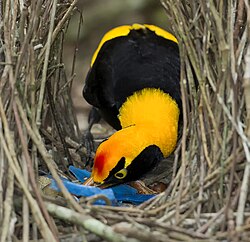
Key Facts
- Species Diversity: 23 species across eight genera.
- Size Range: From the golden bowerbird (22 cm, 70 g) to the great bowerbird (40 cm, 230 g).
- Diet: Primarily frugivorous (fruit-eating), supplemented by insects, nectar, and leaves.
- Longevity: One of the longest-lived passerine families; some individuals, like the satin bowerbird, have lived up to 26 years.
- Distribution: Endemic to the Sahul region (Australia and New Guinea).
Courtship and the Art of the Bower
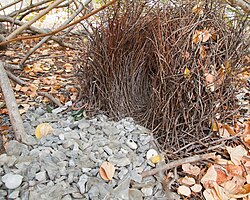
The bower is not a nest, but a stage. Males invest significant effort into building and maintaining these structures to impress females. Depending on the species, these structures fall into several distinct styles:
- Avenue-builders: Create two parallel walls of sticks forming a central walkway.
- Maypole-builders: Construct a central pillar of sticks, often surrounded by a meticulously cleared court.
- Stage-makers: Create a cleared area or platform for display.

Beyond architecture, bowerbirds are masters of vocal mimicry. MacGregor's bowerbird is known to imitate human chatter, waterfalls, and even pigs. The satin bowerbird frequently mimics other local bird species to enhance its courtship performance.
Intriguingly, some species employ forced perspective—an optical illusion. By arranging objects in the bower's court from smallest to largest, the male creates a visual trick that holds the female's attention longer, which is strongly correlated with higher mating success.
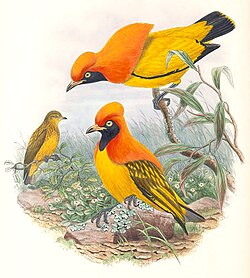
Biology and Ecology
Bowerbirds exhibit unique reproductive traits. While Papuan species lay a single egg, Australian species may lay between one and three. Their eggs are notably heavier than those of other passerines of similar size; for example, a satin bowerbird egg weighs approximately 19 g, nearly double the expected weight for a bird of its mass.
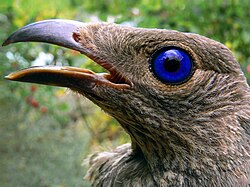
The incubation period lasts between 19 and 24 days. In species that lay multiple eggs, hatching is asynchronous (occurring at different times), though siblicide—where siblings kill one another—has not been observed in this family.
Taxonomy and Evolutionary History
Historically, bowerbirds were thought to be closely related to birds of paradise. However, modern molecular studies indicate they are part of a broader radiation of ancient songbirds in Sahul. Recent cladistic analyses suggest they are more closely allied with the Australasian treecreepers (Climacteridae).
Research has revealed surprising shifts in their lineage. The Tooth-billed catbird, once thought to be a true catbird, is actually more closely related to maypole-builders. Conversely, the "true catbirds" (genus Ailuroedus) are monogamous and do not build bowers, making them the most derived group in the family, despite their seemingly primitive behavior.
Fossil Record
The fossil record for bowerbirds is sparse but significant. The earliest known species, Sericuloides marynguyenae, dates back 26 to 23 million years to the late Oligocene. Found in the Riversleigh World Heritage Area, this tiny ancestor resembles the modern avenue-builders. Another Miocene fossil from 16.55 million years ago suggests the presence of smaller bowerbirds, and a potential species, Aeviperditus gracilis, has been described from New Zealand, suggesting a wider historical distribution.
Bowerbird Classification Summary
| Group | Key Genera | Notable Species | Courtship Style |
|---|---|---|---|
| True Catbirds | Ailuroedus | Green catbird, Spotted catbird | No bower (Monogamous) |
| Maypole-builders | Amblyornis, Archboldia, Prionodura, Scenopoeetes | Vogelkop bowerbird, Golden bowerbird | Central pillar/Maypole |
| Avenue-builders | Sericulus, Ptilonorhynchus, Chlamydera | Satin bowerbird, Great bowerbird | Parallel stick walls |
Frequently Asked Questions
Do bowerbirds use their bowers as nests?
No. The bower is strictly a courtship structure used by males to attract females. The actual nesting and raising of young occur in separate, more traditional nests.
Why do bowerbirds mimic other sounds?
Vocal mimicry is used as part of their complex courtship displays to attract mates and demonstrate their fitness and versatility.
Are bowerbirds considered pests?
Some species, specifically the satin and spotted bowerbirds, are occasionally viewed as agricultural pests because they feed on introduced fruit and vegetable crops.
How long do bowerbirds live?
They have the longest life expectancy of any passerine family with significant banding data. While many live 8 to 10 years, some individuals have been recorded living up to 26 years.
What is the difference between a maypole and an avenue bower?
An avenue bower consists of two parallel walls of sticks creating a corridor, whereas a maypole bower features a central tower or pillar of sticks surrounded by a cleared court.