Southern Masked Weaver: The Master Architect of Southern Africa
The Southern Masked Weaver (Ploceus velatus), also known as the African masked weaver, is a vibrant and industrious resident bird common throughout southern Africa. Renowned for its complex nest-building skills and striking appearance, this species is a staple of the region's diverse avian landscape.
These birds are highly adaptable, thriving in a wide array of environments. From the arid stretches of semi-desert areas and savannas to lush inland wetlands, open woodlands, and grasslands, the Southern Masked Weaver is frequently encountered. They have even integrated into human environments, making themselves at home in suburban parks and gardens.
Key Facts
- Scientific Name: Ploceus velatus
- Conservation Status: Least Concern (IUCN 3.1)
- Range: Widespread across southern Africa
- Diet: Omnivorous, consuming seeds, insects, and nectar
- Distinctive Feature: Intricate woven nests built primarily by males
Physical Characteristics
Measuring between 11 and 14.5 cm (4.3–5.7 in), the Southern Masked Weaver is characterized by a short, strong, conical bill and pinkish-brown legs. There is a significant difference in appearance between the sexes, particularly during the breeding season.
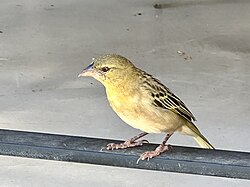
The adult male in breeding plumage is striking, featuring a bright yellow head and underparts contrasted by a black face, throat, and beak. His back is a plain yellowish-green, and he possesses distinct red eyes. In contrast, the female is a more muted greenish-yellow with darker streaks on her upper back, a yellowish throat that fades to off-white on the belly, and a pinkish-brown bill with brown or red-brown eyes.
Juveniles resemble the females, while non-breeding males also take on a female-like appearance, though they retain their red eyes.
Vocalizations
The Southern Masked Weaver communicates using a harsh swizzling call, a sound typical of many species within the Ploceidae (weaver) family. Additionally, they emit a sharp "chuk" note when sounding an alarm.
Behavior and Ecology
Diet and Social Structure
These birds are versatile feeders, consuming a mix of insects, seeds, and nectar. While they are often seen individually or in small groups, they may congregate in larger flocks, sometimes mixing with other seed-eating bird species. They are also known to visit human feeding tables.
Nest Building and Breeding
The breeding season typically runs from September to January, during which the Southern Masked Weaver nests in colonies. The males are the primary architects, weaving intricate nests from grass, reed, or palm. A single male may build up to 25 nests in a single season to attract multiple female partners.
Nests are typically constructed in trees—often positioned over water for protection—though they are also found in reeds or suburban settings. Once a female selects a nest, she lines the interior with feathers and soft grass.
Defense Against Parasitism
To protect their offspring from cuckoos (birds that lay their eggs in other species' nests), the Southern Masked Weaver employs a clever biological strategy. They lay eggs of various colors. Because a cuckoo cannot know the specific egg colors of a nest until it has already entered, the weaver parents can easily identify and eject any egg that does not match the specific coloration of their own clutch.
| Attribute | Details |
|---|---|
| Scientific Classification | Order: Passeriformes; Family: Ploceidae; Genus: Ploceus |
| Average Length | 11–14.5 cm |
| Primary Habitat | Savanna, shrubland, wetlands, and suburban areas |
| Breeding Season | September to January |
| Conservation Status | Least Concern |
Frequently Asked Questions
What do Southern Masked Weavers eat?
Their diet consists of a variety of seeds, insects, and nectar. They are opportunistic feeders and will occasionally visit garden feeding tables.
How do they protect their nests from cuckoos?
They lay eggs in various colors, which allows the parents to recognize and eject foreign eggs laid by cuckoos that do not match the specific colors of their own eggs.
How many nests does a male build?
A male Southern Masked Weaver is highly prolific, typically building around 25 nests per breeding season to attract females.
Where can the Southern Masked Weaver be found?
They are resident breeding birds found throughout southern Africa in habitats ranging from semi-deserts and savannas to suburban gardens.
What is the difference between the male and female?
Breeding males have bright yellow plumage with a black face and red eyes. Females are duller greenish-yellow with streaked backs and brown or red-brown eyes.