Botanical Nomenclature: The Science of Naming Plants
In the vast world of botany, precision is everything. To ensure that scientists across the globe are discussing the exact same organism, they rely on botanical nomenclature—the formal, scientific system of naming plants. While often confused with taxonomy, nomenclature is a distinct process: while taxonomy focuses on the grouping and classification of plants, nomenclature provides the standardized names for those groups.
The foundation of modern naming began with Carl Linnaeus and his seminal work, Species Plantarum, published in 1753. Today, this process is governed by the International Code of Nomenclature for algae, fungi, and plants (ICNafp), which replaced the earlier International Code of Botanical Nomenclature (ICBN). This code also extends its reach to cover fossil plants.
Key Facts
- ICNafp: The primary governing body for naming algae, fungi, and plants.
- Linnaeus: Established the starting point for modern nomenclature in 1753.
- Independence: Botanical naming is separate from zoological naming, meaning a plant and an animal can share the same genus name (e.g., Iris).
- Cultivars: Plants altered by humans are governed by a separate set of rules called the International Code of Nomenclature for Cultivated Plants (ICNCP).
- Priority: When two names apply to the same group, the earliest published name generally takes precedence.
The Evolution of Plant Naming
The history of botanical naming predates modern science, stretching back to Greek writers such as Theophrastus (c. 370–287 BC) and Dioscorides (c. 40–90 AD). For centuries, Latin served as the lingua franca (universal scientific language) of Europe. During the Middle Ages, much of this knowledge was preserved by Benedictine monks in herbals, which were primarily used for medicinal purposes.
The invention of the printing press in 1450 democratized this information. Later, German physician Leonhart Fuchs helped pioneer Latin names for new discoveries, coining the term Digitalis in 1542. However, the most pivotal shift occurred in 1753 when Linnaeus adopted binomial nomenclature—the system of using two names (genus and species) to identify a plant.
As the field grew, the need for rigid laws became apparent. This led to the 1867 lois de Candolle, the 1906 Vienna Rules, and most recently, the Shenzhen Code adopted in 2018.
Botanical Nomenclature vs. Plant Taxonomy
To understand how plants are named, one must understand the relationship between nomenclature and taxonomy. Taxonomy is an empirical science that determines the circumscription (the defined limits) of a taxon—a taxonomic grouping such as a species or genus.
Nomenclature is simply the set of rules that decides which name applies to that taxon. When taxonomists agree on the limits, rank, and position of a plant, only one name applies. However, when they disagree, a single plant may be known by multiple names depending on the scientific opinion followed.
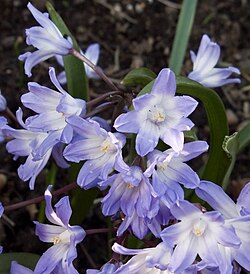
Example: Siehe's Glory-of-the-Snow
The plant Chionodoxa siehei illustrates how these disagreements manifest in three ways:
- Species Level: Some see Chionodoxa siehei and Chionodoxa forbesii as distinct species, while others merge them. If merged, the earlier published name (C. forbesii) must be used.
- Genus Level: Some botanists keep Chionodoxa separate from Scilla. Others merge them. Because Scilla was published first, the plant becomes Scilla siehei.
- Family Level: The Angiosperm Phylogeny Group (APG) moved the plant from the family Hyacinthaceae to the larger Asparagaceae in 2009. Depending on the rank assigned (family vs. subfamily), the name may change to Scilloideae to follow the ICN rule that subfamilies must end in "-oideae".
Summary of Naming Conflicts
| Type of Confusion | Cause | Resolution Method |
|---|---|---|
| Nomenclatural | Disagreement on the correct name for the same group. | ICN rules (usually the earliest published name). |
| Taxonomic | Disagreement on the group's limits, rank, or position. | Further scientific research and consensus. |
Accepted and Ambiguous Names
Because of the complexities of taxonomy, botanical databases like Plants of the World Online and World Flora Online categorize names. An accepted name is the one currently recognized as correct. A synonym is a name that is no longer used because it has been replaced by an accepted name. Finally, a name may be labeled ambiguous if its separate existence cannot be reliably determined.
Frequently Asked Questions
What is the difference between taxonomy and nomenclature?
Taxonomy is the science of classifying plants into groups (taxa) based on their characteristics. Nomenclature is the system of rules used to assign a formal scientific name to those groups.
Why do some plants have multiple scientific names?
This usually happens when taxonomists disagree on whether a plant belongs to a specific species or genus. Depending on which scientist's classification is used, the plant may be referred to by different names.
Can a plant and an animal have the same scientific name?
Yes. Because botanical nomenclature and zoological nomenclature are independent systems, it is possible for a genus name to be used in both. For example, Iris exists as both a plant genus and an animal genus.
What happens when two different names are given to the same plant?
According to the ICNafp, the rule of priority generally applies, meaning the earliest validly published name is the one that must be used.
What is the ICNCP?
The International Code of Nomenclature for Cultivated Plants (ICNCP) is a specific set of rules for cultivars—plants that have been deliberately selected or altered by humans.