Understanding the "Correct Name" in Botanical Nomenclature
In the world of science, precision is everything. When a botanist discusses a specific plant, they aren't just using any name; they are using a correct name. But what exactly makes a name "correct"? In botany, this isn't a matter of personal preference, but a strict adherence to the rules of nomenclature—the formal system of naming organisms.
To understand this, we must distinguish between taxonomy (the science of classifying organisms) and nomenclature (the rules for naming them). While taxonomists may disagree on how a plant should be classified, the rules of nomenclature ensure that once a classification is chosen, the name follows a specific, predictable logic.
The Rules of Botanical Naming
The governing body for these rules is the International Code of Nomenclature for algae, fungi, and plants (ICN). According to the ICN, a correct name is the single botanical name assigned to a particular taxon (a group of organisms) based on its circumscription (the specific boundaries or definition of that group), its position in the biological hierarchy, and its rank.
Determining the correct name is a rigorous process involving several key requirements:
- Valid Publication: A name must be published following the specific procedures outlined in at least 16 different articles of the ICN.
- Legitimacy: Beyond being validly published, a name must also be "legitimate" to be considered correct.
- Priority: If multiple legitimate names exist for the same taxon, the correct name is typically the one that was published earliest. However, names can be "conserved" (protected) if they have been used very widely.
When a name is validly published but is not the currently accepted "correct" name, it is referred to as a synonym. Because different scientists may define the boundaries of a plant group differently, it is possible for a single plant to have multiple "correct" names depending on the taxonomic viewpoint being used.
Spelling and Variations
A correct name has only one authorized spelling, which is usually the original spelling used when the plant was first described. Any other versions of the spelling are known as orthographical variants.
It is worth noting that in the field of zoology (the study of animals), the equivalent of a "correct name" is referred to as a valid name.
Case Study: The Many Names of a Single Tree
To see these rules in action, we can look at one of the fastest-growing trees in the world. Its original name is Adenanthera falcataria L. The "L." stands for Linnaeus, the scientist who first validly published the name. This original name is also known as the basionym—the "base name" from which later names are derived.
Depending on how a taxonomist chooses to classify this tree, its "correct" name changes:
- Genus Albizia: If the tree is placed in the genus Albizia, the correct name becomes Albizia falcataria (L.) Fosberg. In this case, "Fosberg" is the authority who transferred the species to the new genus, while "L." remains the authority for the basionym.
- Genus Paraserianthes: If placed in the genus Paraserianthes, the correct name is Paraserianthes falcataria (L.) I.C.N. Nielsen.
- Genus Falcataria: If the taxonomic rank is changed so that the section Falcataria becomes its own genus, a unique rule applies. In botany, tautonyms—names where the genus and the species are the same word (such as Falcataria falcataria)—are forbidden. To avoid this, a new name must be created. The correct name in this scenario is Falcataria falcata (L.) Greuter & R.Rankin.
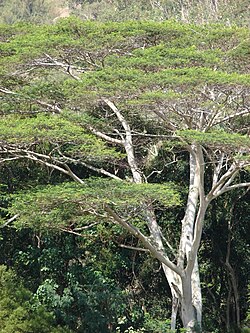
As shown above, the "right" genus is a question of taxonomy, not nomenclature. Therefore, different experts may use different correct names for the exact same tree.
Summary of Taxonomic Names for Adenanthera falcataria
| Scientific Name | Authority | Taxonomic Context |
|---|---|---|
| Adenanthera falcataria | L. | Original name (basionym) |
| Albizia falcataria | (L.) Fosberg | Placed in the genus Albizia |
| Paraserianthes falcataria | (L.) I.C.N. Nielsen | Placed in the genus Paraserianthes |
| Falcataria falcata | (L.) Greuter & R.Rankin | Placed in the genus Falcataria (avoids tautonym) |
Nomenclature in Prokaryotes
The principles of naming are not limited to plants. The study of prokaryotes (microscopic organisms like bacteria and archaea) inherits many of these concepts from the ICN. The List of Prokaryotic names with Standing in Nomenclature (LPSN) works to maintain consistency in these names.
While newer names are often based on more advanced phylogenomic data (the study of evolutionary relationships through genome sequencing), the LPSN notes that simply choosing the "last valid combination" is not always enough, as different scientific concepts of a genus can lead to inconsistencies.
Key Facts
- The ICN provides the official rules for naming algae, fungi, and plants.
- Priority dictates that the earliest validly published name is usually the correct one.
- Synonyms are validly published names that are not the currently accepted correct name.
- Tautonyms (identical genus and species names) are prohibited in botanical nomenclature.
- Taxonomy determines how organisms are classified, while nomenclature determines what they are called.
Frequently Asked Questions
What is the ICN?
The International Code of Nomenclature for algae, fungi, and plants (ICN) is the set of rules that governs the scientific naming of these specific groups of organisms.
What is a synonym in botany?
A synonym is a name that was validly published according to the ICN but is not the currently accepted "correct" name for a particular taxon.
Why can one plant have multiple correct names?
Because different taxonomists may have different opinions on the classification (the genus, rank, or boundaries) of a plant, each different classification can result in a different correct name.
What is a tautonym?
A tautonym is a scientific name where the genus and the species epithet are the same word. While allowed in zoology, tautonyms are forbidden in botanical nomenclature.
What is the difference between taxonomy and nomenclature?
Taxonomy is the scientific study and classification of organisms, whereas nomenclature is the formal system and set of rules used to assign names to those organisms.