Boston College: A History of Jesuit Education and Institutional Growth
Founded on a vision of providing accessible higher education to the Irish Catholic immigrant population, Boston College has evolved from a modest community center into a world-renowned university. Its journey reflects the broader narrative of the Catholic experience in New England, blending rigorous Jesuit scholarship with a commitment to social progress and institutional excellence.
Early Foundations in the South End
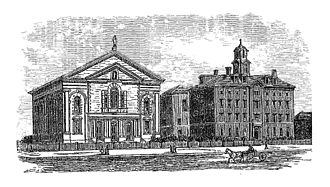
The origins of Boston College trace back to 1849, when the first Jesuit community in New England was established at St. Mary's Church in Boston. Father John McElroy, recognizing the educational needs of the city's growing immigrant population, spearheaded the effort to create a formal institution. In 1857, with the support of his superiors, McElroy purchased land on Harrison Avenue in the South End neighborhood to establish "The Boston College."
The institution received its university charter from the Commonwealth of Massachusetts on April 1, 1863, granting the board of trustees the authority to confer degrees. Under the leadership of its first president, John Bapst, collegiate instruction officially began on September 5, 1864.
The Early Student Experience
In its formative years, the college mirrored the European preparatory traditions of the Society of Jesus (the Jesuits). This was evident in the student demographics; the average student age was just fourteen, meaning many were essentially high schoolers. The student body primarily consisted of local boys from Boston parishes, some of whom attended via scholarships.
Campus life was deeply rooted in faith, with mandatory attendance at Mass, confession, and participation in devotional societies. The academic framework followed the Ratio Studiorum—the standardized Jesuit system of education—which placed heavy emphasis on theology, philosophy, Greek, and Latin.
The Legacy of Robert and Catharine Morris
Boston College's history is also intertwined with the legacy of Robert Morris, the second African American to pass the bar in the United States. A civil rights leader and defender of Irish immigrants, Morris maintained strong ties with early college leaders, including President Robert J. Fulton.
In 1895, Catharine H. Morris bequeathed the family library to the Church of the Immaculate Conception, which was administratively linked to the college. While the original donation is estimated at 1,000 volumes, the Burns Library currently holds over 100 confirmed texts from this collection. This archive is highly valued by historians for its 19th-century editions of anti-slavery texts, history, and literature, marking Robert Morris as one of the first self-conscious collectors of the African American experience.
The Move to Chestnut Hill
By 1907, President Thomas I. Gasson concluded that the urban quarters of the South End were too cramped for the university's ambitions. Drawing inspiration from John Winthrop's concept of a "city upon a hill," Gasson envisioned the college as a beacon of scholarship. He purchased the Amos Adams Lawrence farm on Chestnut Hill, located six miles west of downtown Boston, and launched an international competition for the campus master plan.
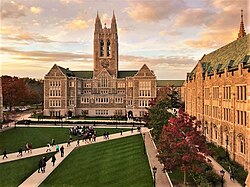
Construction began in 1909, but financial hurdles slowed progress. By 1913, Gasson Hall—the university's centerpiece—stood alone for three years while the college launched its first "capital campaign." To track fundraising progress, a large replica of the Gasson Hall clock tower was placed on Boston Common, eventually securing the funds needed to realize the vision.
Academic Expansion and Modernization
Throughout the 1920s, the university expanded its academic offerings to match its charter, establishing several key schools:
- Graduate School of Arts & Sciences
- Law School
- Woods College of Advancing Studies
- Graduate School of Social Work
- Carroll School of Management
- Connell School of Nursing
- Lynch School of Education and Human Development
While the university conferred its first degrees to women in 1926, it did not become fully coeducational until 1970. A landmark moment in the university's history occurred on April 20, 1963, when President John F. Kennedy—the first Catholic U.S. President and an honorary degree recipient—delivered an address during the centennial celebrations.
Financial Recovery and Institutional Growth
The presidency of J. Donald Monan, beginning in 1972, marked a period of critical financial restructuring. Facing a $30 million debt, Monan shifted the Board of Trustees from a purely Jesuit composition to include lay alumni and business leaders. He appointed Frank B. Campanella as the first executive vice president in 1973 to manage fiscal administration.
A pivotal move occurred in 1974 when BC merged with Newton College of the Sacred Heart. This acquisition provided a 40-acre campus that allowed the Law School to relocate and provided essential housing for students. Through aggressive capital campaigns in 1976 and 1989, the university's endowment grew from $36 million in 1982 to $590 million by 1996.
Contemporary Development
Under President William P. Leahy, Boston College further solidified its role as a leader in Catholic intellectualism. In 2002, the "Church in the 21st Century" program was initiated to address the clergy sexual abuse scandal and advocate for Church reform. The university also sought to merge with the Weston Jesuit School of Theology to enhance its theological standing.
In 2007, the university announced a $1.6 billion master plan for campus revitalization. Approved by city authorities in 2009, this plan focused on enhancing facilities and expanding faculty, ensuring the institution remains competitive in the modern landscape of higher education.
Key Facts
- Founded: 1857 in Boston's South End; moved to Chestnut Hill in 1909.
- Founding Visionary: Jesuit priest John McElroy.
- Academic Root: Based on the Ratio Studiorum, emphasizing classical languages and theology.
- Coeducation: First degrees awarded to women in 1926; fully coeducational by 1970.
- Notable Archive: The Morris library collection, featuring rare 19th-century anti-slavery texts.
- Financial Growth: Endowment grew from $36 million (1982) to $590 million (1996).
| Year | Event | Significance |
|---|---|---|
| 1863 | University Charter granted | Authorized the conferral of degrees. |
| 1909 | Chestnut Hill Construction | Transition from urban quarters to a dedicated campus. |
| 1963 | JFK Centennial Address | Celebrated 100 years with the first Catholic U.S. President. |
| 1974 | Newton College Merger | Expanded campus size and provided Law School relocation. |
| 2009 | Master Plan Approval | Initiated $1.6 billion in campus revitalization. |
Frequently Asked Questions
Why did Boston College move from the South End to Chestnut Hill?
President Thomas I. Gasson determined that the urban facilities in the South End were too cramped and inadequate for the university's growth. He sought a location that could serve as a "beacon of Jesuit scholarship," leading to the purchase of the Lawrence farm in 1907.
What is the Ratio Studiorum?
The Ratio Studiorum is the standardized system of Jesuit education. At early Boston College, this curriculum emphasized the study of Latin, Greek, philosophy, and theology.
Who was Robert Morris and what is his connection to BC?
Robert Morris was a civil rights leader and the second African American to pass the bar in the U.S. His family library, bequeathed by his wife Catharine, provided Boston College with a significant collection of 19th-century literature and anti-slavery texts.
When did Boston College become fully coeducational?
Although the university began conferring degrees on women as early as 1926, it did not become fully coeducational until 1970.
How did the university resolve its financial crisis in the 1970s?
Under President J. Donald Monan, the university restructured its Board of Trustees to include lay business leaders, appointed an executive vice president for fiscal matters, adopted depreciation accounting, and launched successful capital campaigns.