Blue Jay: The Bold and Intelligent Bird of North America
The Blue Jay (Cyanocitta cristata) is one of the most recognizable and spirited birds in North America. Known for its striking blue plumage and assertive personality, this member of the Corvidae family is as intelligent as it is loud. From its role as a sentinel for other forest birds to its complex social behaviors, the Blue Jay is a fascinating subject for birdwatchers and scientists alike.
Historically, these birds have been documented by naturalists for centuries. Early descriptions date back to 1731, and they have since become symbols of regional pride, serving as the provincial bird of Prince Edward Island, Canada, and the mascot for several universities, including Johns Hopkins, Elmhurst, and Creighton.
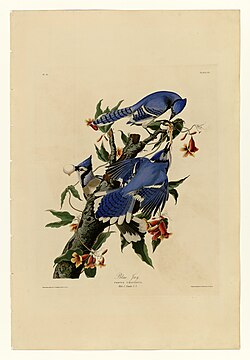
Key Facts
- Scientific Name: Cyanocitta cristata
- Conservation Status: Least Concern (IUCN 3.1)
- Diet: Omnivorous, consisting of 75% vegetable matter.
- Range: Southern Canada through the eastern and central United States.
- Distinctive Feature: A prominent blue crest that changes position based on mood.
- Lifespan: Average of 7 years in the wild, with a record of nearly 27 years.
Taxonomy and Etymology
The Blue Jay's scientific classification has evolved over time. First described by Mark Catesby in 1731 and later by Carl Linnaeus in 1758 as Corvus cristatus, it was eventually given its current name, Cyanocitta cristata, by Hugh Edwin Strickland in 1845.
The name Cyanocitta is derived from the Greek words kyaneos (blue) and kitta or kissa (chattering bird/jay), essentially meaning "blue chatterer." The specific epithet cristata comes from Latin, referring to the bird's distinctive crest.
Physical Description
Measuring between 22 and 30 cm (9–12 in) in length with a wingspan of 34–43 cm (13–17 in), the Blue Jay is a medium-sized passerine. Their weight typically ranges from 70 to 100 g (2.5–3.5 oz). Interestingly, these birds follow Bergmann's rule, which suggests that animals in colder climates tend to be larger; for example, jays in Connecticut are generally heavier than those in southern Florida.
The most striking feature is the crest—a crown of feathers that serves as a visual indicator of the bird's emotional state. The crest is fully raised when the bird is aggressive or excited, bristles outward when frightened, and lies flat when the bird is resting or feeding.
Distribution and Habitat
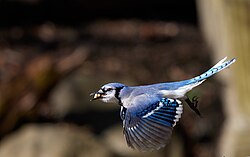
Blue Jays are found from southern Canada through the eastern and central United States, extending south to Florida and northeastern Texas. Their western boundary generally aligns with the eastern foothills of the Rocky Mountains, where they meet the closely related Steller's jay (C. stelleri). Due to increased tree planting and fire suppression in the Great Plains, their range has expanded westward over the last century.
While many are year-round residents, the northernmost subspecies, C. c. bromia, may migrate south during winter. Migration patterns are somewhat irregular and likely influenced by weather and food availability. In some regions, Blue Jays have hybridized with other species, including Steller's jays and, in a rare 2023 case in Texas, the Green Jay (Cyanocorax luxuosus), resulting in a hybrid known as the "grue jay."
Subspecies Overview
There are four recognized subspecies of the Blue Jay, varying primarily in size and plumage intensity.
| Subspecies | Common Name | Description | Distribution |
|---|---|---|---|
| C. c. bromia | Northern blue jay | Largest; duller, pale blue plumage | Northern range |
| C. c. cristata | Coastal blue jay | Mid-sized; vivid blue | Coastal regions |
| C. c. cyanotephra | Interior blue jay | Varies by region | Interior regions |
| C. c. semplei | Florida blue jay | Smaller size | Southern Florida |
Behavior and Ecology
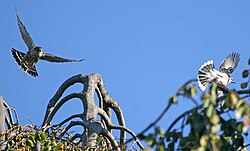
Blue Jays are bold, noisy, and highly territorial. While they are moderately slow fliers (32–40 km/h), their boldness often makes them a target for raptors like Accipiter hawks. However, they are not without defenses. Blue Jays often act as a forest alarm system, screaming to warn other birds of approaching predators.
They are known for their mimicry, sometimes impersonating the calls of red-tailed or red-shouldered hawks to test for predators or clear competitors from a food source. While they can be aggressive—occasionally raiding other birds' nests or attacking small bats—studies suggest that nest-raiding makes up only about 1% of their total food intake.
Diet and Foraging
As omnivores, Blue Jays consume a wide variety of plant and animal matter, though roughly 75% of their diet is vegetable-based. They possess strong black bills ideal for cracking nuts, corn, and seeds. They are particularly fond of peanuts in the shell.
Their diet includes:
- Seeds and Nuts: Acorns, beech mast, and grains.
- Fruits: Various berries and wild fruits.
- Animal Matter: Small invertebrates, meat, and occasionally eggs or nestlings.
Some individuals practice caching, the act of hiding food for later use, though this behavior varies between birds.
Reproduction and Life Cycle
The mating season typically runs from mid-March through July, peaking in April and May. Blue Jays generally form monogamous pair bonds for life. They build open, cup-shaped nests made of twigs, bark, moss, and sometimes human materials like cloth or paper, usually positioned 3 to 10 meters high in a tree.
The female lays a clutch of two to seven eggs (averaging 4 or 5), which are incubated for 16–18 days. The young are altricial, meaning they are born blind and featherless, requiring intensive care. The female broods the young for 8–12 days, while the male provides food for the female. After fledging between 17 and 21 days, the juveniles stay with their parents for one to two months before dispersing in early fall.

Frequently Asked Questions
Are Blue Jays aggressive?
Yes, Blue Jays are known to be bold and territorial. They may chase other birds away from feeders and can be aggressive toward humans or other animals that approach their nests.
What do Blue Jays eat?
They are omnivores that primarily eat vegetable matter (75%), including nuts, seeds, corn, and berries, but they also consume insects, small invertebrates, and occasionally eggs.
Why do Blue Jays have a crest?
The crest is used for communication and expressing mood. It is raised when the bird is excited or aggressive, bristles when frightened, and is flattened when the bird is relaxed.
Do Blue Jays migrate?
Some do, particularly the northern subspecies (C. c. bromia). Migration is often irregular and depends on weather conditions and the availability of winter food sources.
How long do Blue Jays live?
The average lifespan for a wild adult is about 7 years, though some have lived much longer; one banded individual was recorded at nearly 27 years old.