Blowguns: History, Mechanics, and Global Sporting Traditions
A blowgun (also known as a blowpipe or blow tube) is a simple yet effective ranged weapon. It consists of a long, narrow tube designed to launch light projectiles, such as darts, using the force of a human breath. This pneumatic propulsion relies entirely on the user's respiratory muscle strength and lung vital capacity to drive the projectile toward its target.
While often viewed as primitive, the blowgun represents a sophisticated adaptation to specific environments, allowing hunters to strike from a distance with extreme stealth. From the dense rainforests of the Amazon to the river valleys of North America, these tools have served as vital instruments for survival and, more recently, as the centerpiece of international sporting competitions.
Key Facts
- Mechanism: Uses forced exhalation to pneumatically propel darts or pellets.
- Primary Use: Historically used for hunting small animals like birds and monkeys; rarely used as anti-personnel weapons.
- Global Reach: Used by indigenous peoples in East Asia, Southeast Asia, Western Europe, North and Central America, and South America.
- Modern Application: Employed by herpetologists for capturing lizards and in various international target sports.
- Lethality: Often enhanced by toxins such as curare or upas sap to paralyze or kill prey.
Historical and Cultural Usage
The blowgun has been adopted by diverse cultures across the globe. In North America, the Cherokee and Choctaw peoples crafted blowguns from river cane to hunt rabbits, squirrels, and birds. Interestingly, pre-adolescent boys in Cherokee villages used smaller-bore blowguns for early pest control, targeting rodents that threatened food caches.
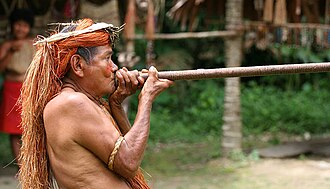
In Central America, specifically the Huehuetenango region of Guatemala, the Jakaltek Maya utilized wooden blowguns to fire clay pellets. In South America, particularly the Amazon Basin and the Guianas, the blowgun became a primary tool for hunting in the canopy.
The Role of Toxins
To increase effectiveness, many cultures developed potent poisons. In the Amazon and Orinoco basins, hunters use curare, a plant-based extract that paralyzes the target. The Piaroa people, for example, derive their poison from the Strychnos genus, specifically Strychnos crevauxii, mixing it with kraraguero sap for better adhesion. A target hit by this mixture can die within fifteen minutes.
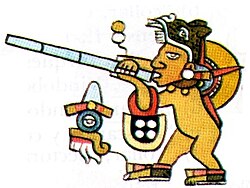
In Southeast Asia, the sumpit (or sumpitan) is often coated in the sap of Antiaris toxicaria (upas), which causes cardiac arrest. Unlike many other blowguns, the sumpit often features a metal spearhead, allowing it to double as a stabbing weapon in close combat.
Materials and Specifications
The construction of a blowgun varies significantly based on regional materials and intended use. Darts are typically made from hardwoods to prevent cracking, though modern versions utilize aluminum or carbon-reinforced plastic. Fletching—the stabilizing material at the rear of the dart—can range from animal fur and down to cellophane cones in Japanese competition.
| Type | Origin/Region | Typical Length | Primary Material | Projectile Type |
|---|---|---|---|---|
| Fukidake | Japan | 120 cm (Tournament) | Tube/Metal | Cellophane cone darts |
| Cherokee | North America | 2 to 3 m | River cane | Hardwood darts |
| Jakaltek | Guatemala | ~1 m | Wood | Clay pellets |
| Sumpit | SE Asia | 1.2 to 1.8 m | Bamboo/Wood | Darts with cork/resin |
| Modern (IFA) | International | 121 cm | Various | Standardized darts |
The Evolution of Sport Blowgun
Today, the blowgun has transitioned from a survival tool to a competitive sport managed by organizations like the International Fukiyado Association (IFA). There are three primary competition styles currently pursued for potential Olympic recognition:
- Target Shooting: Based on the Japanese fukiya, shooters fire 30 darts at a target 10 meters away.
- Field Style: Inspired by the Cherokee Annual Gathering, this resembles a biathlon where shooters run between stations to hit targets at various heights and distances.
- Long Distance: A precision event starting at 20 meters, where shooters move back 2 meters after every successful round.
Legal Status
Due to their nature as weapons, blowguns are subject to various laws worldwide. In the United Kingdom and Australia, they are categorized as offensive weapons, making it illegal to manufacture or sell them (though antiques are exempt). Canada classifies them as prohibited weapons, requiring imported tubes to be deactivated via drilling or blocking.
In the United States, legality varies by jurisdiction. While legal in most states, they are prohibited in California, Massachusetts, and Washington, D.C. Similarly, Guatemala passed laws in the 1930s outlawing their use to protect small game.
Frequently Asked Questions
What is the difference between a blowgun and a blowpipe?
In general usage, the terms are interchangeable. Both refer to a tube used to propel a projectile via forced exhalation.
How do poisoned darts work?
Poisoned darts use plant extracts or animal secretions, such as curare or upas sap, to induce paralysis or cardiac arrest in the target, ensuring the prey cannot escape even if the physical wound is small.
Are blowguns used for anything other than hunting or sport?
Yes, herpetologists use blowguns with stun darts to capture elusive lizards, and wildlife professionals use them with tranquilizer darts to capture or stun dangerous animals.
What materials are used for the darts?
Traditional darts are made from hardwoods like oak, ash, or maple. Modern competitive darts may be made from aluminum, carbon-reinforced plastic, or rolled cellophane.
Is the blowgun an Olympic sport?
It is not currently an Olympic sport, but the International Fukiyado Association is working toward standardization to make it a viable candidate for the games.