Bit Agusi: The Rise and Fall of the Neo-Hittite Aramean State
During the Iron Age, the northern Levant was a mosaic of competing powers and shifting alliances. Among these was Bit Agusi (also known as Bit Agushi or Bet Agus), an ancient Neo-Hittite state of the Arameans. Established in the early 9th century BC by Gusi of Yakhan, this kingdom emerged as a significant political entity in what is now modern Syria.
The state was centered around its capital, Arpad, and included other key cities such as Nampigi (Nampigu) and, in its later years, Aleppo. At the height of its territorial expansion, Bit Agusi stretched from the A'zaz area in the north down to Hamath in the south.
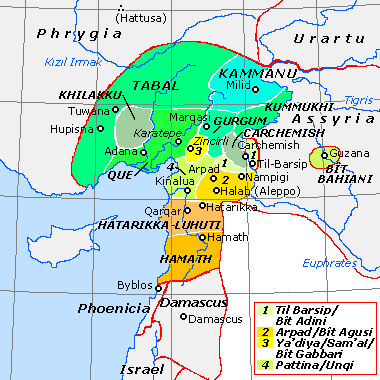
Key Facts
- Founder: Established in the early 9th century BC by Gusi of Yakhan.
- Capital: Arpad (modern Tell Rifaat).
- Geography: Spanned from A'zaz in the north to Hamath in the south.
- Key Cities: Arpad, Nampigi, and Aleppo.
- Ultimate Fate: Destroyed by the Neo-Assyrian king Tiglath-Pileser III around 740 BC.
The Seven Stages of Bit Agusi History
Historians divide the trajectory of Bit Agusi in Northern Syria during the 9th and 8th centuries BC into seven distinct chronological stages, reflecting its struggle for autonomy against larger empires.
Stage 1: Early Independence (858–ca. 842 BC)
In its early years, Bit Agusi operated without formal political alliances. However, in 858 BC, King Arame—the second ruler of the state—voluntarily submitted to Assyria, following a regional trend that included rulers from southern Anatolia.
Stage 2: Assyrian Subjugation (841–823 BC)
During this period, the state lost its autonomy and was fully subjugated by the Assyrian Empire.
Stage 3: The Push for Independence (c. 823 BC)
Bit Agusi successfully led a local alliance to oppose Assyrian hegemony, managing to regain its independence.
Stage 4: The Supremacy of Aram-Damascus (Until ca. 805 BC)
Regional power shifted as Aram-Damascus gained dominance, with King Hazael emerging as a prominent figure in the region.
Stage 5: Regional Fragmentation (ca. 800–754 BC)
As Assyria weakened, new powers rose. The Kingdom of Hamath-and-Luash emerged in the south, while Urartu became a dominant force in the north.
Stage 6: The Kingdom of Arpad (754–744 BC)
Now referred to as the Kingdom of Arpad, the state rose to prominence again, possibly controlling Hamath or operating within a close confederation. This era is marked by the Sefire treaty between Mati-ilu (son of King Attarsumki of Arpad) and Bar-Gayah, the King of KTK.
The identity of "KTK" remains a subject of scholarly debate, possibly referring to a large confederation known as "All Aram." Bar-Gayah may have been a powerful royal co-regent based at Til Barsip, the military capital of the Assyrian kingdom of Bit Adini, acting as a superior to Mati-ilu.
Stage 7: Provincial Status (743–740 BC)
The independence of the state ended abruptly when it was reduced to a mere province of the Assyrian Empire.
The Decline and Fall of Arpad
In its final years, Arpad became a major vassal city of the Kingdom of Urartu. This alignment brought it into direct conflict with the Neo-Assyrian Empire during the Urartu-Assyria War. In 743 BC, the Neo-Assyrian king Tiglath-Pileser III laid siege to Arpad after defeating the Urartian army of Sarduri II at Samsat.
The city resisted fiercely, but after a grueling three-year siege, Tiglath-Pileser III conquered Arpad. The victory was brutal: the inhabitants were massacred and the city was destroyed. Following the fall of Arpad, a coalition of allied princes—including the kings of Kummuh, Quwê, Carchemish, and Gurgum—was also defeated.
Bit Agusi was never repopulated. Today, the remnants of Arpad's walls are still visible at Tell Rifaat, reaching heights of 8 meters.
Summary of Bit Agusi's Evolution
| Period/Stage | Approx. Dates | Political Status | Key Influence/Ruler |
|---|---|---|---|
| Stage 1 | 858–842 BC | Independent / Voluntary Submission | King Arame / Assyria |
| Stage 2 | 841–823 BC | Subjugated | Assyria |
| Stage 3 | c. 823 BC | Independent | Local Alliance |
| Stage 4 | Until 805 BC | Regional Subordination | King Hazael (Aram-Damascus) |
| Stage 5 | 800–754 BC | Fragmented | Urartu / Hamath-and-Luash |
| Stage 6 | 754–744 BC | Prominent (Kingdom of Arpad) | Mati-ilu / Bar-Gayah |
| Stage 7 | 743–740 BC | Assyrian Province | Tiglath-Pileser III |
Frequently Asked Questions
Who founded the state of Bit Agusi?
Bit Agusi was established in the early 9th century BC by Gusi of Yakhan.
What was the capital of Bit Agusi?
The capital of the state was the city of Arpad, the ruins of which are located at Tell Rifaat.
What was the Sefire treaty?
The Sefire treaty was an agreement concluded between Mati-ilu, the son of King Attarsumki of Arpad, and Bar-Gayah, the King of KTK (possibly representing the "All Aram" confederation).
How did Bit Agusi eventually fall?
The state fell after a three-year siege by the Neo-Assyrian king Tiglath-Pileser III around 740 BC, resulting in the massacre of its people and the total destruction of the city of Arpad.
What remains of the city today?
The remains of Arpad's walls are still preserved at Tell Rifaat, with some sections standing up to 8 meters high.