Bishop Selwyn and the Anglican Church in New Zealand
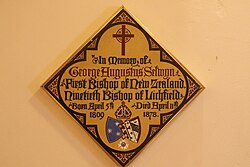
The establishment of the Anglican Church in New Zealand was profoundly shaped by the leadership of Bishop Selwyn. Consecrated at Lambeth on October 17, 1841, Selwyn arrived in the colony with a vision for a structured, self-governing church and a deep commitment to missionary work. His tenure was marked by immense physical endurance, administrative innovation, and a complex relationship with both the indigenous Māori people and the Church Missionary Society (CMS).
The Journey to New Zealand
Selwyn departed Plymouth in late December 1841 aboard the barque Tomatin, accompanied by a 23-member missionary party, including his chaplain, William Charles Cotton. The group brought essential supplies, animals, and four hives of bees. During the voyage, Selwyn demonstrated his characteristic diligence by studying the Māori language with a Māori boy returning from England, allowing him to preach in the native tongue immediately upon arrival.
After a brief stop in Sydney in April 1842, Selwyn and Cotton continued to Auckland on the brig Bristolian, arriving on May 30. They were initially guests of Captain William Hobson, the first Governor of New Zealand, before visiting mission stations in the Hauraki Gulf and the Bay of Islands. Among their party was William Bambridge, a clerk and artist who would later serve as the photographer to Queen Victoria.
Establishing the Mission and College
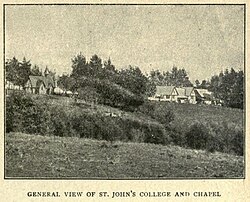
In June 1842, Selwyn established his residence at the Te Waimate mission, located 15 miles (24 km) inland from Paihia. Here, he converted existing buildings to create the College of St John the Evangelist, designed to teach theology to candidates for ordination.
Selwyn was known for his tireless energy, embarking on extensive tours of his diocese. In late 1842, he traveled the west coast of the North Island to visit missions at Ōtaki and Whanganui, and later the east coast to visit William Williams. These journeys often involved walking long distances over dangerous terrain or traveling by canoe.
By late 1844, Selwyn moved his operations 160 miles (257 km) south to Tāmaki, near Auckland. He purchased 450 acres (180 ha) of land, naming it Bishop's Auckland. This site became the permanent home of the college. The first buildings were constructed from scoria (a volcanic rock), with a kitchen and dining hall completed in 1846, followed by wooden structures and the consecration of the Collegiate Chapel in 1847.

Ecclesiastical Leadership and Conflict
For 28 years, Selwyn's seat was St Paul's Church in Auckland, which served as the city's cathedral for over four decades. His leadership was not without friction. He frequently clashed with Archdeacon Henry Williams of the CMS over land purchase disputes involving Governor George Grey. Although Selwyn initially supported Grey's accusations—leading to Williams' dismissal from the CMS in 1849—he later regretted this stance and lobbied for Williams' reinstatement in 1854.
These tensions were often rooted in theological differences. The CMS missionaries generally held low church (Evangelical) beliefs, while Selwyn adhered to high church traditions associated with the Oxford Movement, also known as the Tractarians. Despite these differences, Selwyn continued to appoint CMS missionaries to key roles, including the appointment of William Williams as the first Bishop of Waiapu.
Expanding the Diocese and the Pacific
A clerical error in Selwyn's letters patent accidentally extended his jurisdiction to the 34th degree of north latitude, rather than south, effectively including various Pacific Islands in his diocese. Selwyn chose not to correct this error and instead used it as a mandate to conduct voyages to Melanesia starting in December 1847.
His efforts in the Western Pacific led to the formation of the Australasian Board of Missions in 1850 and the subsequent Melanesian Mission. This work culminated in 1861 with the consecration of John Coleridge Patteson as the first Bishop of Melanesia.
Administrative Legacy and the Primacy
Selwyn sought to move the New Zealand church toward self-governance. During a visit to England in 1854, he secured authorization to subdivide his diocese and establish a general synod—a governing body comprising bishops, presbyters, and laity.
Upon his return, four new bishops were consecrated for the North and South Islands. In 1858, Selwyn was appointed metropolitan bishop over all New Zealand dioceses. By the 1858 revision of the General Synod's constitution, his role was titled the Primate, a designation that remains in use today.
Relationship with the Māori People
Selwyn's legacy regarding the Māori people is complex. He was criticized by figures such as Thomas Grace and Henry Venn for being too slow to ordain Māori clergy. Selwyn insisted that candidates first learn Greek and Latin, resulting in an 11-year wait before the first Māori deacon, Rota Waitoa, was ordained, and 24 years before the first Māori priest.
Politically, Selwyn often advocated for Māori rights. In 1860, he protested the government's declaration of martial law against the Te Ati Awa tribe in Taranaki, arguing that civil power should be exhausted before military action.
However, his role as a chaplain during the Invasion of the Waikato damaged his standing. He was frequently seen on the frontlines with British and colonial forces. Following the tragic deaths of women and children at Rangiaowhia on February 21, 1864, some accused him of misleading the victims or assisting in the massacre. While a Māori pamphlet, Ngā minita i roto i te whawhai, exonerated him by confirming he was providing aid to casualties at Te Awamutu, the ambiguity of his military presence left a lasting scar on the church's relationship with Māori.
Key Facts
- Arrival: Arrived in Auckland on May 30, 1842, after sailing from Plymouth on the Tomatin.
- Education: Founded the College of St John the Evangelist to train theology candidates.
- Governance: Established the general synod and the office of the Primate in New Zealand.
- Pacific Reach: Utilized a clerical error in his letters patent to establish the Melanesian Mission.
- Theology: A proponent of high church (Tractarian) views amidst a predominantly low church CMS environment.
- Controversy: Criticized for delaying Māori ordinations and for his presence with military forces during the New Zealand Wars.
| Year | Event/Achievement | Significance |
|---|---|---|
| 1841 | Consecrated at Lambeth | Beginning of his mission to New Zealand |
| 1842 | Founded St John's College | Established theological training in the colony |
| 1847 | Pacific Voyages | Expansion of the church into Melanesia |
| 1854 | Synod Authorization | Moved the church toward self-government |
| 1858 | Named Primate | Became the metropolitan bishop of New Zealand |
Frequently Asked Questions
Why did Bishop Selwyn visit the Pacific Islands if they weren't meant to be in his diocese?
A clerical error in his letters patent listed his boundaries from the 34th degree of north latitude instead of south. Selwyn was aware of the mistake but chose not to correct it, using the error as a legal basis to conduct missionary work in Melanesia.
What was the difference between the "high church" and "low church" views mentioned?
High church (Tractarian) views emphasize ritual, tradition, and the formal structure of the church. Low church (Evangelical) views, held by many CMS missionaries, prioritize personal faith and a simpler form of religious practice.
Why was Selwyn criticized regarding the ordination of Māori?
He was accused of being ineffective and slow because he required candidates to learn Greek and Latin before ordination. This led to a significant delay in ordaining Māori deacons and priests compared to the expectations of the CMS.
What was Selwyn's role during the New Zealand Wars?
Selwyn's role was contradictory; he wrote letters protesting unjust land acquisitions and the use of martial law, yet he also served as a chaplain on the frontlines during the Invasion of the Waikato.
What is the significance of the title "Primate"?
The title was added to the constitution of the General Synod in 1858 to describe Selwyn's role as the metropolitan bishop over all the dioceses of New Zealand, a title that continues to be used today.