Bike Lanes: Infrastructure, Safety, and Global Implementation
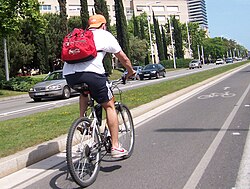
Whether they are called bike lanes in the United States or cycle lanes in the United Kingdom, these dedicated spaces on the roadway are essential components of modern urban mobility. Unlike bike paths, which are entirely separate from highways, or cycle tracks, which feature physical separation, bike lanes are primarily designated areas on the road intended for cyclists.
The evolution of this infrastructure began shortly after the bicycle boom of the 1880s. While the mid-20th century saw a decline in cycling due to the rise of the automobile, the 1970s marked a significant comeback. Today, the United Nations Environment Programme suggests that to meet environmental goals, there should be ten times more bike lanes by 2030 than existed in 2020.
Key Facts
- Safety: Separated bike lanes are linked to 44% fewer road fatalities and 50% fewer serious injuries.
- Economy: Replacing on-street parking with bike lanes has been shown to increase customer spending and foot traffic in retail corridors.
- Standards: In the U.S., standard bike lane widths typically range from 5 to 7 feet (1.5 to 2.1 m).
- Global Variety: Infrastructure ranges from simple painted lines to physically buffered lanes and specialized junction designs.
The Impact of Bike Lane Infrastructure
Safety and Public Health
Research consistently indicates that separated bike lanes—those with a physical barrier between cyclists and motor vehicles—significantly improve safety. A 2024 U.S. Department of Transportation assessment concluded that these lanes offer overall improved safety performance. Furthermore, data from 2019 suggests that cities implementing separated lanes saw a dramatic reduction in both fatalities and serious crash injuries.
![Bike lane separated by plastic delineators, New Orleans[contradictory]](/images/30/f0/30f0f18fc642b2458a62ac28a2cc9143a476a301da24f0a8b02e689ebe811627.jpg)
Economic Effects on Local Business
A common concern among business owners is that removing parking for bike lanes hurts commerce. However, evidence suggests the opposite. A 2019 study in Toronto found that replacing 136 parking spots on the Bloor Street retail corridor actually increased the number of customers and monthly spending. A broader 2021 review confirmed that replacing car lanes with bike or pedestrian lanes generally has positive or non-significant economic effects on nearby businesses.
Encouraging Active Transportation
Active transportation—referring to non-motorized travel like walking and cycling—is often dependent on perceived safety. Research from 2020, particularly in the Southeast U.S., indicates that potential cyclists are more likely to ride if separated lanes are available. However, planners must account for different cyclist groups, as preferences for specific infrastructure vary.
Global Implementation and Variations
North America
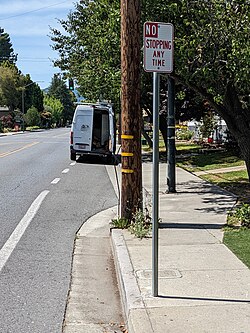
In the United States, the Manual on Uniform Traffic Control Devices (MUTCD) provides the standards for markings and signage. The U.S. categorizes bikeways into different classes:
- Class II: Standard bike lanes marked by a solid white stripe.
- Class III: Bicycle routes marked by signs suggesting a route and urging drivers to share the road.
- Class IV: Separated bikeways that are physically isolated from motor traffic.
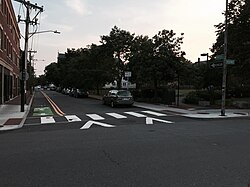
Additionally, the National Association of City Transportation Officials (NACTO) distinguishes between conventional lanes and buffered bike lanes, which provide extra space between the cyclist and the vehicle lane.
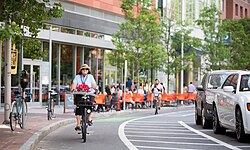
Europe
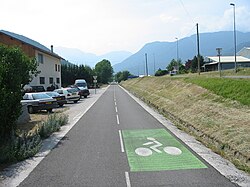
European terminology varies by country. In France, bandes cyclables are lanes beside the carriageway, while pistes cyclables are independent paths. In the Netherlands, a cycle lane is typically called a fietsstrook. In Belgium, cycle lanes are identified by two parallel broken white lines and are specifically defined as being too narrow for motor vehicle use.
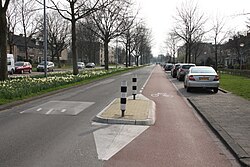
Asia
China utilizes a mix of protected, unprotected, and shared lanes. In cities like Nanjing, high bicycle usage has led to the design of specialized road junctions that minimize direct contact between cyclists and cars. In Japan, Tokyo has implemented lanes that allow two-directional bicycle flow while separating them from both pedestrians and motor vehicles.
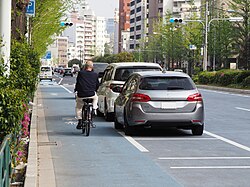
Africa
In South Africa, infrastructure varies by city. Cape Town has an extensive network of green-painted lanes integrated into its Non-Motorized Transport (NMT) routes, which are strategically placed to connect cyclists to buses and trains. In Johannesburg, some lanes utilize concrete dividers for increased separation.
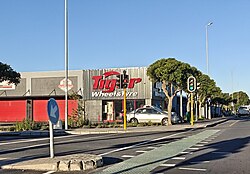
Summary of Bike Lane Types
| Type | Separation Method | Primary Characteristic |
|---|---|---|
| Conventional Bike Lane | Painted markings | Preferential use; adjacent to vehicle traffic. |
| Buffered Bike Lane | Painted buffer zone | Additional space between cars and cyclists. |
| Separated Bikeway (Class IV) | Physical barriers | Restricted to cyclists; highest safety rating. |
| Shared Lane (Class III) | Signage | Cyclists and motorists share the same space. |
![Marking guide for bike lanes[25]](/images/30/b4/30b410810603e5b3f7c258eb8f0ec63cc5aa1bae36e3fded69577566f0e3d141.gif)
Frequently Asked Questions
Do bike lanes hurt local businesses?
No. Research, including a study of Toronto's Bloor Street, indicates that bike lanes can actually increase customer spending and the total number of visitors to local businesses.
What is the difference between a bike lane and a bike path?
A bike lane is a designated part of a roadway used by cyclists, whereas a bike path is completely separate from any highway or road.
Are separated bike lanes safer than painted ones?
Yes. Studies show that cities with separated bike lanes have significantly fewer road fatalities (44% fewer) and serious injuries (50% fewer) compared to those without.
What are the standard dimensions for a bike lane in the U.S.?
According to the MUTCD, the width of a bike lane typically ranges from 5 to 7 feet (1.5 to 2.1 meters).
How does the UK distinguish between different types of cycle lanes?
In the UK, a solid white line indicates a firmly restricted lane where motor vehicles are prohibited, while a broken white line indicates an advisory lane where vehicle entry is permitted.