Big-Box Stores: The Evolution and Impact of Large-Scale Retail
In the modern commercial landscape, few sights are as recognizable as the massive, rectangular buildings that dominate suburban skylines. Known variously as big-box stores, hyperstores, supercenters, or megastores, these large-scale retail establishments have fundamentally changed how the world shops. The term "big-box" itself is a nod to the typical architectural appearance of these structures: massive, functional, and designed for high-volume commerce.
Whether they are part of a global chain or a local powerhouse, these retailers serve different roles in the economy. Some offer a vast array of general merchandise, while others act as "category killers"—specialty stores that dominate a specific niche, such as electronics, furniture, or hardware.
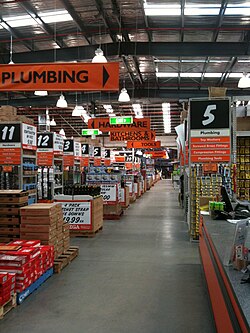
Key Facts
- General Merchandise: Retailers like Walmart and Target that sell a wide variety of goods.
- Specialty Stores: Known as "category killers," these focus on specific ranges like IKEA (furniture) or Best Buy (electronics).
- Hypermarkets: A term used primarily in Europe for stores that combine large-scale retail with grocery services.
- Power Centers: In the U.S., shopping clusters of big-box stores ranging from 250,000 to 600,000 square feet.
- Architectural Style: Typically single-story, steel-framed structures located in large, vehicle-accessible parking lots.
Understanding Retail Categories
To understand the big-box phenomenon, it is helpful to distinguish between the different commercial models used by these giants. While the terms are often used interchangeably, they represent distinct business strategies.
General Merchandise vs. Specialty Retail
General merchandise retailers aim to be a "one-stop shop," providing everything from clothing to household goods. In contrast, specialty stores focus on a specific domain. For example, a store might specialize exclusively in books or consumer electronics, allowing them to offer a depth of inventory that smaller shops cannot match.
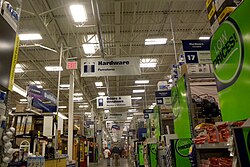
Hypermarkets and Warehouse Clubs
In many European countries, the term hypermarket describes a massive establishment that integrates a supermarket with a general merchandise store. Another distinct model is the warehouse club, such as Costco or Sam's Club. These require a membership fee and often encourage customers to purchase goods in larger quantities, typically at lower unit prices.
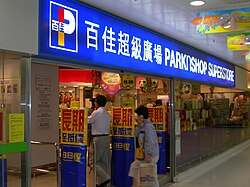
Global Retail Landscapes
The big-box model has taken different forms depending on the geography and local economy. From the dense urban centers of Hong Kong to the sprawling suburbs of the United States, the format adapts to its environment.
North America and Canada
In the United States, the trend began in the early 20th century, evolving from "one-stop shopping centers" into the massive megastores of the 1960s through the 1980s. In Canada, the market features a mix of American giants and strong domestic chains like Loblaws, Canadian Tire, and Shoppers Drug Mart. Canadian developers often utilize "power centres"—clusters of big-box stores—rather than traditional shopping malls.
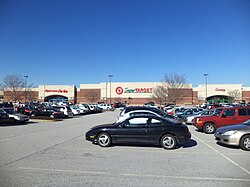
Asia and Oceania
In China, many big-box stores are multi-story structures that include everything from mobile phones to clothing, sometimes even providing free bus services to transport customers. In Hong Kong, due to high population density, superstores are significantly smaller than their Western counterparts. Australia refers to this sector as "large format retail," which includes specialized showrooms for bulky goods.
Europe and India
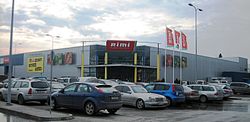
European retail is diverse, ranging from the French hypermarket model to the UK's out-of-town retail parks. In India, the retail sector has undergone a revolution since the early 2000s. While large conglomerates like Reliance and TATA have entered the space, much of the daily commerce is still handled by small and medium enterprises.
Architectural and Urban Impact
The physical design of a big-box store is highly standardized. They are typically large, free-standing, single-floor structures built on concrete slabs, featuring steel trusses and metal or masonry siding. Because they are designed for efficiency and volume, they are almost always surrounded by expansive paved parking lots.
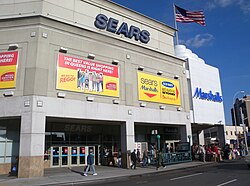
This design, however, is not without controversy. Urban planners often criticize the big-box model for being unsustainable, as the stores are frequently inaccessible to pedestrians and rely heavily on motor vehicle transport. Additionally, labor unions have historically raised concerns regarding the impact of these large chains on employment standards and the traditional grocery market.
Summary of Retail Formats
| Format | Primary Focus | Key Characteristics |
|---|---|---|
| General Merchandise | Wide variety of goods | One-stop shopping, often includes groceries |
| Category Killer | Specific product niche | Deep inventory in one area (e.g., electronics) |
| Hypermarket | Groceries + General goods | Common in Europe; massive floor space |
| Warehouse Club | Bulk goods | Membership-based; high-volume purchasing |
Frequently Asked Questions
What is the difference between a supermarket and a hypermarket?
A supermarket typically focuses on food and household items, whereas a hypermarket is a much larger establishment that combines a supermarket with a full range of general merchandise, such as clothing and electronics.
What does the term "category killer" mean?
A category killer is a specialty retailer that carries such a vast selection of a specific type of product that it makes it difficult for smaller competitors to survive in that niche.
Why are big-box stores often located in suburbs?
The model relies on large amounts of land for massive floor spaces and expansive parking lots, which is more cost-effective and available in suburban areas than in dense city centers.
Are big-box stores the same as department stores?
No. While both sell various goods, traditional department stores are generally not classified as big-box stores. Big-box stores are defined by their specific architectural scale and often their location in standalone, large-format buildings.
What is a power center?
A power center is a shopping concentration consisting of several big-box stores, typically ranging from 250,000 to 600,000 square feet in total, often located in the United States.