Bible Belt: Geography, History, and Cultural Influence in the United States
The Bible Belt is a distinct cultural region of the United States characterized by a high concentration of Protestantism and a strong social and political emphasis on biblical teachings. While often associated with the American South, the region's influence extends through various states where religious faith plays a central role in daily life and governance.
Key Facts
- Core States: Includes Alabama, Arkansas, Georgia, Kentucky, Mississippi, North Carolina, Oklahoma, South Carolina, and Tennessee, as well as parts of Florida.
- Highest Biblical Belief: Mississippi (56%) and Alabama (51%) lead the nation in the belief that the Bible is the literal word of God.
- Political Leanings: Strong support for Republican candidates, particularly those aligned with Christian Social Conservatism.
- The "Buckle": Certain cities, such as Knoxville and Shreveport, are identified as the most "Bible-minded" in the U.S.
Geography and Religiosity
Defining the exact boundaries of the Bible Belt often relies on sociological data. A 2016 study by the Pew Research Center identified the ten most religious states as Alabama, Mississippi, Tennessee, Louisiana, Arkansas, South Carolina, West Virginia, Georgia, Oklahoma, and North Carolina.
Beyond general religiosity, the degree of biblical literalism—the belief that the Bible is the literal word of God—varies by state. According to 2014 Pew Research data, the highest percentages are found in Mississippi (56%), Alabama (51%), and South Carolina (49%), followed by West Virginia (47%), Tennessee (46%), Arkansas (45%), Louisiana (44%), Georgia (41%), Kentucky (41%), and Texas (39%).
![Percentage of respondents in the USA stating that religion is "Very important" or "Somewhat important" in their lives, 2014[16]](/images/43/3f/433ff14d44e12d8e41f4025cf1ee9da540abb2ca4fd75e40178cb80c92030e09.webp)
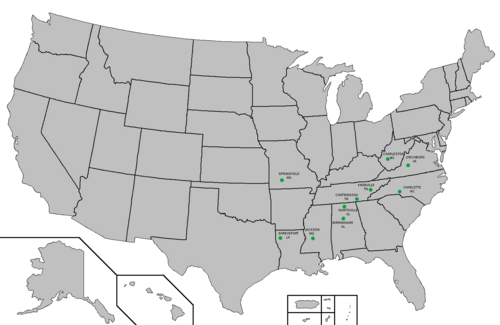
The "Buckle of the Bible Belt"
The term "Buckle of the Bible Belt" refers to the areas where biblical influence is most concentrated. A study commissioned by the American Bible Society, based on over 42,000 interviews between 2005 and 2012, identified the ten most "Bible-minded" cities. These include Knoxville, Tennessee; Shreveport, Louisiana; Chattanooga, Tennessee; Birmingham, Alabama; Jackson, Mississippi; Springfield, Missouri; Charlotte, North Carolina; Lynchburg, Virginia; Huntsville-Decatur, Alabama; and Charleston, West Virginia.
Historical Foundations
The religious landscape of the South was shaped by early missionary efforts. While the northern colonial Bible Belt, particularly New England with its Puritan heritage, often performed missionary work in the South, the Middle Colonies served as an early center for Baptist activity.
In 1707, the Philadelphia Baptist Association was established by five churches in New Jersey, Pennsylvania, and Delaware. This body became a catalyst for growth; by 1760, it included churches across Connecticut, New York, New Jersey, Pennsylvania, Delaware, Virginia, and West Virginia. This expansion led to the creation of the Warren Baptist Association in New England and the Ketochton Baptist Association in Virginia by 1767. Additionally, the Philadelphia Association helped organize the Charleston Baptist Association in the Carolinas in 1751.
Political and Cultural Context
The Bible Belt's religious identity strongly correlates with its voting patterns. In presidential elections, Alabama, Mississippi, South Carolina, and Texas have consistently voted for Republican candidates since 1980. Oklahoma has shown even longer consistency, supporting Republicans in every election since 1968, with every county in the state voting Republican since 2004. Other states, including Kentucky, Louisiana, West Virginia, Arkansas, Missouri, and Tennessee, have voted Republican in every election since 1996.
Within Republican primaries, Christian Social Conservatives—voters who prioritize traditional biblical values in policy—typically perform well. This was evident in 2008 when Mike Huckabee won most Bible Belt states, and in 2012 when Rick Santorum achieved similar success. In 2016, Donald Trump won the majority of these states, while Ted Cruz won a smaller number.
Global Comparisons
While the term is most famous in the U.S., other countries have regions colloquially referred to as "Bible belts." In Australia, the northwestern suburbs of Sydney, specifically The Hills District (home to Hillsong Church), were traditionally known as the Bible belt. However, census data from 2011 to 2016 showed a decline in the Christian population in this district by 18.5%, while the number of people identifying as having no religion grew from 1 in 8 in 2006 to 1 in 5 by 2016.
| State | Belief in Bible as Literal Word of God (%) |
|---|---|
| Mississippi | 56% |
| Alabama | 51% |
| South Carolina | 49% |
| West Virginia | 47% |
| Tennessee | 46% |
Frequently Asked Questions
Which states are considered part of the Bible Belt?
The core states include Alabama, Arkansas, Georgia, Kentucky, Mississippi, North Carolina, Oklahoma, South Carolina, and Tennessee, along with parts of Florida.
What is the "Buckle of the Bible Belt"?
The "Buckle" refers to the most intensely "Bible-minded" areas of the region. Cities like Knoxville, TN, and Shreveport, LA, are among those identified as having the highest concentration of biblical influence.
How does the Bible Belt influence U.S. politics?
The region is a stronghold for the Republican Party, particularly for candidates who align with Christian Social Conservative values. Many of these states have voted Republican in every presidential election for several decades.
Is the Bible Belt only found in the United States?
While the term primarily describes a U.S. region, similar terms have been used to describe religious clusters in other countries, such as the Hills District in Sydney, Australia, though some of these areas are seeing a decline in religious affiliation.