Belgium Nuclear Phase-out: Policy Shifts and Energy Transitions
Belgium's approach to nuclear energy has been defined by a complex tug-of-war between environmental goals, economic stability, and geopolitical realities. For over two decades, the nation has navigated a volatile path toward a nuclear phase-out—the systematic decommissioning of nuclear reactors—while struggling to secure a reliable alternative for its electricity grid.
The journey began in 1999 under the Verhofstadt I Government, where a coalition including the green parties Groen! and Ecolo introduced the first plan to exit nuclear power. Despite a 2000 commission report suggesting that nuclear power remained vital to the country, the government passed formal phase-out legislation in 2003. This law prohibited the construction of new commercial reactors and mandated that the seven existing reactors be shut down after 40 years of operation, a milestone all units were set to reach between 2015 and 2025.
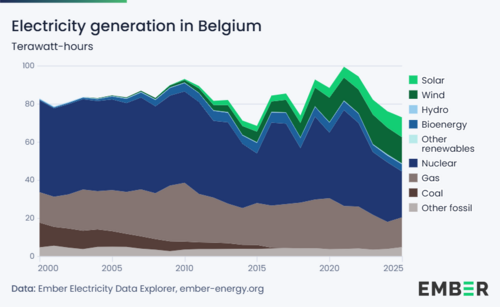
The Economic and Environmental Dilemma
As the 2025 deadline approached, the Belgian government faced significant warnings regarding the feasibility of the phase-out. A 2005 report from the Federal Planning Bureau revealed that nuclear power accounted for more than 50% of electricity generation in many regions. This raised concerns that Belgium would fail to meet the emissions targets set by the Kyoto Protocols—an international treaty to reduce greenhouse gas emissions—without nuclear energy.
By 2007, the Belgian Commission on Energy argued that nuclear power was imperative for maintaining economic stability and meeting CO2 requirements, warning that electricity prices could double without it. This led to a series of policy reversals and extensions. In 2009, the government decided to extend the lives of the three oldest plants until 2025, though political instability and the 2011 Fukushima disaster in Japan delayed the finalization of these laws.
Timeline of Reactor Closures and Extensions
The scheduling of plant closures became a moving target. While the government initially planned for a strict exit, several reactors saw their operational lives extended to ensure grid stability. The current landscape of the Belgian nuclear fleet is summarized below:
| Reactor Unit | Original/Planned Closure | Current Status/Extension |
|---|---|---|
| Doel 1 & Doel 2 | 2015 | Extended to 2025 |
| Tihange 1 | Variable | Extended to 2025 |
| Doel 3 | 2022 | Scheduled for closure |
| Tihange 2 | 2023 | Scheduled for closure |
| Doel 4 & Tihange 3 | 2025 | Extended by 10 years (post-2022 decision) |
The CRM and the Shift to Gas
To replace nuclear capacity, the government introduced the Capacity Remuneration Mechanism (CRM), a system of subsidies designed to ensure energy production capacity. In 2021, under Minister of Energy Tinne Van der Straeten, the Council of Ministers authorized the construction of 2,300 MWe of gas-fired power plants. The European Commission approved these subsidies on the strict condition that the nuclear phase-out proceed as planned.
However, this transition faced internal opposition. Critics argued that replacing low-carbon nuclear power with fossil gas was harmful to the climate. Furthermore, the project faced legal hurdles when provincial and Flemish authorities blocked permits for a gas plant in Vilvoorde, casting doubt on whether the phase-out was achievable.
Geopolitical Shifts and the "Plan B"
The Russian invasion of Ukraine in February 2022 fundamentally altered Belgium's energy strategy. The reliance on new gas-fired plants became untenable due to the resulting energy crisis. This forced the government to activate a "plan B"—a fallback option to maintain a portion of nuclear capacity.
In March 2022, Belgium officially postponed the closure of Doel 4 and Tihange 3 by an additional 10 years. Following negotiations, an agreement was reached in January 2023 with the operator Engie. Under this deal, Engie agreed to invest in the plants, while the government agreed to cap costs related to nuclear waste and the discontinuation of other units.
Key Facts
- Phase-out Law: Passed in 2003, mandating closure after 40 years of operation.
- Financial Cost: The 2018 estimated cost of the phase-out (excluding waste) was €15.1 billion.
- Nuclear Reliance: Nuclear power has provided over 50% of electricity in various Belgian regions.
- Current Extension: Doel 4 and Tihange 3 have been extended by 10 years beyond 2025.
- Alternative Energy: The CRM was used to authorize 2,300 MWe of gas-fired capacity.
Frequently Asked Questions
Why did Belgium decide to phase out nuclear power?
The phase-out was primarily driven by political policy statements starting in 1999, led by a coalition government that included green parties (Groen! and Ecolo).
What is the Capacity Remuneration Mechanism (CRM)?
The CRM is a subsidy system approved by the European Commission to ensure that Belgium has enough energy production capacity to replace nuclear power, specifically through the construction of gas-fired plants.
Which reactors are staying open the longest?
Following the 2022 decision triggered by the energy crisis, Doel 4 and Tihange 3 are the reactors whose closures have been postponed by 10 years.
How does the phase-out affect Belgium's climate goals?
There has been significant debate on this; while the phase-out aligns with some environmental goals, critics and the Belgian Commission on Energy have argued that removing low-carbon nuclear power makes it harder to meet CO2 requirements and Kyoto Protocol targets.
Who manages the phase-out funds?
Synatom manages the phase-out fund, which as of 2018 held more than €10 billion, including liabilities for nuclear waste management.