Renewable Portfolio Standards: Driving the Global Transition to Clean Energy
As the world shifts away from fossil fuels, governments are increasingly utilizing regulatory frameworks to ensure a steady increase in clean power production. One of the most effective tools in this transition is the Renewable Portfolio Standard (RPS). This regulation mandates an increased production of energy from renewable sources, such as wind, solar, biomass, and geothermal energy.
Depending on the region, these policies may go by different names. At the United States federal level, the concept is often referred to as a Renewable Electricity Standard (RES), while in the United Kingdom, it is known as the Renewables Obligation. Regardless of the name, the core objective remains the same: ensuring that a specific portion of electricity comes from sustainable, renewable origins.
How the RPS Mechanism Works
The RPS mechanism functions by placing a legal obligation on electricity supply companies to produce a specific fraction of their electricity from renewable sources. To facilitate this, the system utilizes a market-based approach involving certificates:
- Generation: Certified renewable energy generators produce electricity and earn certificates for every unit they generate.
- Trading: These generators can sell their certificates, along with the electricity itself, to supply companies.
- Compliance: Supply companies then submit these certificates to a regulatory body to prove they have met their legal obligations.
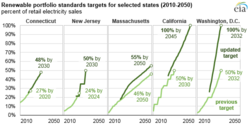
While some jurisdictions rely on the private market for implementation, others use strict legislation. For example, California Senate Bill 350, passed in October 2015, requires retail sellers and publicly owned utilities to procure 50 percent of their electricity from eligible renewable energy resources by 2030.
Economic Impact and Competition
Proponents of RPS mechanisms argue that market implementation fosters competition, efficiency, and innovation. By encouraging different types of renewable technologies to compete, these programs aim to deliver energy at the lowest possible cost. This is increasingly vital as renewable energy becomes more cost-competitive with fossil fuels. Notably, since 2013, the levelized cost of electricity (the average total cost of building and operating an asset per unit of total electricity generated) for wind energy has dropped below that of all fossil fuels, with solar energy following suit in 2015.
Key Facts
- Global Adoption: RPS-type mechanisms are used in the UK, Italy, Poland, Sweden, Belgium, Chile, and 29 U.S. states.
- U.S. Impact: The Lawrence Berkeley National Laboratory estimates RPS requirements were responsible for 60% of the total increase in American renewable electricity generation since 2000.
- Cost Efficiency: Wind energy's levelized cost of electricity fell below all fossil fuels in 2013.
- Policy Variations: Some states, like Michigan and Virginia, use multipliers where certain technologies (like solar) count for more toward compliance than others.
Global Policy Landscape
Renewable energy targets vary significantly by country and region, reflecting diverse economic and environmental priorities.
Asia and Oceania
In China, targets set in 2009 aimed for 500 GW of renewable electricity by 2020 (comprising 300 GW from hydro, 150 GW from wind, 30 GW from biomass, and 20 GW from solar PV), with a broader goal of 15% renewable energy (including nuclear) by 2020. Japan targeted 118 million KWh by 2012 under the 1997 Act on the Promotion of New Energy Usage, while the Republic of Korea adopted its promotion act in 2012.
Europe and the United Kingdom
The European Union set targets to reach 33% renewable electricity and 20% total renewable energy by 2020. Germany has been particularly aggressive, utilizing feed-in tariffs—a policy mechanism designed to accelerate investment in renewable energy by offering long-term contracts to producers—to drive growth. Germany's targets include 35% renewable electricity by 2020 and 80% by 2050.
In the United Kingdom, the Renewables Obligation (RO) has been instrumental. Since its introduction, it has more than tripled the level of eligible renewable electricity generation, rising from 1.8% of the total UK supply to 7.0% in 2010. The scheme is set to run until 2037 in England and Wales, and until 2033 in Northern Ireland.
The United States
While the 1978 Public Utility Regulatory Policies Act promoted renewable use through feed-in tariffs, it lacked explicit quotas. While a federal Renewable Electricity Standard was considered in 2009, it did not pass the full Senate. Consequently, the U.S. landscape is defined by state-level programs. Although RPS roles in annual renewable builds declined from 71% in 2013 to 46% in 2015, they remain a cornerstone of state energy policy.
Summary of Regional Targets and Policies
| Region/Country | Policy Name/Mechanism | Key Target/Detail |
|---|---|---|
| United Kingdom | Renewables Obligation (RO) | Targeted 15.4% by 2015/16; runs until 2037 |
| Germany | Renewable Energy Act | 80% renewable electricity by 2050 |
| China | Renewable Energy Targets | 500 GW renewable electricity by 2020 |
| California (USA) | Senate Bill 350 | 50% electricity from renewables by 2030 |
| European Union | EU Directive | 20% renewable energy by 2020 |
Frequently Asked Questions
What is the difference between RPS and RES?
They are essentially the same concept. RPS (Renewable Portfolio Standard) is a common term, while RES (Renewable Electricity Standard) is frequently used at the United States federal level.
How do renewable energy certificates work?
Generators earn certificates for every unit of renewable electricity they produce. These certificates can be sold to electricity supply companies, who use them to prove they have met their regulatory requirements.
Why do some states give more credit to solar energy?
Some state RPS programs use multipliers to encourage specific technologies. For example, in Michigan and Virginia, solar generation may count for twice as much as other renewable sources toward meeting the mandate.
Has the impact of RPS in the U.S. changed recently?
Yes. While RPS requirements were responsible for 60% of the total increase in American renewable electricity generation since 2000, their role in annual renewable builds has seen a decline, dropping from 71% in 2013 to 46% in 2015.
Are renewable energy sources becoming cheaper than fossil fuels?
Yes. The levelized cost of electricity for wind energy dropped below that of all fossil fuels in 2013, and solar energy followed this trend in 2015.