Beirut Barracks Bombings of 1983: A Tragedy of Peacekeeping
On the morning of October 23, 1983, the world witnessed one of the deadliest suicide attacks in military history. Two massive truck bombs detonated nearly simultaneously, targeting buildings in Beirut, Lebanon, that housed American and French service members. These personnel were part of the Multinational Force in Lebanon (MNF), a military peacekeeping operation deployed during the volatile Lebanese Civil War.
The attacks resulted in a staggering loss of life, claiming 307 victims. The devastation served as a turning point in the region's conflict and highlighted the extreme risks faced by international peacekeepers in asymmetric warfare.
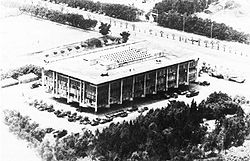
Key Facts
- Date: October 23, 1983, at approximately 6:22 am.
- Total Deaths: 307 (241 U.S. military, 58 French military, 6 civilians, and 2 suicide bombers).
- Injuries: 150 people were wounded.
- Perpetrators: Claimed by the Islamic Jihad Organization/Hezbollah; court findings linked the Iranian Ministry of Intelligence and Islamic Amal.
- Motive: Opposition to U.S. and French support for Iraq.
- Location: Beirut International Airport (BIA) and the 'Drakkar' building.
The Road to Tragedy: 1982–1983
The environment leading up to the bombings was defined by escalating violence and geopolitical instability. The conflict was a complex intersection of the Lebanese Civil War and the spillover from the Iran–Iraq War.
The timeline of escalation began in earnest on June 6, 1982, when Israel launched Operation "Peace for Galilee," invading Southern Lebanon. Tensions continued to mount throughout the following year, marked by significant violence, including the bombing of the U.S. Embassy in Beirut on April 18, 1983, which killed 63 people, including 17 Americans.
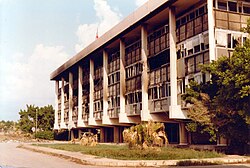
The Attacks of October 23
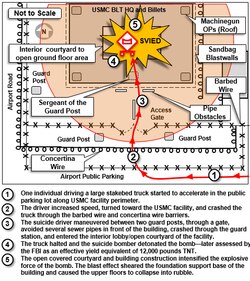
The strikes were carried out using truck bombs—vehicles loaded with explosives driven directly into the targets. The first attack targeted the U.S. Marine Corps barracks at Beirut International Airport. A suicide bomber drove a truck through the perimeter and detonated the payload in the center of the building, causing a massive collapse.
![A map of the route taken by the suicide bomber on the morning of October 23, 1983. [From the Long Commission Report].](/images/52/85/5285c9af836bc5d957d503be9d9e7fae2fee332120b2bc9f42a7e5bd28558922.jpg)
Simultaneously, a second truck bomb struck the 'Drakkar' building, which served as the headquarters for French paratroopers. The scale of the explosions was catastrophic, leaving the structures in ruins and trapping hundreds of service members beneath the debris.
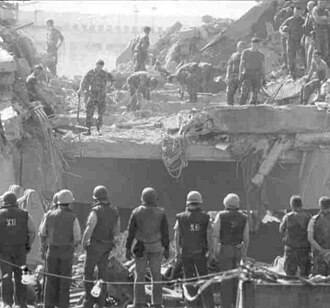
Rescue and Recovery
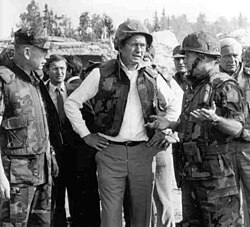
From October 23 to October 28, 1983, intense rescue and recovery operations were conducted. Military personnel and emergency responders worked through the rubble to retrieve the fallen and save survivors. The aftermath was a scene of total devastation, later visited by high-ranking officials, including Vice President George H. W. Bush.
Response and Aftermath
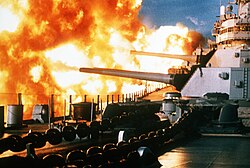
The response to the bombings was swift and multifaceted. The United States engaged in airstrikes and shelling against anti-government forces in Lebanon to retaliate and secure the area. This included the use of the USS New Jersey, which fired salvos against forces in the Shouf region in January 1984.
In the years following the attack, the search for the perpetrators led to significant legal and diplomatic battles. A U.S. District Court eventually found the Iranian government responsible, leading to rulings that Iran must pay damages to the victims' families.
Commemoration and Remembrance
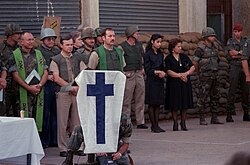
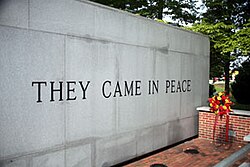
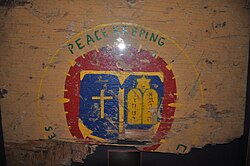
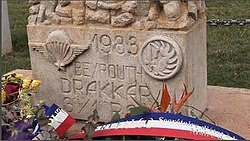
The sacrifice of the service members is honored through various memorials. These include the Beirut Memorial at Marine Corps Base Camp Lejeune and tributes to the 58 French paratroopers of the 1st and 9th RCP.
Summary of Casualties and Responsibility
| Category | Details |
|---|---|
| U.S. Military Deaths | 241 |
| French Military Deaths | 58 |
| Civilian Deaths | 6 |
| Total Fatalities | 307 |
| Total Injured | 150 |
| Primary Perpetrators | Islamic Jihad Organization / Hezbollah |
| State Sponsorship | Iranian Ministry of Intelligence (Court Finding) |
Frequently Asked Questions
What was the purpose of the Multinational Force in Lebanon?
The MNF was a military peacekeeping operation intended to provide stability and support during the Lebanese Civil War.
Who was responsible for the 1983 bombings?
The Islamic Jihad Organization and Hezbollah claimed responsibility. However, U.S. court findings specifically identified the Iranian Ministry of Intelligence and Islamic Amal as being responsible for the attacks.
What was the motive behind the attacks?
The attackers sought to force the withdrawal of foreign forces from Lebanon, specifically opposing the United States and France due to their support for Iraq.
How did the U.S. respond militarily after the bombings?
The U.S. responded with airstrikes and naval shelling of anti-government positions in Lebanon, including operations conducted by the battleship USS New Jersey.
Were there other attacks in Beirut around the same time?
Yes, the environment was highly volatile; for example, the U.S. Embassy in Beirut was bombed on April 18, 1983, killing 63 people prior to the barracks attacks.