Bedford College: A Pioneering Legacy in Women's Higher Education
The history of higher education in the United Kingdom was fundamentally altered in 1849 with the establishment of Bedford College. Founded during an era when academic opportunities for women were virtually non-existent, the college served as a beacon of liberal, non-sectarian education, challenging the societal norms of the Victorian age and paving the way for future generations of female scholars.
The Vision of Elizabeth Jesser Reid
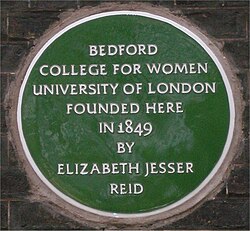
Bedford College was the brainchild of Elizabeth Jesser Reid, a dedicated social reformer and anti-slavery activist. Utilizing a private income left to her by her late husband, Dr. John Reid, Mrs. Reid sought to address the systemic lack of educational opportunities for women. In 1849, she leased a property at 47 Bedford Square in Bloomsbury, London, to open the Ladies College in Bedford Square.
To ensure the institution's viability, Reid deposited £1,500 with three male trustees and recruited a circle of well-educated friends to serve as professors and management committee members. The college opened its doors to 68 pupils in its first term, offering a curriculum that was uniquely non-sectarian for the time.
Early Governance and Growth
The college was a trailblazer in administration, becoming the first British institution partly directed by women. Governance was split between a Ladies Committee—which managed student welfare, discipline, and chaperoning via "Lady Visitors"—and a General Committee consisting of trustees, professors, and women.
Recognizing that many incoming students had only received limited home-based education from governesses, Reid founded the Bedford College School in 1853 to raise the standard of entrants. By 1860, the college expanded into 48 Bedford Square, transforming into a residential establishment where students were encouraged to manage their own accounts and assist in running the house.
Evolution and Academic Expansion
Following the death of Elizabeth Reid in 1866, the college was managed by three female trustees: Eliza Bostock, Jane Martineau, and Eleanor Smith. Under their leadership, the institution was reconstituted as an association under the Board of Trade and officially renamed Bedford College.
The college relocated to 8 and 9 York Place off Baker Street in 1874. This move, organized by Eliza Bostock, allowed for the addition of science laboratories to accommodate a growing student body. To maintain academic rigor, the college introduced entrance examinations and a preparatory department in the late 1870s.
The Path to University Degrees
A pivotal shift occurred in 1878 when the University of London opened its degree examinations to women. By the early 1880s, Bedford College students were earning Bachelor of Arts, Bachelor of Science, and Master's degrees. The college further expanded its mission in 1891 by training women graduates for secondary education, a program that grew significantly under the leadership of Sara Melhuish starting in 1910.
In 1900, as the University of London transitioned into a teaching university, Bedford College became one of its constituent colleges. It received a royal charter in 1909, officially becoming Bedford College for Women.
The Regent's Park Era and Global Impact
To accommodate its continued growth, the college moved to a purpose-built site at Regent's Park in 1908. Designed by architect Basil Champneys and opened by Queen Mary in 1913, these buildings remained the college's home for 70 years, despite sustaining significant damage during wartime bombing.
Bedford College also made strides in professional healthcare. In 1921, in partnership with the College of Nursing and the League of Red Cross Societies, it developed one of the first postgraduate courses for nurses, focusing on public health for international students until 1939.
Institutional "Firsts" and Identity
The college's identity was reflected in its colors: green and grey (associated with Minerva), with purple added in 1938 to represent the university. These colors mirrored those of the UK women's suffrage movement.
Bedford College is credited with several historic milestones:
- The first British institution partly run by women.
- The establishment of the UK's first Social Sciences department in 1918.
- The first art school in England allowing women to draw from life.
- Appointing Susan Stebbing as the first woman to hold a chair in philosophy in the UK.
- Producing one of the first two women fellows of the Royal Society.
- Producing Marie Patterson, the fourth woman chairman of the Trades Union Congress (TUC).
The college transitioned to a fully coeducational institution in 1965 and reverted its name to Bedford College. By the early 1980s, it boasted approximately 1,700 students and 200 academic staff across 20 departments.
Merger with Royal Holloway
In 1985, Bedford College merged with Royal Holloway College to form Royal Holloway and Bedford New College (RHBNC). The merged institution moved to the Egham campus in Surrey. While the merger caused some friction among alumni who feared the loss of Bedford's pioneering identity, the institution honored the legacy by naming its central library the "Bedford Library."
The former Regent's Park premises now serve as the home of Regent's University London.
Key Facts
- Founded: 1849 by Elizabeth Jesser Reid.
- Original Location: 47 Bedford Square, London.
- Firsts: First UK Social Sciences department (1918) and first women-led British institution.
- University Affiliation: Constituent college of the University of London.
- Merger: Joined Royal Holloway College in 1985.
- Legacy: Pioneer in non-sectarian higher education for women.
| Year | Event | Significance |
|---|---|---|
| 1849 | Foundation | First non-sectarian college for women in the UK. |
| 1853 | Bedford College School opened | Improved standards for incoming students. |
| 1878 | University of London degrees opened | Women began earning BA, BSc, and Master's degrees. |
| 1909 | Royal Charter received | Officially recognized as Bedford College for Women. |
| 1913 | Regent's Park campus opened | Purpose-built facilities for expanding growth. |
| 1965 | Coeducation adopted | Admitted male students; name reverted to Bedford College. |
| 1985 | Merger with Royal Holloway | Formation of RHBNC in Egham, Surrey. |
Frequently Asked Questions
Who founded Bedford College and why?
Elizabeth Jesser Reid founded the college in 1849 to provide women with a liberal, non-sectarian education, which was unavailable in any other UK institution at the time.
When did women at Bedford College start receiving degrees?
Students began gaining Bachelor of Arts, Bachelor of Science, and Master's degrees from the University of London in the early 1880s, following the opening of degree examinations to women in 1878.
What were some of the college's most significant "firsts"?
Bedford College was the first British institution partly directed by women, established the UK's first Social Sciences department in 1918, and was the first English art school where women could draw from life.
What happened to the college in 1985?
Bedford College merged with Royal Holloway College to become Royal Holloway and Bedford New College (RHBNC), relocating its main operations to Egham, Surrey.
Where is the original Bedford College site now?
The college's final London premises at Regent's Park are now occupied by Regent's University London.