Beatrice Harrison: The Virtuoso Cellist of the Nightingale Duets
Beatrice Harrison (1892–1965) was a distinguished British cellist whose career spanned the first half of the 20th century. Renowned for her technical mastery and evocative tone, she became a pivotal figure in the promotion of English classical music. Harrison is most remembered for her close collaborations with legendary composers such as Edward Elgar and Frederick Delius, and for her enchanting, widely popular recordings of duets with nightingales.
Key Facts
- First Recording: Made the first official recording of Edward Elgar's Cello Concerto in 1928, conducted by the composer.
- Delius Collaborations: Premiered several works by Frederick Delius, including his Cello Sonata and the Double Concerto.
- The Nightingale Duets: Became a household name through BBC broadcasts and HMV records featuring her cello playing alongside singing nightingales.
- Instrument: Performed on a rare cello crafted by Pietro Guarneri (Pietro da Venezia).
- Education: Studied at the Royal College of Music in London and the High School of Music in Berlin.
Early Life and Musical Foundations
Born on December 9, 1892, in Roorkee, British India, Beatrice was the daughter of Colonel John Harrison and Annie Harrison. Music was a cornerstone of her upbringing; her mother had studied singing, and Beatrice grew up in a household where siblings were taught different instruments to facilitate ensemble playing. Her sisters included violinist May Harrison, pianist Margaret Harrison, and mezzo-soprano Monica Harrison.
Harrison's formal training took her from the Royal College of Music in London to Berlin, where she studied under Hugo Becker at the High School of Music. Her early talent was recognized quickly; she won the Mendelssohn Prize in 1910 and made her professional debut at Berlin's Bechstein Hall. By 1911, she was performing under the baton of Sir Henry Wood, earning the admiration of leading musical figures like Charles Villiers Stanford and Edward Elgar.
Championing English Composers
Beatrice Harrison played a critical role in debuting and recording significant English works. She had a particularly fruitful relationship with Frederick Delius. In 1918, she gave the first performance of Delius's Cello Sonata at Wigmore Hall. Later, in January 1920, she and her sister May performed the premiere of Delius's Double Concerto. At Harrison's request, Delius also composed a Cello Concerto, which she premiered in 1921.
Her association with Edward Elgar was equally profound. Harrison gave the first performance of Elgar's Cello Concerto outside of London at the 1921 Three Choirs Festival. Elgar held her playing in such high regard that he specifically requested her as the soloist whenever he conducted the piece. This partnership culminated in the 1928 "official" recording for His Master's Voice (HMV), conducted by Elgar himself.
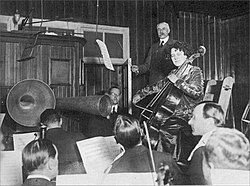
The Elgar Legacy and Wartime Performances
Throughout her career, the Elgar Concerto remained the work most closely linked to her identity. Even during the hardships of World War II, she continued to perform. In August 1940, she performed the concerto at the old Queen's Hall during a concert where gunfire could be heard outside and plaster fell from the ceiling. Sir Henry Wood later described this specific performance as the finest he had ever directed.
The Nightingale Duets and BBC Fame
Beyond the concert hall, Harrison achieved unique fame through the emerging medium of radio. In May 1924, she participated in one of the BBC's first live outside broadcasts, playing her cello in the garden of her home, "Foyle Riding" in Oxted, while duetting with wild nightingales.
These performances were later captured by His Master's Voice on 10-inch shellac discs in 1927. The recordings, which included the Londonderry Air and Dvořák's Songs My Mother Taught Me, became immense commercial successes. While some later critics questioned the authenticity of these duets, contemporary letters and research from the Museum of Music History in Dorking support the fact that no bird impersonators were used.
Summary of Major Contributions
| Category | Key Achievement / Work | Significance |
|---|---|---|
| Recordings | Elgar's Cello Concerto (1928) | First official recording conducted by the composer. |
| Premieres | Delius's Cello Sonata (1918) | First performance of the work. |
| Innovation | Nightingale Duets (1924/1927) | Pioneered nature-integrated musical broadcasts. |
| Collaborations | Delius's Double Concerto (1920) | Premiered with sister May Harrison. |
Later Years and Legacy
Beatrice Harrison passed away on March 10, 1965, at the age of 72. She is buried at St Peter's Church in Limpsfield, Surrey, near other prominent musicians including Sir Thomas Beecham.
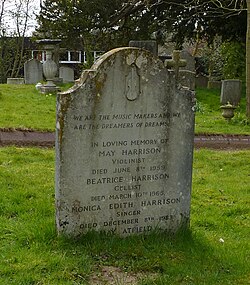
Her legacy was celebrated in 1992 with a Centenary Concert at Wigmore Hall, featuring cellist Julian Lloyd Webber. Her influence persists not only in the recordings of the great English concertos but also in literature and drama, where her nightingale duets have inspired poems, plays, and novels.
Frequently Asked Questions
Which famous composer specifically requested Beatrice Harrison as his soloist?
Edward Elgar specifically requested that Beatrice Harrison be the soloist whenever he conducted his Cello Concerto, following her deep study of the piece with him.
What was the controversy surrounding the nightingale recordings?
Some suggested the bird songs were faked by a voice artist. However, documentary evidence and research by music historians indicate that the duets were genuine and no impersonators were used.
What instrument did Beatrice Harrison play?
She played a cello crafted by Pietro Guarneri (also known as Pietro da Venezia), who lived from 1695 to 1762.
How did Beatrice Harrison contribute to the works of Frederick Delius?
She premiered Delius's Cello Sonata and the Double Concerto (with her sister May), and she inspired Delius to write his Cello Concerto.
Where can Beatrice Harrison's grave be found?
She is buried in the churchyard of St Peter's Church in Limpsfield, Surrey, England.