BCS National Championship Game: History, Controversies, and Legacy
For fifteen years, the BCS National Championship Game served as the definitive climax of the American college football season. Operating from 1999 to 2014, the Bowl Championship Series (BCS) was designed to ensure a matchup between the top two ranked teams in the nation, moving away from the fragmented championship outcomes of previous decades.
Before the BCS, the Bowl Coalition (1992–1994) and the Bowl Alliance (1995–1997) attempted similar goals. However, these predecessors often failed to secure the top two teams because major conferences, specifically the Big Ten and Pac-10, did not always participate. The BCS solved this by integrating a broader set of conferences and a complex ranking formula.
Key Facts
- Operational Years: 1999–2014.
- Successor: The College Football Playoff (CFP), which began in 2015.
- Rotation: The game rotated every four years between State Farm Stadium, Caesars Superdome, Hard Rock Stadium, and the Rose Bowl.
- Most Successful Conference: The SEC, with 9 wins across 11 appearances.
- Highest Payout: US$ 23,900,000 for the 2014 game.
The Evolution of the Championship Format
The BCS utilized a rotating system for its venue and location, cycling through Glendale, Arizona; New Orleans, Louisiana; Miami Gardens, Florida; and Pasadena, California. In its early years, the game was also hosted at Sun Devil Stadium in Tempe, Arizona (1999, 2003).
The financial and commercial scale of the event grew rapidly, attracting major corporate sponsors including Tostitos, Nokia, FedEx, AT&T, Citi, Allstate, Discover, and Vizio. Television rights also shifted over time, moving from ABC to FOX, and finally to ESPN for the final years of the era.
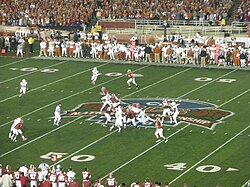
Performance and Records
The BCS era saw the rise of several college football dynasties. The SEC dominated the period, while individual players left an indelible mark on the game. Vince Young's performance for Texas against USC in 2006 remains one of the most storied, with Young accounting for 467 yards of total offense.
While many Heisman Trophy winners struggled in the title game, others flourished. Jameis Winston (Florida State) and Cam Newton (Auburn) are among the Heisman winners who secured victories in the BCS National Championship.
| Conference | Appearances | Wins | Losses | Win Pct | Key Schools |
|---|---|---|---|---|---|
| SEC | 11 | 9 | 2 | .818 | Alabama, LSU, Florida, Auburn, Tennessee |
| Big 12 | 7 | 2 | 5 | .286 | Oklahoma, Texas, Nebraska |
| ACC | 4 | 2 | 2 | .500 | Florida State |
| Big East | 3 | 1 | 2 | .333 | Miami (FL), Virginia Tech |
| Big Ten | 3 | 1 | 2 | .333 | Ohio State |
| Pac-12 | 3 | 1 | 2 | .333 | USC, Oregon |
| Independent | 1 | 0 | 1 | .000 | Notre Dame |
Controversies and the Shift to Playoffs
Despite its goal of clarity, the BCS was frequently criticized for its selection methodology. The most notable controversy occurred during the 2003 season. The BCS rankings selected the University of Oklahoma over the University of Southern California (USC), despite USC being ranked No. 1 in the AP poll. This resulted in a split national championship, with LSU winning the BCS title and USC winning the AP and football writers' titles.
Other undefeated teams, such as Utah (2004, 2008) and Boise State (2004, 2009), were often excluded in favor of traditional powerhouses. These recurring disputes led to the 2012 decision to implement a four-school playoff format.
This transition led to the creation of the College Football Playoff (CFP), which began with the 2014 season. The CFP replaced the BCS formula with a selection committee and a semifinal round, eventually expanding to a 12-team format starting in 2024.
Frequently Asked Questions
What was the BCS National Championship Game?
It was a defunct college football game operated from 1999 to 2014 that aimed to determine a single national champion by pitting the top two ranked teams against each other.
Why was the BCS system considered controversial?
The system was criticized because its formula sometimes excluded undefeated teams or teams ranked No. 1 in the AP poll, leading to disputed championships and claims of bias toward traditional powerhouses.
Which conference was most successful in the BCS era?
The SEC was the most successful conference, recording 9 wins out of 11 appearances, with Alabama and Florida being particularly dominant.
What replaced the BCS?
The BCS was succeeded by the College Football Playoff (CFP) in 2015, which introduced a playoff bracket starting with four teams, and later expanding to 12 teams in 2024.
Who held the television rights for the BCS games?
The rights were held by ABC from 1999 to 2005, then shared with FOX starting in 2006, and finally held by ESPN from 2011 to 2014.