Bay-capped Wren-spinetail
The Bay-capped wren-spinetail (Spartonoica maluroides) is a distinctive bird belonging to the ovenbird family, Furnariidae. Found across the southern regions of South America, this species is highly specialized for life in wetland environments, where it blends into the reeds and sedges of its native habitat.
Unlike many of its relatives, the bay-capped wren-spinetail is the sole member of its genus, Spartonoica. While it was historically grouped with other genera such as Synallaxis and Asthenes, modern genetic research has clarified its lineage, revealing it as a sister species to the cachalotes of the genus Pseudoseisura.
Key Facts
- Scientific Name: Spartonoica maluroides
- Conservation Status: Least Concern (IUCN 3.1)
- Primary Habitat: Freshwater, brackish, and saltwater marshes.
- Distribution: Argentina, Brazil, Paraguay, and Uruguay.
- Diet: Invertebrates, primarily insects and spiders.
- Unique Feature: Builds an open-cup nest, which is unique among furnariids.
Physical Description
The bay-capped wren-spinetail is a small bird, measuring between 13 and 14.5 cm (5.1 to 5.7 in) in length and weighing approximately 10.5 g (0.37 oz). Both males and females share the same plumage, making them indistinguishable by sight.
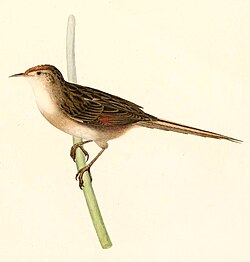
Their appearance is characterized by a sandy brown face with a whitish supercilium (the stripe of feathers above the eye) and a rufous crown. The upperparts range from sandy brown to olive-brown, featuring bold black streaks across the nape and upper back. Their wings are brown with cinnamon accents at the base of the flight feathers, while the graduated tail is mostly brown with black on the central pair of pointed feathers.
The underparts are whitish, with a cinnamon or buff tinge on the flanks, breast, and sides. Their physical details include a dull white, whitish, or pale bluish iris, a blackish maxilla (upper beak), and a mandible (lower beak) that ranges from whitish to pinkish with a dark tip. Their legs and feet are light tan.
Distribution and Habitat
This species is distributed from extreme southern Brazil, moving south through Uruguay and into northern Argentina, reaching as far south as the Río Negro Province. It has also been recorded as a non-breeder in Paraguay.
The bay-capped wren-spinetail is strictly tied to wetland ecosystems. It inhabits reedbeds and sedges within freshwater, brackish, and saltwater marshes, ranging from sea level up to elevations of approximately 900 m (3,000 ft).
Behavior and Ecology
Movement and Feeding
While the species is primarily resident, some movement occurs, as evidenced by sightings in Paraguay during the non-breeding season. When foraging, the bay-capped wren-spinetail typically works alone, gleaning insects and spiders from marsh grasses and sedges. Interestingly, pairs that nest in salt marshes have been observed preferentially feeding in freshwater marshes.
Breeding and Nesting
In Argentina, the breeding season occurs between September and February. The species is monogamous, with both parents sharing the responsibilities of building the nest, incubating eggs, and feeding the young.
The nest is an open cup constructed from grass and twigs, placed low to the ground deep within marsh vegetation. This open-cup design is unique within the ovenbird family. A typical clutch consists of two to four eggs, with an incubation period of about 13 days. Fledging generally occurs 11 to 14 days after hatching.
Vocalization
The primary song of the bay-capped wren-spinetail is described as a long, tuneless, grasshopper-like buzz that rises and falls. The bird also utilizes other vocalizations, though their specific purposes remain undefined.
Conservation Status
The IUCN revised the status of the bay-capped wren-spinetail from Near Threatened to Least Concern in 2022. Despite its large range, the population size is unknown and believed to be decreasing.
The species faces several environmental threats due to its reliance on specific wetland habitats. These include:
- Marsh drainage and the drying effects caused by Eucalyptus and Pinus plantations.
- Overgrazing of grasslands by cattle.
- The establishment of wind farms.
Summary Table
| Feature | Details |
|---|---|
| Average Length | 13 – 14.5 cm |
| Average Weight | 10.5 g |
| Diet | Insects and spiders |
| Clutch Size | 2 – 4 eggs |
| Incubation Period | ~13 days |
| IUCN Status | Least Concern |
Frequently Asked Questions
What makes the bay-capped wren-spinetail's nest unique?
Unlike other members of the furnariid (ovenbird) family, the bay-capped wren-spinetail builds an open-cup nest made of twigs and grass.
Where can the bay-capped wren-spinetail be found?
It is found in Argentina, Brazil, Uruguay, and occasionally in Paraguay, specifically in freshwater, brackish, and saltwater marshes.
What do bay-capped wren-spinetails eat?
They primarily feed on invertebrates, specifically insects and spiders, which they glean from sedges and marsh grasses.
What are the main threats to this species?
The primary threats include the drainage of marshes, the drying effects of commercial pine and eucalyptus plantations, cattle overgrazing, and the construction of wind farms.
How does the bay-capped wren-spinetail sound?
Its main song is a long, tuneless buzz that resembles the sound of a grasshopper, characterized by a rising and falling cadence.