Barley: A Global Staple of History and Nutrition
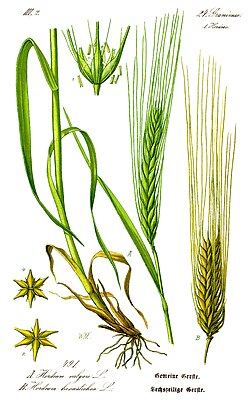
Barley (Hordeum vulgare) is one of the world's most versatile and historically significant cereal grains. Ranking fourth among grains in global production quantity, it follows only maize, rice, and wheat. While widely recognized as a primary ingredient in beer and whisky, barley serves a dual purpose in the global economy: approximately 70% of its production is utilized as animal feed, while the remaining 30% is used for human consumption and the production of fermentable materials.
From its origins in the Fertile Crescent to its role in modern agriculture, barley has remained a cornerstone of human civilization, appearing in everything from ancient Egyptian tomb offerings to contemporary health foods.
![The Barley Barn at Cressing, Essex, built around 1220; its name means "barley barley-store".[3]](/images/70/a7/70a7feae5491bdd53194779c24bd13aa94626375c8db8d384d5b2b4530c31a8c.jpg)
Key Facts
- Global Rank: 4th most produced grain worldwide (146 million tonnes in 2023).
- Primary Uses: 70% animal feed, 30% human food and beverage (beer, whisky).
- Origins: Domesticated around 9,000 BC in the Fertile Crescent and Tibet.
- Genetics: Genome consists of seven pairs of nuclear chromosomes totaling 5,000 Mbp.
- Nutritional Strength: Rich in dietary fiber, niacin, iron, and manganese.
Origins and Domestication
Barley was among the first grains domesticated by humans. Its journey began in the Fertile Crescent—a region of Western Asia characterized by abundant water—around 9,000 BC. However, genetic research indicates that Tibet served as an additional center of domestication.
The earliest evidence of wild barley (H. vulgare ssp. spontaneum) consumption dates back to approximately 23,000 BC at Ohalo II, near the Sea of Galilee, where starch traces were found on ancient grinding stones. True domestication—the creation of cultivars that require human assistance to reproduce—emerged in Mesopotamia, specifically the Jarmo region of modern-day Iraq, between 9,000 and 7,000 BC.
Global Spread and Cultural Impact
By 2,000 BC, barley had spread across Eurasia. It reached Eastern Finland by 4200 BC and was cultivated on the Korean Peninsula by 1500–850 BC. In ancient India, it is cited as a principal grain in the Rigveda and was a staple of the Harappan civilization.
Beyond nutrition, barley held deep cultural and economic value. In ancient Mesopotamia, it was used as currency, and a stalk of barley served as the primary symbol for the goddess Shala. In English folklore, the grain is personified as "John Barleycorn," reflecting its vital role in the production of alcoholic beverages.
![Genetic analysis on the spread of barley from 9,000 to 2,000 BC[16]](/images/94/3e/943e023ca41e921dbb2dac94537e02fc470533dd011cb731cf3e975415d865fa.jpg)

Botanical and Genetic Profile
The barley genome was fully sequenced in 2012, revealing a structure of seven pairs of nuclear chromosomes (1H through 7H), one mitochondrial chromosome, and one chloroplast chromosome.
Varieties of Barley
Barley is primarily categorized by the arrangement of its grains on the ear:
- Two-row barley: Typically preferred for malting.
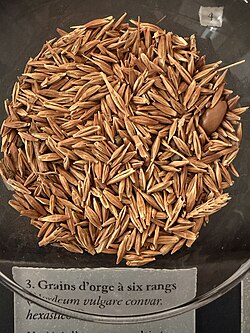
- Six-row barley: Characterized by having three fertile spikelets per cluster, often used for feed or specific brewing styles.
- Hulless barley: A variety where the outer husk is absent or easily removed.
Global Production and Cultivation
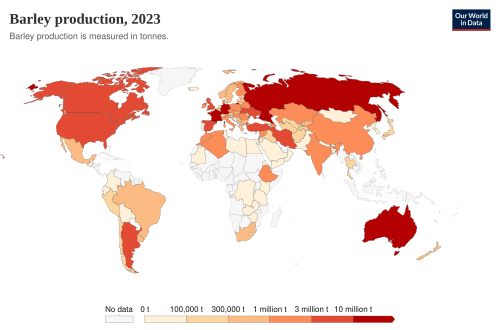
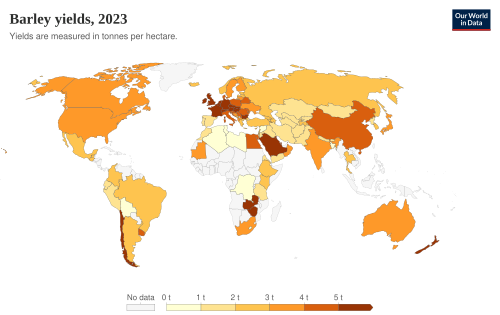
In 2023, global barley production reached 146 million tonnes. While it trails behind the "big three" grains, it remains essential for livestock and brewing industries.
| Country | Production (Million Tonnes) |
|---|---|
| Russia | 16.7 |
| Australia | 13.3 |
| Germany | 10.6 |
| France | 9.7 |
| Turkey | 8.1 |
| Canada | 8.1 |
| World Total | 142.0 - 146.0 |
Cultivation involves managing various pests and diseases, most notably barley rust, a fungal infection caused by Puccinia hordei. Modern harvesting is typically performed using combine harvesters, though traditional hand-harvesting with scythes was common in previous centuries.
Nutrition and Culinary Uses
Cooked barley is composed of 69% water, 28% carbohydrates, 2% protein, and 0.4% fat. It is highly valued for its dietary fiber and essential micronutrients.
Nutritional Value (per 100g cooked)
- Energy: 123 kcal (515 kJ)
- Niacin: 14% of Daily Value (DV)
- Manganese: 12% DV
- Iron: 10% DV
Culinary applications vary by culture, including Mugimeshi (Japanese steamed barley rice), Keşkek (Middle Eastern stew), and traditional barley breads. In the beverage industry, barley is processed into malt—a traditional method of germination and drying—to provide the fermentable sugars necessary for beer and whisky.
Frequently Asked Questions
What is the difference between two-row and six-row barley?
The primary difference lies in the number of fertile spikelets per cluster. Six-row barley has three fertile spikelets per cluster, whereas two-row barley has fewer, which often affects its use in malting and brewing.
How is barley used in the beverage industry?
Barley is converted into malt through a process of soaking and drying. This malt provides the fermentable sugars that yeast converts into alcohol for the production of beer and distilled spirits like whisky.
Where did barley originate?
Barley was first domesticated in the Fertile Crescent of Western Asia around 9,000 BC, with additional evidence suggesting Tibet was also a center of domestication.
Is barley used for more than just food and drink?
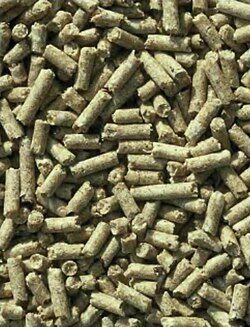
Yes, a significant majority (70%) of global barley production is used as animal feed, often processed into pellets for livestock.
What are the main health benefits of barley?
Barley is a rich source of dietary fiber and essential minerals such as manganese and iron, and it provides a significant amount of the B vitamin niacin.