Balboa: The Historic Administrative Heart of the Panama Canal
Founded by the United States during the monumental construction of the Panama Canal, the town of Balboa stands as a testament to the engineering and administrative efforts of the early 20th century. Named after Vasco Núñez de Balboa—the Spanish conquistador credited with discovering the Pacific Ocean—the town's name was suggested to the Canal Zone authorities by the Peruvian ambassador to Panama.
Before its development, the hilly region north of Panama City consisted primarily of unused marshlands and a few subsistence ranches. To make the land habitable and functional, the United States Army Corps of Engineers undertook a massive project to drain, fill, and level the terrain.
Key Facts
- Naming: Named after explorer Vasco Núñez de Balboa via a suggestion from the Peruvian ambassador.
- Infrastructure: Developed from marshland by the U.S. Army Corps of Engineers.
- Administrative Role: Served as the administrative center of the Canal Zone until December 31, 1999.
- Governance: Transitioned from U.S. control to the Panamanian government under the Torrijos-Carter Treaties.
- Key Landmark: Home to the Panama Canal Administration Building featuring murals by William B. Van Ingen.
Life in the Canal Zone
As a primary hub, Balboa was equipped with a comprehensive array of facilities operated by the Canal Zone Government. Residents had access to essential services including post offices, police and fire stations, commissaries, and cafeterias. For leisure and culture, the town provided a movie theater, a bowling alley, a service center, and various other recreational facilities and company stores.
Education was a priority in the community, with several institutions serving the area, including Balboa Elementary School, Balboa High School, and the private St. Mary's School.
The social fabric of Balboa was further enriched by a variety of private and civic organizations. These included two private banks, a credit union, a Jewish Welfare Board, and churches of several Christian denominations. Civic life flourished through the Masonic Lodge, the Elks Club, the Knights of Columbus, and a YMCA.
The town also featured several historic monuments, including a miniature Statue of Liberty donated by the Boy Scouts of America.
The Transition of Sovereignty
For decades, Balboa functioned as the administrative center of the Canal Zone, which was a solely U.S. territory. This status changed in 1979 following the Panama Canal Treaties, which abolished the territory's status as a U.S. entity.
The final transition occurred at midday on December 31, 1999. Under the terms of the Torrijos-Carter Treaties, the Panama Canal, along with all its associated assets and territories, were fully returned to the government of Panama.
Architectural and Strategic Landmarks
The Panama Canal Administration Building
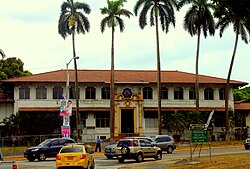
Located in Balboa Heights, the Panama Canal Administration Building once served as the seat of the Panama Canal Company and the Canal Zone Government. Today, it remains the primary headquarters for the Panama Canal Authority (formerly the Panama Canal Commission), the agency responsible for the canal's operation. The building is notable for its large murals painted by William B. Van Ingen, which visually document the construction of the canal.
Balboa Naval Communications Station
Strategic communication was established early in the town's history. A United States Navy very-low-frequency (VLF) communications station, known by the callsign NBA, began service around 1908. By 1913, the addition of a radio naval transmission station enabled the Navy to communicate with ships and eventually transmit critical orders to submerged submarines.
Balboa Summary Overview
| Category | Details |
|---|---|
| Founder | United States |
| Primary Purpose | Administrative center for the Panama Canal Zone |
| Key Engineering Body | U.S. Army Corps of Engineers |
| Transfer Date | December 31, 1999 |
| Current Authority | Panama Canal Authority |
Frequently Asked Questions
Who was the town of Balboa named after?
The town was named after Vasco Núñez de Balboa, the Spanish conquistador who is credited with discovering the Pacific Ocean. The name was suggested by the Peruvian ambassador to Panama.
What happened to Balboa on December 31, 1999?
On this date, according to the Torrijos-Carter Treaties, the Panama Canal and all its territories and assets, including Balboa, were fully returned to the Panamanian government.
What is the significance of the Panama Canal Administration Building?
It was the former seat of the Canal Zone Government and currently serves as the main administration building for the Panama Canal Authority. It also houses historic murals by William B. Van Ingen.
What was the purpose of the Balboa Naval Communications Station?
Starting around 1908, it provided very-low-frequency communications. By 1913, it could transmit messages to ships and send orders to submerged submarines.
Which schools were located in Balboa?
The area was served by Balboa Elementary School, Balboa High School, and the private St. Mary's School.