Baden Wine Region: Germany's Warmest Viticultural Landscape
Stretching along the eastern bank of the Rhine river, Baden stands as the longest wine region in Germany. Spanning approximately 400 km (250 miles), this expansive territory reaches from the border of Franken in the north down to the shores of Lake Constance in the south. Because of its unique geography, Baden offers a distinct profile of wines that differ significantly from those found in other German regions.
The Geography of Warmth
The region is primarily situated within the Rhine rift, a geological valley protected by the Black Forest and the Vosges mountains to the west. This natural shielding creates a microclimate that makes Baden the warmest location for viticulture in Germany. Consequently, the wines produced here tend to be more full-bodied and possess higher alcohol content than those from cooler German regions.
This climatic advantage is so pronounced that Baden is the only German wine region classified under European Union wine growing zone B, whereas other German regions fall into zone A. Directly across the Rhine to the west lies the renowned Alsace region of France.
The Nine Districts of Baden
Due to its immense north-south length, Baden is divided into nine distinct districts, known as Bereiche. This is the highest number of districts of any German wine region, reflecting the diverse terroir found across the landscape.
Northern and Central Districts
- Tauberfranken: Located on the northeastern outskirts and neighboring Franconia. Its wines mirror the style of Franconia and are traditionally sold in the round Bocksbeutel bottle.
- Badische Bergstrasse: Centered around the city of Heidelberg, these vineyards serve as a continuation of the Hessische Bergstrasse region.
- Kraichgau: Situated south of Badische Bergstrasse and northeast of Karlsruhe.
- Ortenau: Extending from Baden-Baden to just south of Offenburg, this is one of the region's most recognized districts.
Southern and Volcanic Districts
As the region moves south, the climate and soil composition shift, leading to some of the most prestigious wine-growing areas in the country.
- Breisgau: Located between Offenburg and Freiburg, this area boasts the highest average temperatures and the most sunshine hours in the region.
- Kaiserstuhl: A cluster of volcanic hills northwest of Freiburg. Known for its characteristic terraced vineyards, Kaiserstuhl produces powerful wines and is perhaps the most famous district in Baden.
- Tuniberg: Situated on flatter land south of Kaiserstuhl and west of Freiburg, producing wines with a lighter style.
- Markgräflerland: Stretching from Freiburg to the Swiss border at Basel, this area is celebrated for its easy-drinking Gutedel (Chasselas) wines.
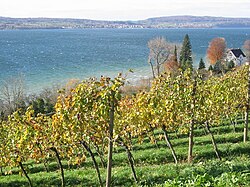
- Bodensee: Located on the northwestern shores of Lake Constance (known as Bodensee in German) in the southeastern outskirts of the region.
Key Facts
- Total Length: Approximately 400 km (250 miles).
- Climate Status: Germany's warmest wine-growing location.
- EU Classification: The only German region in wine growing zone B.
- Administrative Division: Divided into nine districts (Bereiche).
- Geographic Shielding: Protected by the Black Forest and Vosges mountains.
Regional Summary Table
| District (Bereich) | Key Characteristic | Notable Feature |
|---|---|---|
| Tauberfranken | Franconian style | Bocksbeutel bottles |
| Badische Bergstrasse | Heidelberg area | Continuation of Hessische Bergstrasse |
| Kaiserstuhl | Powerful wines | Volcanic hills and terraces |
| Breisgau | High sunshine | Highest average temperatures |
| Markgräflerland | Easy-drinking | Specializes in Gutedel (Chasselas) |
| Bodensee | Lakeside terroir | Northwestern shores of Lake Constance |
Frequently Asked Questions
Why are Baden wines typically more full-bodied than other German wines?
Baden is Germany's warmest wine region because it is situated in the Rhine rift and protected by the Black Forest and Vosges mountains. This warmth leads to higher alcohol levels and a more full-bodied style.
What is unique about Baden's EU wine zone classification?
Baden is the only German wine region situated in European Union wine growing zone B; all other German regions are located in zone A.
Which district is considered the most famous in Baden?
The Kaiserstuhl district is likely the best-known, characterized by its volcanic hills, terraced vineyards, and powerful wines.
What is Gutedel and where is it primarily produced in Baden?
Gutedel, also known as Chasselas, is a grape variety used to produce easy-drinking wines, primarily found in the Markgräflerland district.
How many districts make up the Baden region?
Baden is divided into nine districts (Bereiche), which is more than any other wine region in Germany.