Azalea and the U.S. Lighthouse Service (1891–1917)
On June 25, 1891, the vessel Azalea arrived at Little Harbor in Woods Hole, marking the beginning of her tenure at her new home port. Operating during a transformative era of American maritime safety, Azalea served as a vital link in the U.S. Lighthouse Service, ensuring that the beacons and markers guiding sailors remained operational despite the harsh conditions of the Atlantic coast.
The Evolution of the Lighthouse Service
When Azalea first entered service, the U.S. Lighthouse Service was managed by the U.S. Lighthouse Board under the Department of the Treasury. This organization functioned with a quasi-military structure. Each Lighthouse District was managed by two key figures: an Inspector (usually a U.S. Navy officer) and an Engineer (typically from the Army Corps of Engineers). The Inspector oversaw the placement and maintenance of lightships and buoys, while the Engineer handled the construction of lighthouses and other civil engineering projects. Azalea was assigned to the District Inspector of the 2nd Lighthouse District.
Administrative shifts occurred over the following two decades. In 1903, the Lighthouse Board moved to the U.S. Department of Commerce and Labor. By 1910, Congress abolished the Board entirely, replacing it with an all-civilian bureau. This transition streamlined operations; the separate roles of Inspector and Engineer were merged into a single District Supervisor, and civilian personnel replaced military officers.
Core Missions: Buoys and Supplies
One of Azalea's primary responsibilities was the maintenance of buoys. These markers are frequently displaced by storms and ice, damaged by passing ships, or degraded by rust and weather. The workload was immense; in 1895 alone, Azalea replaced or changed 230 buoys and painted 75.
Winter weather added a layer of complexity to these chores. To prevent heavy iron buoys—such as nuns, cans, and bell buoys—from being sunk or damaged by New England sea ice, Azalea replaced them with wooden spar buoys every autumn. This process was reversed every spring. Additionally, Azalea placed temporary buoys around shipwrecks to warn other vessels while salvage preparations were made.
Beyond markers, Azalea served as a lifeline for lighthouses and lightships that were inaccessible by land. She delivered essential supplies, including food, water, lamp oil, wood, and coal—transporting 453 tons of coal in 1895. She also transported crews and keepers. Because transferring men and supplies via small boats in the open ocean was dangerous, the Lighthouse Service began rotating lightships ashore for provisioning in 1907, reducing the risks associated with these transfers.
Towing and Lightship Management
Many lightships of the era lacked self-propulsion and relied on tenders like Azalea for movement. This included short trips for maintenance, such as towing Light Vessel No. 5 (Cross Rip Lightship) to New Bedford in 1893, and long-distance redeployments. In the fall of 1892, Azalea towed Light Vessel No. 1 from the Nantucket Shoals station all the way to Charleston, South Carolina.
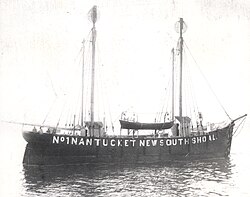
Azalea also acted as a recovery vessel. When gales pushed lightships off course, such as when Light Vessel No. 47 (Pollock Rip lightship) dragged its anchor a mile during a November 1895 storm, Azalea was responsible for returning the vessel to its correct station.
Notable Events and Legal Battles
Azalea's service included high-profile assignments, such as participating in the naval review on the Hudson River for the dedication of Grant's Tomb in New York City on April 27, 1897. During this trip, she also replenished her stock of buoys and chain from the Staten Island general lighthouse depot.
However, her career was not without incident. On October 2, 1899, Azalea collided with the schooner William H. Davenport near Old Saybrook, Connecticut. The collision damaged Azalea's bow, requiring repairs in East Boston that cost $4,261. The resulting legal dispute between the United States and the owner of the schooner reached the U.S. Supreme Court in 1902. Eventually, in 1920, Congress appropriated $2,759.20 to pay for the damages to the William H. Davenport.
Maritime Rescues and the First Wireless Distress Call
Due to her towing equipment and experienced crew, Azalea was often the only government vessel capable of braving severe weather to rescue ships in distress. Her successful rescues include:
- The William Slater (1898): Towed the disabled schooner to Hyannis during a gale.
- The Guardian (1901): Rescued the crew after the schooner wrecked on Pollock Rip.
- The Sally E. Ludlam (1902) and Chester B. Lawrence (1907): Towed these disabled schooners to Vineyard Haven and Hyannis, respectively.
- The Mary Farrow (1910): Rescued a three-man crew after they abandoned their sinking ship.
- The Rescue (1911): Towed the grounded schooner off mud flats near Hyannis.
- The Sadie Ross (1916): Towed the disabled tug and its barge to port.
The most historic rescue occurred on December 10, 1905. Light Vessel 58, which was testing a Marconi radio, sprang a leak that overwhelmed its bilge pumps. The crew sent a wireless message: "Nantucket Shoals Lightship in distress. Send help from anywhere." This was the first distress message ever sent by wireless by an American ship.
Azalea responded from New Bedford, arriving to find the boiler fires extinguished and the crew bailing by hand. Despite high seas, Azalea successfully transferred all 12 crew members before the lightship sank. This rescue earned Captain Charles I. Gibbs a pay increase after the event caught the attention of Admiral Dewey.
Key Facts
- Home Port: Little Harbor, Woods Hole, Massachusetts.
- Primary Duties: Buoy maintenance, supplying inaccessible lighthouses, and towing lightships.
- Historical Milestone: Responded to the first wireless distress signal sent by an American ship in 1905.
- Operational Scale: In 1895, she handled 230 buoys and delivered 453 tons of coal.
- Administrative Shift: Transitioned from a military-led Board (Treasury/Commerce) to a civilian-led bureau by 1910.
| Role | Key Activities | Example/Metric |
|---|---|---|
| Buoy Tender | Replacing, painting, and seasonal swapping of buoys | 230 buoys replaced in 1895 |
| Supply Vessel | Delivering coal, oil, food, and water to remote stations | 453 tons of coal delivered in 1895 |
| Tug/Tender | Moving lightships to stations or for maintenance | Towed LV No. 1 to South Carolina (1892) |
| Rescue Vessel | Towing disabled ships and saving crews in distress | Rescued 12 men from LV 58 (1905) |
Frequently Asked Questions
What was the difference between the Lighthouse Board and the civilian bureau?
The Lighthouse Board was a quasi-military organization where Navy and Army officers (Inspectors and Engineers) managed districts. The civilian bureau, established in 1910, replaced these military roles with a single civilian District Supervisor.
Why did Azalea replace metal buoys with wooden spar buoys in the fall?
Winter sea ice along the New England coast could damage or sink large iron buoys (such as cans and nuns). Wooden spar buoys were used as a seasonal alternative to withstand the ice.
What was the significance of the rescue of Light Vessel 58?
The rescue is historically significant because it was triggered by the first wireless distress message ever sent by an American ship, utilizing a Marconi radio.
How did Azalea support lighthouses that were inaccessible by land?
Azalea delivered essential materials such as coal, wood, lamp oil, food, and water from the sea, and she also transported the rotation of keepers and crews.
What legal issue did Azalea's operators face after the collision with the William H. Davenport?
The collision led to a lengthy legal battle between the United States and the owner of the schooner, which eventually reached the United States Supreme Court in 1902.