Ayyubid Sultanate: The Legacy of Saladin and the Kurdish Dynasty
The Ayyubid dynasty (al-Ayyūbīyūn) was a powerful Sunni Muslim state of Kurdish origin that reshaped the political and religious landscape of the medieval Near East. Established in 1171 by the legendary leader Saladin, the sultanate emerged from the collapse of the Fatimid Caliphate and grew into a vast confederation of principalities spanning Egypt, Syria, and beyond.
At its peak, the Ayyubid realm served as the primary bulwark against the Crusader states, blending military prowess with a commitment to Sunni orthodoxy. While the dynasty eventually succumbed to internal division and external invasions, its influence on Islamic architecture, governance, and the eventual rise of the Mamluks remains profound.
![Late 19th-century sketch of the "Eagle of Saladin" on the walls of the Cairo Citadel, Egypt. It was historically described as having two heads, now missing. It is commonly identified as Saladin's emblem, though historical sources do not confirm this.[19]](/images/9e/a9/9ea914af156fd22da406b623ef08f6d3d610f5138feed844202966f67ad7e033.png)
Key Facts
![Fatimid or Ayyubid dynasty battle scene, Fustat, Cairo, Egypt, 12–13th century.[39][40][41]](/images/a1/f8/a1f89a8284784dcdc792288da46693ca15809af6101568e5ad7ebd0e07d7014c.jpg)
- Founder: Saladin (Salah ad-Din), who abolished the Fatimid Caliphate in 1171.
- Origin: Kurdish ethnicity, following the Sunni Islamic faith (Shafi'i school and Ash'ari creed).
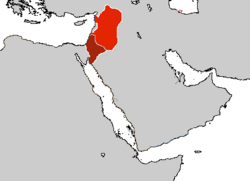
- Peak Territory: Approximately 1.7 to 2 million square kilometers, including Egypt, Syria, Hejaz, Yemen, and Upper Mesopotamia.
- Major Victory: The Battle of Hattin (1187), which led to the recapture of Jerusalem.
- Successor: The Mamluk Sultanate, which rose to power after overthrowing the last Ayyubid rulers in Egypt.
The Rise of Saladin and the Establishment of the State
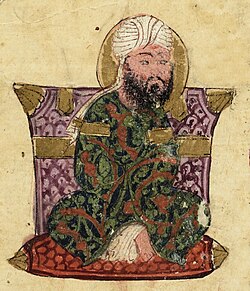
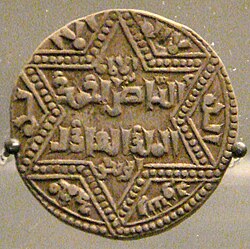
The Ayyubid state began not as a conquest, but as a political transition. Saladin originally served Nur al-Din, the Zengid ruler, leading armies against the Crusaders in Egypt. After being appointed vizier in Fatimid Egypt, Saladin abolished the Fatimid Caliphate in 1171. By 1174, following the death of Nur al-Din, the Abbasid Caliphate proclaimed Saladin as the first Sultan of Egypt.
![A dirham in the name of Saladin, dated 587 AH (1190/91 CE). Saladin is shown wearing the Seljuk Turk sharbush hat, his rallying sign.[30][31] Legend "The Victorious King, Righteousness of the World and the Faith, Yusuf ibn Ayyub".[30][32]](/images/56/d4/56d4147597a658ef6f0cdea8f2167959c4dc562b4a829cc80a7abd00bf908448.jpg)
Saladin's early reign was marked by rapid expansion. He extended his influence across most of Syria, the Hejaz, Yemen, northern Nubia, and Tripolitania. This expansion was not without challenge; in 1174–75, al-Adil (Saladin's brother) had to crush revolts in Aswan and Qus aimed at restoring Fatimid rule.
![Ayyubid expansion 1174–1193, including the campaigns of Saladin, Qaranqush and Turan-Shah.[44]](/images/b4/9e/b49ed9e18cc3b41e4989383ab0a33460333ab1002e244652565b68b6eb32fb75.png)
Conflict with the Crusader States
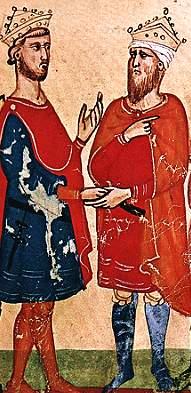
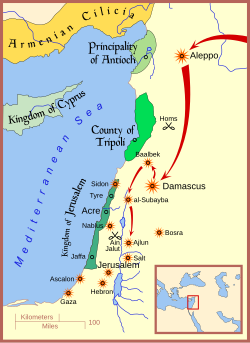
The defining struggle of the Ayyubid era was the conflict with the Latin Kingdom of Jerusalem. While Saladin suffered a significant defeat at the Battle of Montgisard in 1177, he remained persistent. He secured victories at the Battle of Marj Ayyun (1179) and the Battle of Jacob's Ford (1180).
The turning point occurred in 1187 at the Battle of Hattin. This decisive victory allowed the Ayyubids to seize virtually the entire Crusader kingdom in the Levant, including Jerusalem, with the exception of Tyre. This triumph triggered the Third Crusade, which saw the Crusaders attempt to reclaim the Nile Delta, eventually capturing the fortress of Damietta in 1218.
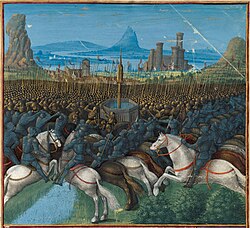
Governance and the Ayyubid Confederation
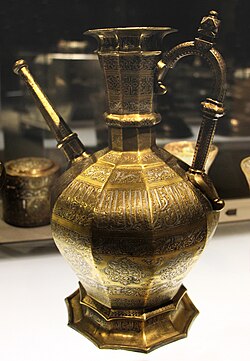
![Basin of Ayubbid Sultan Al-Adil II, Syria, 1238–1240, combat scene.[103]](/images/4b/9e/4b9efebf8f263c7c09288b8b5e9f92d6dfbcfc6e126fd2118fd0da6a3bfb50bd.jpg)
The Ayyubid state operated as a princely confederation. While Cairo served as the economic heart, the seat of government shifted between Cairo, Damascus, and Aleppo depending on the strategic needs of the Sultan. Damascus, in particular, was favored for its proximity to the Crusader frontiers.
The dynasty utilized the Iqta' system, a method of granting land revenues to military officers in exchange for service. This system helped maintain a professional army but also created powerful local emirs who occasionally challenged the central authority of the Sultan.
Art, Science, and Architecture
![Basin made for Ayyubid Sultan As-Salih Ayyub, Damascus, Syria, 1247–1249. Brass inlaid with silver. Freer Gallery of Art.[111]](/images/e0/6f/e06f9da8f751df876b3e499a15bf063748c580773a42c547c1d43114bab77afe.jpg)
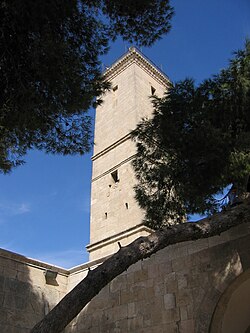
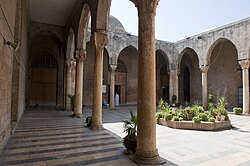
The Ayyubids were prolific builders and patrons of the arts. They are credited with introducing multi-purpose funerary complexes in Cairo, which combined a founder's mausoleum with a madrasa (religious school) and charitable facilities. A prime example is the Madrasa al-Salihiyya, founded by Sultan al-Salih Ayyub in 1242.
![The minaret and part of the façade of the Madrasa of al-Salih Ayyub in Cairo, built in 1242. The decorative niches on the façade reflect an earlier Fatimid style,[187] but the overall form shows an evolution towards later Cairene minarets.[181]](/images/8c/1b/8c1b815055a364d5c85d0760b4886637187181b15b9e230687c614e7c465689e.jpg)
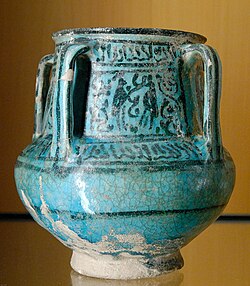
Ayyubid craftsmanship excelled in inlaid metalwork, particularly brass inlaid with silver, and high-quality pottery. Their military engineering was also advanced, as evidenced by the use of counterweight trebuchets in siege warfare.
![Arabic trebuchet, with its counterweight, in the Tabṣira by Murḍi Ibn cālī Ibn Murḍi al-Ṭarsūsī written for Saladin, late Fāṭimid or early Ayyūbid Egypt, c.1170 CE (Ms. Hunt.264, f.117, Bodleian Library, Oxford, UK).[54] This is the only manuscript directly attributable to the Ayyubids, although early manuscripts such as the Kalīla wa-Dimna (BNF Arabe 3465) are also generally considered as Ayyubid.[55]](/images/33/1e/331ecc223dba4797de40ae8384845760afb105a149ad033afe8dba8aca1796a7.jpg)
Summary of the Ayyubid Sultanate
| Category | Details |
|---|---|
| Official Religion | Sunni Islam (Shafi'i/Ash'ari) |
| Capitals | Cairo, Damascus, Aleppo |
| Peak Population | ~7.2 million (12th century estimate) |
| Currency | Dinar and Dirham |
| Key Military Event | Battle of Hattin (1187) |
The Decline and Fall of the Dynasty
![Horseman playing Polo (detail). Damascus, Syria, 1247–1249. Brass inlaid with silver. Freer Gallery of Art.[111]](/images/82/05/82050514d069a1c5cf0db443667a5b6c984614878104bfe7e7bc97575c7c73fc.jpg)
Following Saladin's death in 1193, the empire faced internal strife as his sons contested control. Although Sultan as-Salih Ayyub briefly restored unity by 1247, the realm was fragile. Local dynasties in Yemen and the Hejaz had already declared independence.
The final blow came from within and without. In Egypt, the Mamluks (elite slave-soldiers) seized power after the death of as-Salih Ayyub and the overthrow of his son, al-Mu'azzam Turanshah. Simultaneously, the Mongol invasions swept through the east, sacking Aleppo in 1260 and ending Ayyubid rule in Syria.
A small remnant of the dynasty survived in the principality of Hama under Mamluk patronage until 1341, when the last Ayyubid ruler was finally deposed.
Frequently Asked Questions
![The Governor of al-Rahba. Ayyubid period. Maqamat of al-Hariri, Baghdad (1237). The red beard denotes foreigness.[137]](/images/d6/8d/d68d6430eb36620fbcde9ea9c4b00f3d955fef06a6888e87f25667c9846b94dc.jpg)
![Miniatures from a Coptic Gospel (BNF Copte 13), Damietta, Egypt, Ayyubid period, 1179–80.[161]](/images/cf/29/cf2993b2f8ebc7600ff2cc8e739aa953bfde9af04a860b9f4db3fbfa1293b1ef.jpg)
![The 12th-century Ayyubid wall of Cairo, as seen from present-day al-Azhar Park. This wall was part of an ambitious fortification project begun by Saladin in 1176 that also included the construction of the Cairo Citadel.[179]](/images/74/ca/74ca1d486dce5cb65dea4b99be160aae32dbd4df4023d63ecb91d2d16fc898fa.jpg)
Who founded the Ayyubid Sultanate?
The sultanate was founded by Saladin (Salah ad-Din) in 1171 after he abolished the Fatimid Caliphate in Egypt.
What was the significance of the Battle of Hattin?
The Battle of Hattin in 1187 was a decisive Ayyubid victory that led to the collapse of most Crusader states in the Levant and the recapture of Jerusalem.
What was the ethnic origin of the Ayyubids?
The Ayyubid dynasty was of Kurdish origin.
How did the Ayyubid dynasty end?
The dynasty fell due to a combination of internal coups by Mamluk generals in Egypt and the Mongol conquest of Syria in 1260.
What is the Ayyubid contribution to architecture?
They developed the first multi-purpose funerary complexes in Cairo, combining mausoleums with madrasas and charitable institutions, a style later adopted by the Mamluks.