Aviation and Air Defence Command of Georgia
The Aviation and Air Defence Command (Georgian: თავდაცვის ძალების ავიაციისა და საჰაერო თავდაცვის სარდლობა) is the specialized aerial warfare branch of the Georgian Defence Forces. Tasked with safeguarding the nation's skies and providing critical support to land and sea operations, this command manages a diverse fleet of aircraft, helicopters, and unmanned aerial vehicles (UAVs) to ensure national sovereignty.
Key Facts
- Founded: 1992
- Personnel: 2,971 members
- Total Aircraft: 70
- Headquarters: Alekseevka, Tbilisi
- Primary Airfields: Vaziani and Marneuli
- Key Roles: Aerial warfare, air defense, and reconnaissance
Evolution and History
The origins of Georgia's aerial capabilities date back to January 1, 1992, with the establishment of the Georgian Air Force and Air Defense Division. By August 18, 1998, these divisions were unified into a single joint command structure known as the Georgian Air Force.
A pivotal moment in the command's history occurred on September 19, 1992, when Izani Tsertsvadze and Valeri Nakopia conducted the first combat flight during the separatist war in Abkhazia. This date is now commemorated annually as Georgian Air Force Day.
The organizational structure has shifted over the decades. In 2010, the Air Force was abolished as a separate branch and integrated into the Georgian Land Forces as Air and Air Defense sections. However, as part of broader military reforms, it was re-established as a separate command of the Defence Forces in 2016.
Following a period between 2016 and 2020 where fixed-wing aircraft remained abandoned, the command underwent a modernization phase under Minister of Defense Irakli Garibashvili. This initiative focused on re-servicing existing aircraft and acquiring strike drones to enhance combat readiness.
Mission and Strategic Objectives
The Aviation and Air Defence Command operates with a multifaceted mandate designed to protect Georgia's territorial integrity. Its primary objectives include:
- Maintaining warfare and mobilization readiness across all sub-units.
- Controlling Georgian airspace and protecting state entities and troops from air threats.
- Combating air terrorism and supporting anti-terrorism efforts on land and sea.
- Destroying enemy land and naval targets while providing air support for friendly forces.
- Participating in collective and multinational military exercises.
To achieve these goals, the command performs several critical functions, including MEDEVAC (Medical Evacuation), search and rescue for downed pilots, troop and cargo transportation, and aerial reconnaissance.
Current Inventory and Capabilities
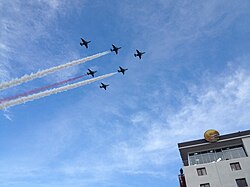
The command utilizes a mix of Soviet-era legacy systems and modern Western and Israeli technology. The attack fleet is centered around the Su-25, which has undergone restoration and modernization.
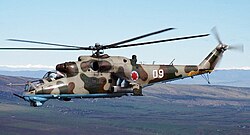
The helicopter fleet provides versatility, ranging from the Mi-24 attack helicopters to utility and search-and-rescue (SAR) platforms like the Eurocopter EC145 and Bell UH-1H.
Georgia has significantly invested in UAV technology, employing the Elbit Hermes 450 for reconnaissance and producing the Warmate and FlyEye drones in collaboration with Poland.
| Category | Primary Models | Origin | Role |
|---|---|---|---|
| Attack Aircraft | Su-25 | Soviet Union | Close Air Support (CAS) |
| Helicopters | Mi-8/171, Mi-24, UH-1H, EC145 | Various | Utility, Attack, SAR |
| UAVs | Hermes 450, Warmate, FlyEye, Aerostar | Israel, Georgia, Poland | Reconnaissance, Kamikaze |
| Transport | An-2, An-28 | Soviet Union | Cargo/Troop Transport |
| Air Defence | Buk-M1, Osa-AKM | Soviet Union | SAM (Medium/Short Range) |
Command Structure and Ranks
The command operates under the leadership of the Ministry of Defense and the Chief of Defense Forces. The current leadership includes Colonel Sergo Ninua as Commander, under the oversight of Maj. Gen. Giorgi Matiashvili (Chief of Defense Forces).
The rank structure follows a traditional military hierarchy. Commissioned officers range from Lieutenant to Army General (Armiis generali), while non-commissioned officers (NCOs) and enlisted personnel range from Private (Rigiti) to Master Sergeant (Mast’er-serzhant’i).
Frequently Asked Questions
When was the Georgian Air Force established?
The Georgian Air Force and Air Defense Division was established on January 1, 1992.
What is the significance of September 19 in Georgia?
September 19 is designated as Georgian Air Force Day, marking the date of the first combat flight conducted by Izani Tsertsvadze and Valeri Nakopia in 1992.
Which UAVs are currently used by the command?
The command utilizes the Elbit Hermes 450, Aerostar, and the Warmate and FlyEye drones (the latter two produced in Georgia and Poland).
Where are the primary airfields located?
The two major airfields are located near Tbilisi at Vaziani and Marneuli.
What surface-to-air missile systems does Georgia operate?
Georgia operates the medium-range 9K37 Buk (Buk-M1) and the short-range 9K33 Osa (Osa-AKM), both of which were formerly Ukrainian vehicles.