Australasia: Defining the Geographical and Cultural Subregion of Oceania
Australasia is a complex geographical subregion of Oceania characterized by ambiguous boundaries. Depending on whether one is speaking from a geopolitical, ecological, or philological perspective, the term can encompass several different but related regions. While the definition varies, it consistently includes Australia and New Zealand, and frequently incorporates New Guinea.
In its most expansive sense, Australasia may extend to include the entire Malay Archipelago, also known as Nusantara, and even parts of insular Asia.
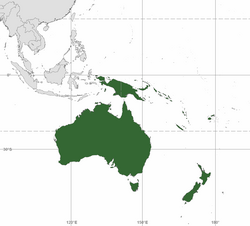
Key Facts
- Core Territories: Always includes Australia and New Zealand.
- Variable Extents: May include New Guinea, Melanesia, and the Malay Archipelago depending on the definition.
- Etymology: Coined by Charles de Brosses in 1756 from Latin, meaning "south of Asia."
- Total Area: Approximately 8,418,763 square kilometers.
- Total Population: Approximately 42,836,966 (as of 2021).
The Evolution of a Term
The term was first introduced in 1756 by Charles de Brosses in his work Histoire des navigations aux terres australes. De Brosses used the French term Australasie to distinguish this region from Polynesia to the east and the southeast Pacific, which he referred to as Magellanica.
Colonial and Geopolitical Contexts
By the late 19th century, the term shifted toward a political meaning, referring to the "Australasian colonies." This specifically designated British colonies south of Asia, including New Zealand and the various Australian colonies: New South Wales, Queensland, South Australia, Tasmania, Western Australia, and Victoria.
In the early 20th century, German geopoliticians viewed Australasia as a strategic counterweight to the former German South Sea Edge (Südseerand), with both areas contributing to the broader "Indo-Pacific" region.
Varying Modern Definitions
Because Australasia is used in different professional and regional contexts, several definitions coexist today:
- Australian Usage: Often includes Australia, New Zealand, New Guinea, and neighboring Pacific islands.
- New Zealand Usage: Frequently limited strictly to Australia and New Zealand.
- North American Dictionaries: Merriam-Webster defines it as Australia, New Zealand, and Melanesia (the subregion of the southwestern Pacific), while the American Heritage Dictionary suggests it can loosely cover all of Oceania.
Cultural and ethnic distinctions further refine these boundaries. For example, New Guinea is categorized as part of Melanesia due to its indigenous Melanesian population, whereas New Zealand is part of Polynesia because of its native Maori population.
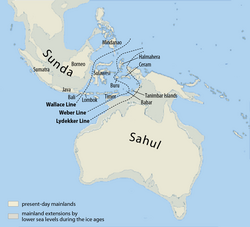
In the broadest conceptual framework, the region can expand even further to include the Malay Peninsula and the Philippines.
![In its broadest concept, it also includes the Philippines and the Malay Peninsula.[1]](/images/94/32/94328041c607afa95e4ec6a0b6f2c59189cd06b7c071b9fcd966aa6ea8766ea9.png)
Regional Demographics
The region comprises a diverse array of sovereign nations and external territories. The following table provides a demographic overview based on 2021 data.
| Region/Country | Area (km²) | Population | Density (per km²) | Capital |
|---|---|---|---|---|
| Australia | 7,686,850 | 25,921,089 | 3.1 | Canberra |
| New Zealand | 268,680 | 5,129,727 | 17.3 | Wellington |
| Papua New Guinea | 462,840 | 9,949,437 | 22 | Port Moresby |
| Indonesian Papua (Total) | 300,000+ | N/a | N/a | Various |
| Other Territories* | ~50,000 | ~5,000 | Variable | Various |
| Total | 8,418,763 | 42,836,966 | 5.1 | N/a |
*Includes Ashmore and Cartier Islands, Christmas Island, Cocos (Keeling) Islands, Coral Sea Islands, and Norfolk Island.
Frequently Asked Questions
What does the word Australasia actually mean?
The term is derived from Latin and literally translates to "south of Asia." It was coined in 1756 by Charles de Brosses.
Which countries are always included in Australasia?
Regardless of the definition used, Australia and New Zealand are always considered part of Australasia.
Is New Guinea part of Australasia?
Yes, New Guinea is often included in the definition of Australasia, though it is ethnically and geographically categorized as part of Melanesia.
How does Australasia differ from Oceania?
Oceania is a larger macro-region that includes all the islands of the Central and South Pacific. Australasia is a subregion of Oceania that focuses specifically on the southwestern portion, primarily Australia, New Zealand, and nearby islands.
Why are there different definitions of the region?
The definitions vary because the term is used in different contexts: geopolitically (referring to former British colonies), ecologically (referring to bioregions), and philologically (referring to language groups).