Athens 2004 Summer Olympics: A Homecoming for Global Sport
The 2004 Summer Olympics returned to their ancestral birthplace in Athens, Greece, under the evocative motto "Welcome Home" (Greek: Καλώς ήρθατε σπίτι). This landmark event served as a bridge between the ancient origins of the Olympic movement and the modern era of global athletics, bringing together thousands of competitors from every corner of the globe.
Opened by President Konstantinos Stephanopoulos on August 13, 2004, and closed by IOC President Jacques Rogge on August 29, the Games were a massive undertaking in logistics, architecture, and international diplomacy.
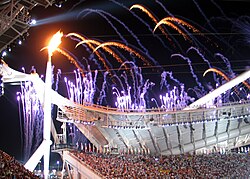
Key Facts

- Host City: Athens, Greece
- Participating Nations: 201
- Total Athletes: 10,557 (6,257 men and 4,300 women)
- Events: 301 events across 28 sports and 40 disciplines
- Opening Date: August 13, 2004
- Closing Date: August 29, 2004
The Road to Athens: Selection and Preparation

The selection of Athens was a journey of competitive bidding. In the final rounds of voting, Athens secured its victory with 66 votes, surpassing Rome, which finished with 41. Other contenders in the process included Cape Town, Stockholm, and Buenos Aires.
Preparation for the Games involved a massive construction effort to modernize the city's infrastructure and create world-class sporting facilities. This included the development of the OAKA (Olympic Athletic Complex) and various outlying venues designed to handle the influx of athletes and spectators.
Ceremonies and Traditions

The 2004 Games were marked by a deep reverence for tradition. The lighting of the flame was staged as a pagan pageant featuring dancing priestesses, emphasizing the spiritual and historical roots of the competition.

For the first time in history, the Olympic Flame toured the world before arriving in Greece, symbolizing a global connection to the spirit of the Games.

The closing ceremony provided a festive conclusion to the festivities, famously featuring balloons falling over the stadium as the athletes bid farewell to Athens.

Athletic Competition and Participation

The Games saw an unprecedented level of global participation, with 201 National Olympic Committees represented. The United States sent the largest delegation with 533 athletes, followed by Australia (470), Russia (446), and Germany (441). The host nation, Greece, also fielded a significant team of 426 athletes.

The sports programme was diverse, spanning 28 sports. While traditional athletics and aquatics remained centerpieces, the Games also featured disciplines such as Taekwondo, Softball, and Baseball. The competition was fierce, with athletes like Army Maj. Zhanbo Jia of China securing gold in the Men's 50m Three-Position Rifle.

Participation Overview
| Category | Detail |
|---|---|
| Total Athletes | 10,557 |
| Male Athletes | 6,257 |
| Female Athletes | 4,300 |
| Number of Nations | 201 |
| Total Gold Medal Events | 301 |
Venues and Infrastructure

Athens utilized a mix of state-of-the-art new constructions and historic sites. The Olympic Stadium served as the primary hub for ceremonies and athletics, while the Panathenaic Stadium hosted archery and the marathon finish.

Specialized venues were created for various disciplines, such as the Athens Olympic Velodrome, designed by the renowned architect Santiago Calatrava.

Other notable sites included the Faliro Olympic Beach Volleyball Centre and the Galatsi Olympic Hall, which hosted rhythmic gymnastics and table tennis.


Technology and Operations
The 2004 Games leveraged significant technological advancements to manage the event. The ATHOC Technology Operations Center served as the nerve center for the Games, ensuring that broadcasting, timing, and logistics ran seamlessly.

Legacy and Post-Games Use
Following the closing ceremony, the city of Athens faced the challenge of maintaining its massive new infrastructure. While some venues, like the Peace and Friendship Stadium, became home courts for professional basketball teams (Olympiacos BC), others were converted for different uses. For example, the Faliro Sports Pavilion was transformed into the Athens International Convention Center.
However, not all facilities found a sustainable second life; some, such as the Hellinikon Baseball and Softball stadiums, were eventually abandoned.
Frequently Asked Questions
What was the motto of the Athens 2004 Olympics?
The motto was "Welcome Home" (Greek: Καλώς ήρθατε σπίτι), reflecting the return of the Olympic Games to their original home in Greece.
How many athletes participated in the 2004 Games?
A total of 10,557 athletes participated, consisting of 6,257 men and 4,300 women from 201 different nations.
Who designed the Athens Olympic Velodrome?
The Athens Olympic Velodrome was designed by the famous architect Santiago Calatrava.
Which country sent the largest number of athletes?
The United States sent the largest delegation, with a total of 533 athletes.
What happened to the venues after the Games?
The legacy of the venues varies; some became professional sports arenas or convention centers, while others were converted into cultural facilities or, in some cases, were abandoned.