Ascorbic Acid: The Molecular Science and Chemical Properties of Vitamin C
Ascorbic acid, widely recognized as Vitamin C, is a vital organic compound with the chemical formula C6H8O6. While most people associate it with nutrition and immune health, its identity as a chemical entity is defined by its unique molecular structure and its role as a potent reducing agent. Originally known as hexuronic acid, this white or light-yellow solid plays a critical role in both biological systems and industrial applications.

Key Facts
- Chemical Formula: C6H8O6
- Molar Mass: 176.124 g/mol
- Common Use: Food additive (E300) and dietary supplement
- Primary Function: Antioxidant and reducing agent
- Solubility: Highly soluble in water (330 g/L)
- IUPAC Name: l-threo-Hex-2-enono-1,4-lactone
Historical Discovery and Nomenclature
The journey to understanding ascorbic acid began in the 18th century when James Lind demonstrated the antiscorbutic (scurvy-preventing) properties of certain foods. By the early 20th century, researchers Axel Holst and Theodor Frølich identified the antiscorbutic factor as a water-soluble chemical substance. Between 1928 and 1932, Albert Szent-Györgyi isolated a substance he called "hexuronic acid," which Charles Glen King later confirmed was the essential antiscorbutic factor.
The naming of the compound evolved as its structure became clear. In 1933, chemist Walter Norman Haworth deduced its correct structure and optical-isomeric nature. He and Szent-Györgyi proposed the name "a-scorbic acid" to reflect its ability to fight scurvy, eventually leading to the standard term L-ascorbic acid. For their groundbreaking work, Haworth and Szent-Györgyi were awarded Nobel Prizes in 1937.
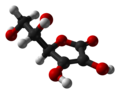
Chemical Structure and Acidity
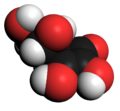
At a molecular level, ascorbic acid is a furan-based lactone of 2-ketogluconic acid. It features an adjacent enediol group (a structure containing two hydroxyl groups attached to a double bond) next to a carbonyl group. This specific arrangement—−C(OH)=C(OH)−C(=O)−—is characteristic of reductones and significantly increases the acidity of one of the hydroxyl groups.
When the acid loses a proton, it forms the ascorbate anion. This conjugate base is highly stable due to resonance, where electron delocalization occurs between two different forms of the molecule. This stability is a key reason why ascorbic acid behaves as an effective antioxidant.

Oxidation and Redox Reactions
The antioxidant power of ascorbic acid stems from its ability to undergo oxidation. When it loses an electron, it forms the semidehydroascorbate acid radical. Further oxidation produces dehydroascorbate (C6H6O6). While dehydroascorbate can sometimes be recycled back into ascorbic acid, aqueous solutions of it are unstable, with a half-life of only 5–15 minutes at 37 °C.

The process of oxidation is carefully regulated in biological systems. The loss of an electron from semidehydroascorbate to produce pseudodehydroascorbate is thermodynamically disfavored, a mechanism that helps prevent the propagation of harmful free radical chain reactions.
Industrial Synthesis and Production
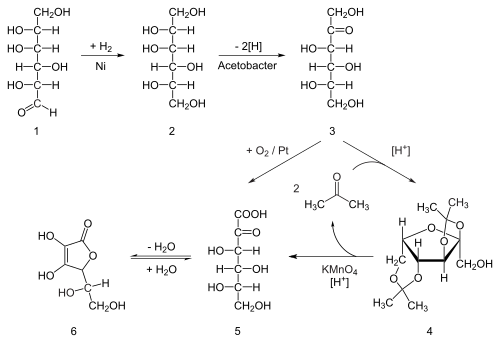
Today, approximately 70% of the world's ascorbic acid is produced in China. There are two primary methods for industrial preparation:
- The Reichstein Process: A five-step method starting from glucose. Glucose is hydrogenated to sorbitol, which is then oxidized to sorbose using the microorganism Acetobacter suboxydans. Through a series of steps involving acetone protection and oxidation, the final lactone is formed.
- Biotechnological Process: A more modern method that bypasses the need for acetone-protecting groups. This involves using genetically modified microbes, such as mutant Erwinia, to oxidize sorbose into 2-ketogluconic acid (2-KGA), which then undergoes ring-closing lactonization.
Applications and Safety
Ascorbic acid is widely used as a food additive (E300) to prevent oxidation and discoloration in various products. Beyond food, it is used in photographic developer solutions and as a preservative. In medical contexts, it is a common dietary supplement.
Regarding safety, the compound has a low toxicity profile, with an LD50 (median lethal dose) of 11.9 g/kg in rats. However, researchers have investigated its potential link to kidney stone formation. It was discovered that ascorbic acid can convert to oxalate via dehydroascorbic acid and 2,3-diketogulonic acid. While some studies suggest a potential association between high-dose supplementation and increased urinary oxalate, clinical significance remains inconclusive.

Summary of Physical and Chemical Properties
| Property | Value/Description |
|---|---|
| Chemical Formula | C6H8O6 |
| Molar Mass | 176.124 g/mol |
| Melting Point | 190 to 192 °C (decomposes) |
| Water Solubility | 330 g/L |
| p Ka (Acidity) | 4.10 (first), 11.6 (second) |
| Appearance | White or light yellow solid |
Frequently Asked Questions
What is the primary chemical function of ascorbic acid?
Ascorbic acid acts primarily as a mild reducing agent and an antioxidant, meaning it can donate electrons to neutralize free radicals.
How is ascorbic acid used in the food industry?
It is used as a food additive (E300) to combat oxidation and prevent the discoloration of food products during storage.
Is there a link between Vitamin C and kidney stones?
Research has shown that ascorbic acid can be converted into oxalate, a component of kidney stones. However, clinical studies regarding the actual risk of stone formation from supplementation remain inconclusive.
What is the difference between ascorbic acid and dehydroascorbic acid?
Ascorbic acid is the reduced form, while dehydroascorbic acid is the oxidized form. Dehydroascorbic acid is less stable in aqueous solutions and can degrade into various acids like oxalic or threonic acid.
How is ascorbic acid manufactured on a large scale?
It is primarily produced from glucose using either the historical Reichstein process or modern biotechnological methods involving genetically modified microbes.