The Artichoke: A Comprehensive Guide to This Culinary Thistle
The artichoke (Cynara cardunculus var. scolymus) is a unique and delicious variety of thistle cultivated specifically for food. While many think of thistles as mere weeds, the artichoke has been transformed through cultivation into a prized culinary ingredient enjoyed globally. The edible portion of the plant is actually the flower bud before it reaches full bloom.
What is an Artichoke?
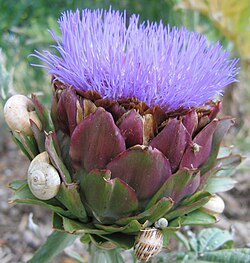
An artichoke bud is technically an inflorescence, which is a cluster of many small budding flowers. These flowers are protected by numerous bracts, which are the leaf-like scales that make up the outer structure of the bud. As the plant matures and the flowers begin to bloom, the structure becomes coarse and largely inedible.
The plant itself is quite impressive, growing between 1.4 and 2 meters (approximately 4.5 to 6.5 feet) tall. It features arching, deeply lobed leaves that have a glaucous-green color—a term used to describe a pale, silvery-green appearance often caused by a waxy coating. The individual florets within the flower head are typically purple.
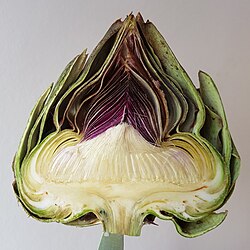
When dissecting the bud, you will find the most prized parts: the fleshy lower portions of the bracts and the base, known as the heart. In the center of the bud lies the choke (or beard), which is a mass of immature florets. While the heart is a delicacy, the choke becomes inedible as the flower grows larger.
Key Facts
- Scientific Name: Cynara cardunculus var. scolymus
- Family: Asteraceae (the thistle family)
- Edible Parts: The fleshy base of the bracts and the heart.
- Global Production (2024): 1.7 million tonnes, led by Egypt and Italy.
- Nutritional Highlight: A rich source of folate (20% or more of the Daily Value).
A Rich History and Linguistic Journey
The history of the artichoke is deeply intertwined with the Mediterranean. It is a domesticated variety of the wild cardoon, a perennial plant native to the Mediterranean region. While there is historical debate regarding whether ancient Greeks and Romans ate the artichoke or the wild cardoon, evidence suggests the plant has been cultivated for millennia. Homer and Hesiod mentioned the cardoon as early as the eighth century BC, and Roman records show it being grown in Carthage and Cordaoba.
The name "artichoke" itself has a fascinating etymology. It was borrowed into English in the sixteenth century from the northern Italian word articiocco. This term likely originated from the Spanish alcarchofa, which in turn was derived from the medieval Andalusi Arabic word al-kharshūfa. The Arabic root kharshūfa comes from the classical word for "scale," a fitting description for the plant's many bracts.
Cultivation and Varieties
Artichokes can be grown from seeds or through vegetative methods such as root cuttings, division, or micropropagation. Although they are technically perennials (plants that live for more than two years), some modern cultivars have been bred to be grown as annuals. For example, the 'Imperial Star' cultivar is designed to produce a harvest in its first year, while the 'Northern Star' variety is capable of overwintering in colder, subzero climates.
Commercial cultivation is most successful in warm areas, specifically in USDA hardiness zones 7 and above. They require good soil, consistent watering, and protection from frost. Because individual plants only live for a few years, gardeners often plant new rooted suckers each season.
Artichokes come in various colors and sizes, including:
- Green, Large: 'Vert de Laon', 'Camus de Bretagne', 'Castel', and 'Green Globe'.
- Green, Medium: 'Verde Palermo', 'Blanca de Tudela', and 'Argentina'.
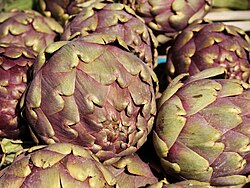
- Purple, Large: 'Romanesco' and 'C3'.
- Purple, Medium: 'Violet de Provence', 'Brindisino', and 'Violetta di Chioggia'.
- Spined: 'Spinoso Sardo e Ingauno' and 'Criolla'.
Nutritional Profile
Artichokes are highly nutritious. A 100-gram serving of cooked, unsalted artichoke provides approximately 74 kcal of energy. They are an excellent source of dietary fiber and are particularly notable for their high folate content.
| Nutrient | Quantity | % Daily Value (Approx.) |
|---|---|---|
| Energy | 310 kJ (74 kcal) | - |
| Carbohydrates | 11.57 g | - |
| Dietary Fiber | 5.5 g | - |
| Protein | 2.81 g | - |
| Fat | 2.87 g | - |
| Folate (B9) | - | 20% or more |
| Vitamin K | - | 10–19% |
| Copper | - | 10–19% |
| Magnesium | - | 10–14% |
Culinary Uses and Global Traditions
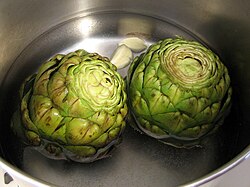
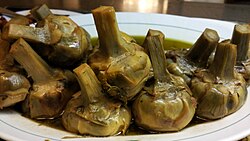
Preparing artichokes requires a bit of technique. To cook them, you can simmer the buds for 15 to 30 minutes or steam them for 30 to 40 minutes. To prevent the artichoke from turning brown due to oxidation, you can place the cut pieces in water acidified with lemon juice or vinegar.
There are countless ways to enjoy this vegetable across the globe:
- Italy: Artichoke hearts in oil are a staple on "four seasons" pizzas. In Rome, "Jewish-style" artichokes are famously deep-fried whole.
- Spain: Smaller, tender artichokes may be sautéed with garlic, used in paella, or combined with eggs in a tortilla.
- Greece: The "city-style" (alla Polita) stew features artichoke hearts with potatoes, carrots, onion, lemon, and dill.
- Middle East and North Africa: Stuffed artichoke hearts are common, often filled with ground lamb and local spices like allspice, mint, or parsley.
Beyond the Plate: Tea and Aperitifs
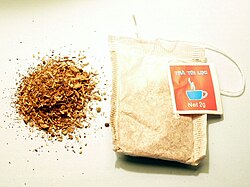
The uses for artichokes extend beyond savory dishes. In several cultures, the flower portion is used to create herbal teas. This is particularly common in Vietnam, and variations like Ceai de Anghinare are consumed in Romania. In Mexico, the infusion is also used, offering a slightly woody and bitter taste.
In the world of beverages, artichoke is the primary botanical ingredient in Cynar, a famous Italian aperitif. This bitter liqueur can be served over ice or used in cocktails, such as the "Cin Cyn," a variation of the Negroni.
Frequently Asked Questions
What part of the artichoke is edible?
The most edible parts are the fleshy base of the bracts (the scales) and the heart at the very bottom of the bud. The "choke" in the center is inedible and should be removed.
Can artichokes be grown in colder climates?
While commercial production is usually limited to warm areas (USDA zone 7 and above), certain newer cultivars like 'Northern Star' are bred to survive subzero temperatures and can be grown in more northerly regions.
How do you prevent artichokes from turning brown?
Artichokes can undergo enzymatic browning once cut. To prevent this, place them in water that has been slightly acidified with lemon juice or vinegar.
What is the difference between an artichoke and a cardoon?
The artichoke is a domesticated variety of the wild cardoon. While they are closely related, the artichoke has been specifically cultivated for its edible flower buds.
Is artichoke tea bitter?
Yes, artichoke-based herbal tea typically has a slightly bitter and woody flavor profile.