Arthropods: The Biology and Evolution of Earth's Most Diverse Phylum
Arthropods represent one of the most successful biological designs in the history of life on Earth. From the depths of the ocean to the highest mountain peaks, these invertebrates have colonized nearly every habitat imaginable. With approximately 1,170,000 species, the phylum Arthropoda is the most diverse group of animals on the planet, characterized by their jointed limbs and protective outer shells.
The success of arthropods is largely attributed to their adaptable body plans and specialized organs, allowing them to evolve into forms as varied as the microscopic mite, the industrious honeybee, and the predatory giant squid's distant cousins in the crustacean world.
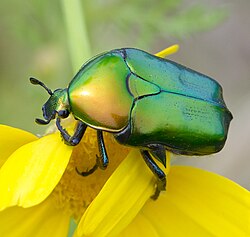
Key Facts
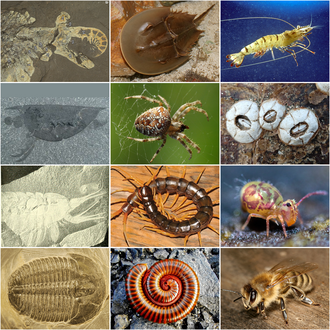
- Species Diversity: Home to around 1.17 million species, making them the most diverse arthropod order.
- Temporal Range: They have existed from approximately 538.8 million years ago to the present day.
- Defining Features: Characterized by a chitinous exoskeleton, segmented bodies, and jointed appendages.
- Major Groups: Divided into Chelicerata, Myriapoda, and Pancrustacea (which includes insects and crustaceans).
- Human Impact: While many are beneficial, some act as vectors for diseases like malaria and dengue fever.
Anatomy and Physiological Systems
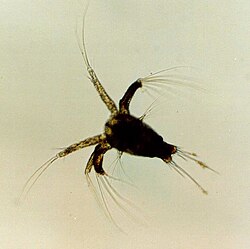
The Exoskeleton and Molting
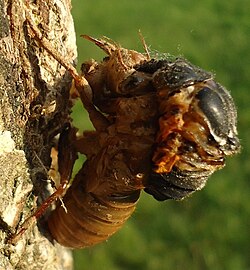
The most striking feature of an arthropod is its exoskeleton, a hard external covering that provides structural support and protection against predators and dehydration. However, because this shell is rigid, it cannot grow with the animal. To increase in size, arthropods undergo moulting (ecdysis), a process where they shed their old exoskeleton and grow a new, larger one.
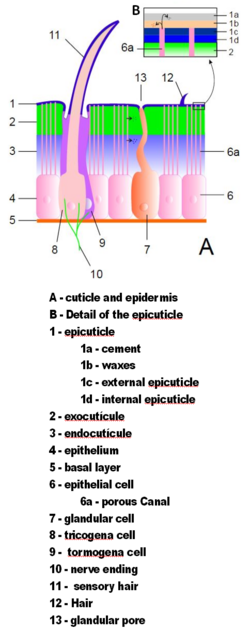
During the molting process, the animal is temporarily vulnerable until the new cuticle hardens.
Segmentation and Appendages
Arthropod bodies are organized into segments, often fused into functional units called tagmata (such as the head, thorax, and abdomen). Their appendages are jointed, which allows for a wide range of movement and specialization. Some appendages are biramous (branched into two), while others are uniramous (single-branched).
![Structure of a biramous appendage.[21]](/images/57/70/5770145b7826c7f9a21eb04325fdc4b90f005e40eb5efcef54ee09c40e71a3da.png)
Internal Systems
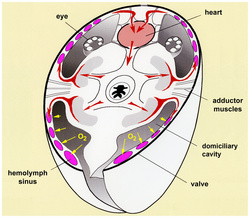
- Circulation and Respiration: Arthropods typically have an open circulatory system with a heart that pumps hemolymph. Respiration varies by species, ranging from gaseous diffusion in some ostracods to gills in aquatic species and tracheae in insects.
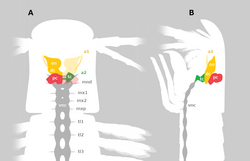
- Nervous System: Their central nervous system consists of a brain (including the deutocerebrum) and a ventral nerve cord organized by segmented ganglia.
- Excretory System: Specialized organs remove metabolic waste from the body.
Sensory Organs
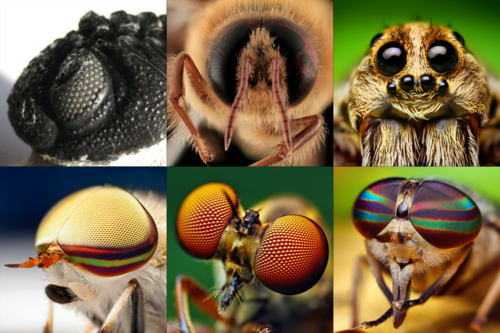
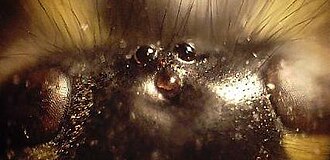
Arthropods possess highly developed senses. Their optical systems include compound eyes, which are made of many individual lenses, and ocelli (simple eyes) used for light detection. They also utilize setae (sensory bristles) to detect touch and chemical changes in their environment.
Classification and Diversity
The phylum Arthropoda is broadly categorized into several major clades based on their evolutionary lineage and anatomical features.
| Subphylum | Major Classes | Example Species |
|---|---|---|
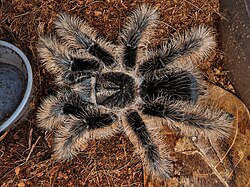
| Chelicerata | Pycnogonida, Xiphosura, Arachnida | Platycryptus undatus (Spider) |
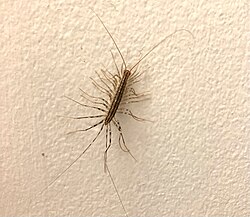
| Myriapoda | Symphyla, Pauropoda, Diplopoda, Chilopoda | Archispirostreptus gigas (Millipede) |
| Pancrustacea (Crustacea) | Malacostraca, Branchiopoda, Remipedia, etc. | Ocypode ceratophthalma (Ghost Crab) |
| Pancrustacea (Hexapoda) | Insecta, Entognatha | Saturnia pavonia (Moth) |
Evolutionary History
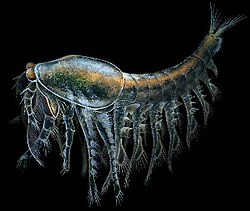
The fossil record reveals that arthropods emerged during the Cambrian period. Early transitional fossils, such as Kylinxia, suggest a link between stem-arthropods and the true arthropods we see today. Other enigmatic extinct groups, like the Marrella from the Burgess Shale, highlight the experimental nature of early arthropod body plans.
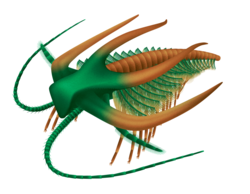
![Kylinxia may be a key transitional fossil between stem-arthropods and true arthropods.[68]](/images/69/64/6964d831ad0985e157834268a739bc4af26daca24477e78c20c00cbaccd991f5.png)
Research indicates that arthropods are closely related to Onychophora (velvet worms), which share similar segmented body plans but lack the hard exoskeleton of true arthropods.
![The velvet worm (Onychophora) is closely related to arthropods[94]](/images/d1/6f/d16f13b1287b1df1b7f7f2cfc263adfa8c8843aa0f51f0cf534cac3b040ba23b.jpg)
Interaction with Humans
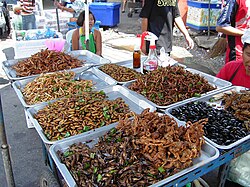
Arthropods have a complex relationship with humanity. While many are essential for pollination and food production, others are significant vectors for disease. Mosquitoes, for instance, are responsible for millions of cases of malaria and dengue fever annually.
Frequently Asked Questions
What is the difference between a chelicerate and a mandibulate?
Chelicerates (like spiders and scorpions) possess chelicerae (pincers or fangs) for feeding, whereas mandibulates (like insects and crustaceans) possess mandibles (jaws) used for chewing and manipulating food.
Why do arthropods have to molt?
Because their exoskeleton is made of a rigid material that does not expand, they must shed the old shell to allow their body to grow larger before a new, larger exoskeleton hardens.
What are compound eyes?
Compound eyes are visual organs consisting of numerous small lenses called ommatidia, which provide a wide field of view and are particularly sensitive to movement.
Which arthropod group is the most numerous?
The Hexapoda, specifically the class Insecta, is the most numerous and diverse group within the phylum Arthropoda.
How do arthropods breathe?
Depending on the species, they use different methods: aquatic arthropods often use gills, terrestrial insects use a system of tubes called tracheae, and arachnids often use book lungs.