Arktikugol Aviation History on Svalbard
The history of aviation managed by Arktikugol on the Svalbard archipelago is a reflection of the geopolitical and industrial shifts of the 20th century. Starting as a vital link between remote mining settlements, these flight operations evolved from small shuttle services into a more complex network involving international agreements and specialized Arctic aircraft.
The Early Years of Shuttle Services
Arktikugol began its flight operations in 1961, establishing a shuttle service to connect its two primary mining towns: Barentsburg and Pyramiden. Barentsburg served as the central base of operations and housed the larger of the two facilities. During this initial phase, flights were operated by Aeroflot, utilizing two Mil Mi-4 helicopters, each capable of transporting eleven passengers.
From 1961 to 1974, Arktikugol adhered to the Aviation Act by obtaining a helicopter operating concession from the Ministry of Transport and Communications. However, this regulatory relationship shifted in 1974 when the Soviet Union argued that such regulations violated the Svalbard Treaty, which guarantees free shipping in the region.
Expansion and the Longyear Airport Era
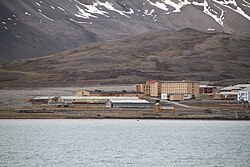
A significant turning point occurred in 1971 when the Soviet Union agreed to the construction of Svalbard Airport, Longyear. This agreement was contingent upon the airport having the capacity to support Aeroflot flights directly to Moscow. The opening of the airport in 1975 increased the strategic importance of the Pyramiden heliport, as it became a key transit point for passengers traveling from Barentsburg to Longyearbyen.
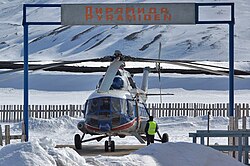
To support this growing demand, Arktikugol expanded its fleet to five Mil Mi-8 helicopters. These aircraft, bearing Aeroflot markings, offered a significant upgrade in capability, featuring a range of 375 kilometers (233 mi) and a passenger capacity of 28 people per aircraft.
Navigational Improvements and Controversy
In 1977, the Civil Aviation Administration sought to improve safety during the polar night—the period of total darkness in the Arctic winter—by installing seven navigational lights around Billefjorden. While these lights aided navigation, the project faced controversy because one of the lights was positioned within the Gåsøyane Bird Sanctuary.
Post-Soviet Decline and Current Status
The dissolution of the Soviet Union in 1991 led to a sharp decrease in the subsidies and resources allocated to Arktikugol and its Svalbard operations. By 1993, the fleet had dwindled to just two helicopters, and all airport employees and crew were relocated to Barentsburg.
During the early 1990s, Pyramiden saw between 40 and 60 aircraft movements per month, with activity peaking during the summer. Operations were further scaled back in 1998 when Arktikugol closed Pyramiden. Despite the closure, Arktikugol maintains an operational heliport and continues to conduct irregular flights to the settlement.
Key Facts
- Start Date: Aviation operations began in 1961.
- Primary Hubs: Barentsburg (main base) and Pyramiden.
- Aircraft Used: Mil Mi-4 (11 passengers) and Mil Mi-8 (28 passengers).
- Mil Mi-8 Range: 375 kilometers (233 mi).
- Key Infrastructure: Svalbard Airport, Longyear opened in 1975.
- Peak Activity: 40 to 60 monthly movements at Pyramiden in the early 1990s.
| Aircraft Model | Passenger Capacity | Operational Period | Key Role |
|---|---|---|---|
| Mil Mi-4 | 11 | Starting 1961 | Initial shuttle service |
| Mil Mi-8 | 28 | Post-1975 expansion | High-capacity transport |
Frequently Asked Questions
Which aircraft did Arktikugol use for its operations?
Arktikugol initially used two Mil Mi-4 helicopters and later expanded its fleet to five Mil Mi-8 helicopters, all operated with Aeroflot markings.
Why was the construction of Svalbard Airport, Longyear significant for the Soviet Union?
The Soviet Union agreed to the airport's construction on the condition that it would have the capacity to allow Aeroflot to operate flights directly to Moscow.
What caused the decline in aviation activity at Pyramiden?
The dissolution of the Soviet Union in 1991 led to reduced subsidies and resources, resulting in a smaller fleet and the eventual closure of Pyramiden in 1998.
What was the controversy regarding the navigational lights in 1977?
The controversy arose because one of the seven navigational lights installed by the Civil Aviation Administration around Billefjorden was placed inside the Gåsøyane Bird Sanctuary.
Does Arktikugol still fly to Pyramiden?
Yes, although Pyramiden was closed in 1998, Arktikugol retains an operational heliport and continues to conduct irregular flights to the location.