Argentine Sea
The Argentine Sea (Spanish: Mar Argentino) is a significant marginal sea of the South Atlantic Ocean, located along the southeastern coast of South America. Stretching from the Río de la Plata estuary in the north to Isla de los Estados in the south, it serves as a vital ecological and geopolitical region. This vast body of water is characterized by its relationship with the Patagonian Shelf, a massive underwater plateau that defines much of its physical and biological nature.
The sea's dimensions are substantial, covering a surface area of approximately 1,000,000 square kilometers. Its width varies considerably, measuring 210 km near Mar del Plata and expanding to 850 km at the latitude of the Falkland Islands. The coastline spans 4,725 km, transitioning eastward into the deeper Argentine Basin.
Key Facts
- Surface Area: 1,000,000 square kilometers.
- Depth: Average depth of 1,205 m, reaching a maximum of 2,224 m.
- Salinity: 3.5%.
- Key Islands: Falkland Islands and Tierra del Fuego.
- Major River Sources: Río de la Plata, Colorado, Río Negro, Chubut, and Deseado rivers.
- Naming: Coined by Romanian explorer Julius Popper in the mid-1880s.
Geography and Physical Characteristics
Situated about 800 km north of Antarctica, the Argentine Sea is underlain by the Patagonian Shelf. Morphologically, the sea resembles the Extra-Andean Patagonia due to its series of stair-shaped plateaux that descend eastward in large terraces. As the continental landmass narrows toward the south, the sea progressively widens.
The sea is defined by the 200-meter isobath (a line connecting points of equal underwater depth), which marks the boundary between the shelf and the deeper ocean basin. The Falkland Islands are situated within this continental shelf region.
| Feature | Detail |
|---|---|
| Location | Eastern shore of Argentina, South Atlantic Ocean |
| Coordinates | 46°S 63°W |
| Basin Countries | Argentina, Uruguay, Falkland Islands (UK) |
| Max Depth | 2,224 meters |
| Coastline Length | 4,725 kilometers |
Territorial Claims and International Disputes
Maritime boundaries in the Argentine Sea are subject to complex legal claims governed by the United Nations Convention on the Law of the Sea (UNCLOS). Argentina claims a territorial sea of 12 nautical miles, a contiguous zone of an additional 12 nautical miles, and an Exclusive Economic Zone (EEZ) extending 200 nautical miles from the coast.
Conflict with the United Kingdom
Argentina's EEZ overlaps with claims maintained by the United Kingdom around the Falkland Islands, South Georgia, and the South Sandwich Islands. While joint commissions managed fishing and mineral resources from 1990 to 2005, Argentina unilaterally withdrew in 2005 to pursue a more assertive stance regarding its claim to the islands.
Dispute with Chile
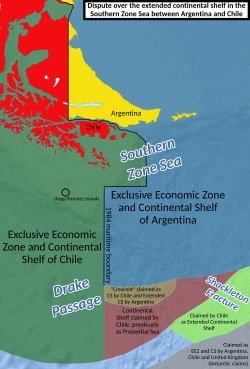
A separate dispute exists between Argentina and Chile regarding the extended continental shelf. In 2009, Argentina submitted a presentation to the UN Commission on the Limits of the Continental Shelf, which included a crescent-shaped area south of the territorial sea. Chile also claims this area as part of its presential sea and the waters surrounding the Antarctic Peninsula.
Tensions escalated in 2021 when Chilean President Sebastián Piñera signed a decree claiming the continental shelf east of the 67º 16' 0 meridian. Argentina has formally rejected these measures and subsequent illustrative graphics published by the Chilean Navy (SHOA). In 2023, the International Court of Justice provided a ruling on the priority of a Continental Shelf over an Extended Continental Shelf in a separate case (Colombia vs. Nicaragua), which remains a point of legal reference for such disputes.
Marine Biodiversity
The Argentine Sea is one of the world's most temperate seas, influenced by the convergence of two major currents: the cold Falkland Current from the Antarctic and the warm Brazil Current from the north.
This intersection of temperatures supports immense biodiversity. The ecosystem is built upon a foundation of plankton, algae, crustaceans, sardines, and anchovies. These species support a diverse array of higher predators, including:
- Marine Mammals: Whales, dolphins, Burmeister's porpoise, fur seals, sea lions, and southern elephant seals.
- Birds: Penguins and cormorants.
- Fish: Various species of sharks.
To protect this environment, the region contains twelve identified areas of high biodiversity, including two international protected areas, one national protected area, and eighteen provincial ones.
Frequently Asked Questions
Who named the Argentine Sea?
The name is attributed to Julius Popper, a Romanian-born explorer who charted parts of Tierra del Fuego in the mid-1880s and published the name in charts in 1891.
What is the Patagonian Shelf?
The Patagonian Shelf is the continental sea shelf that underlies the Argentine Sea, characterized by a stair-shaped series of plateaux that descend toward the east.
Why is there a dispute between Argentina and the UK?
The dispute centers on overlapping claims to the Exclusive Economic Zone (EEZ) and sovereignty over the Falkland Islands, South Georgia, and the South Sandwich Islands.
What causes the high biodiversity in the Argentine Sea?
The high biodiversity is primarily driven by the meeting of the cold Falkland Current from the south and the warm Brazil Current from the north, creating a nutrient-rich temperate environment.
What is the current status of the dispute between Argentina and Chile?
The two nations disagree over the limits of the extended continental shelf, specifically a crescent-shaped area and waters near the Antarctic Peninsula, with both countries submitting reports to the UN Commission on the Limits of the Continental Shelf.