Archery History: From Ancient Survival to Modern Sport
Archery is one of humanity's oldest and most versatile technologies. What began as a critical tool for survival and hunting evolved into a dominant force on the ancient battlefield and, eventually, a refined global sport. From the bone arrowheads of prehistoric Africa to the precision-engineered compound bows of today, the story of the bow is a reflection of human ingenuity and cultural evolution.
Key Facts
- Oldest Evidence: Bone and stone arrowheads in South Africa date back 60,000 to 72,000 years.
- Earliest Complete Bows: Found in Northern Europe, with German sites dating back 17,500 to 18,000 years.
- Military Evolution: The composite bow provided power and mobility, while the English longbow became legendary for its massed firepower.
- Technological Shift: Firearms rendered archery obsolete in warfare due to their easier training requirements and superior penetration of steel armor.
- Modern Era: Archery transitioned from a noble social pastime in the 18th century to a standardized Olympic sport.
Origins and Ancient Archery
The earliest traces of archery are found in the archaeological record of South Africa, specifically at Sibudu Cave, where arrowheads date back approximately 72,000 to 60,000 years. However, the first evidence of complete bows and arrows appears in Northern Europe. Sites such as Mannheim-Vogelstang in Germany (17,500–18,000 years ago) and Stellmoor (11,000 years ago) provide critical insights into early designs.
In Switzerland, Azilian points found in Grotte du Bichon suggest arrows were in use 13,500 years ago. Similarly, obsidian bladelets found in skeletons at Nataruk, Kenya, indicate stone-tipped arrows were used as weapons roughly 10,000 years ago. Over time, the bow replaced the spear-thrower—a device used to launch projectiles—on every continent except Australasia.
As civilizations grew, so did the sophistication of the bow. The composite bow (a bow made from multiple materials like wood, horn, and sinew for increased power) was likely invented in Central Asia by the Scythians. This technology was adopted by the Akkadians, Egyptians, and various Asian dynasties. In Egypt, the expertise of Nubian archers was so renowned that the region was called "Ta-Seti," or "The Land of the Bow."
The Evolution of Medieval Warfare
During the early medieval period, the shortbow—similar to classical era bows with a range of about 91 meters—was the primary ranged weapon. By the tenth century, the crossbow emerged in Europe. While slower to fire, the crossbow offered greater accuracy, penetration, and a longer range (up to 274 meters), making it capable of piercing armor.
The late medieval period saw the rise of the English longbow. Unlike the crossbows favored by the French, the longbow was a mass weapon with a range of up to 270 meters. Though less accurate at long distances, its rapid rate of fire led to decisive English victories at the Battle of Crécy and the Battle of Agincourt.
Mounted Archery
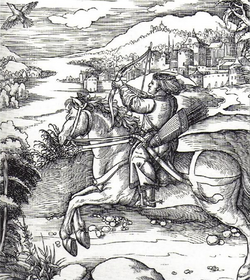
The Scythians mastered the art of archery on horseback, utilizing the compact power of the composite bow to dominate the Central Asian steppes. This mobility allowed them to conquer vast areas of Eurasia. Later, the Seljuk Turks used similar tactics during the First Crusade, specifically at the Battle of Dorylaeum in 1097, using their speed to harass infantry without allowing them to close the distance.
The Decline of the Bow in Battle
The advent of firearms eventually made the bow obsolete in military contexts. While early guns were slower to fire and sensitive to moisture, they possessed a longer effective range and were tactically superior when shooting from behind cover. Most importantly, firearms required significantly less training than the longbow, which required years of practice to develop the necessary musculature to penetrate armor.
Despite this, some nations attempted to preserve the skill. England and Wales enforced longbow practice until the end of the 16th century, recognizing its historical role in the Hundred Years' War. Today, while rare in combat, the bow remains a vital tool for hunting and sport.
Archery as a Social and Modern Sport
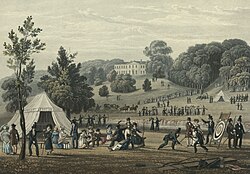
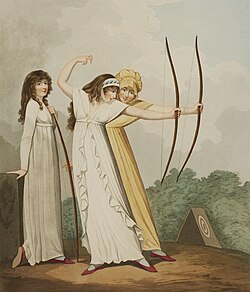
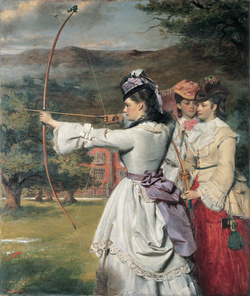
In the late 18th century, archery experienced a fashionable revival among the English aristocracy. Sir Ashton Lever founded the Toxophilite Society in 1781 under the patronage of the Prince of Wales. These clubs became extravagant social hubs, often featuring music, flags, and elaborate costumes.
Notably, archery was one of the few sports where women could compete and socialize openly, making it a popular forum for romance and flirtation. The sport was further romanticized by Sir Walter Scott's 1819 novel Ivanhoe, which helped transition archery from an elitist pastime to a broader cultural interest.
Standardization and the Modern Era
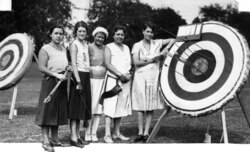
By the 1840s, archery began its transition into a modern sport. The Grand National Archery Society standardized the "York Round," a series of shoots at 55, 73, and 91 meters. In the United States, the National Archery Association (now USA Archery) was organized in 1879.
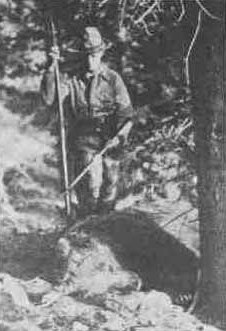
The 20th century brought scientific engineering to the craft. Professional engineers developed the recurve bow and the compound bow (which uses a system of pulleys to reduce the draw weight), which now dominate Western archery. Traditional skills were also preserved through figures like Saxton Pope, who learned traditional techniques from Ishi, the last member of the Yahi tribe.
Archery in Mythology and Culture
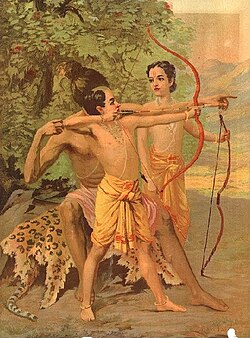
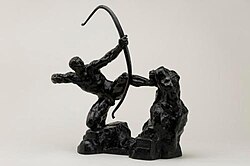
The bow is a recurring symbol of power and divinity across global mythologies. In Greek myth, Artemis and Apollo are the quintessential archers, while the Odyssey features a pivotal competition where Odysseus proves his identity by stringing his great bow.
In Indian epic literature, the Mahabharata describes legendary archers like Arjuna and Karna, including a famous feat of hitting the eye of a rotating fish by looking only at its reflection. Other cultures, such as the Yoruba of West Africa, recognize Osoosi as a deity of the hunt associated with the bow and arrow.
| Bow Type | Key Characteristic | Primary Use/Era | Notable Range/Feature |
|---|---|---|---|
| Shortbow | Simple wooden construction | Early Medieval | ~91 meters |
| Longbow | Tall, powerful wooden stave | Late Medieval (English) | Up to 270 meters |
| Composite Bow | Horn, wood, and sinew | Ancient Asia/Scythians | High power, compact size |
| Crossbow | Mechanical trigger/stock | Medieval Europe | Up to 274 meters; high penetration |
| Compound Bow | Pulley/Cam system | Modern Era | High precision and efficiency |
![An archery in the coat of arms of Lieksa,[36] based on the 1669 seal of the old town of Brahea.[37]](/images/2d/d9/2dd914032c7a83d07f3577f1db3062b896621b3e653412c2bde51ef45e688431.webp)
Frequently Asked Questions
What is a composite bow?
A composite bow is a bow constructed from multiple materials—typically a combination of wood, horn, and sinew—glued together. This design allows the bow to be shorter and more powerful than a simple wooden bow, making it ideal for mounted archery.
Why did firearms replace the bow in warfare?
Firearms were tactically superior because they had a longer effective range and could penetrate steel armor more easily. Crucially, they required far less training to use, allowing armies to deploy large numbers of effective soldiers without the years of physical training required for the longbow.
What was the "York Round"?
The York Round was a set of standardized rules and distances established in the 1840s to turn archery into a modern sport. It consists of a series of shoots at distances of 55 meters, 73 meters, and 91 meters.
Who were the Toxophilites?
The Toxophilite Society was an archery club formed in London in 1781 by Sir Ashton Lever. It played a major role in the 18th-century revival of archery as a fashionable social sport for the British aristocracy.
How did the longbow differ from the crossbow?
The longbow had a faster rate of fire and was used as a mass weapon to shower enemies with arrows. The crossbow was slower to reload but offered greater accuracy, more penetration, and was easier for an individual soldier to use effectively.