Arboreal Locomotion: How Animals Master Life in the Trees
Life in the canopy presents a unique set of physical challenges. Arboreal locomotion—the movement of animals within trees—requires a sophisticated blend of anatomical engineering and behavioral strategy. While some animals are scansorial, meaning they only scale trees occasionally, others are exclusively arboreal, spending their entire lives aloft.
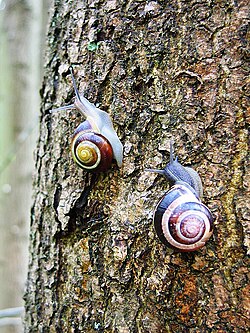
From the smallest snail to the largest primate, creatures have evolved diverse ways to navigate narrow branches, fight gravity, and bridge the gaps between treetops. These biological solutions not only allow animals to find food and shelter but also provide a blueprint for movement on other steep surfaces, such as rock piles and mountains.
Key Facts
- Brachiation is a high-speed swinging motion used exclusively by certain primates like gibbons.
- Prehensile tails act as a fifth limb for stability in species such as spider monkeys and silky anteaters.
- Dry adhesion allows geckos to stick to smooth surfaces using van der Waals forces.
- Center of mass management is critical to prevent toppling on narrow substrates.
- Passive stability is achieved by animals like sloths that hang beneath branches.
The Biomechanics of Tree Navigation
Moving through a forest canopy is far more complex than walking on flat ground. Animals must solve several mechanical problems to survive and thrive.
The Challenge of Diameter and Balance
On the ground, an animal's center of mass can shift side-to-side without risk. However, on a narrow branch, this same shift can move the center of mass beyond the edge of the substrate, causing the animal to topple. To counter this, many species have developed pedal grasping to clamp themselves firmly to small diameters.
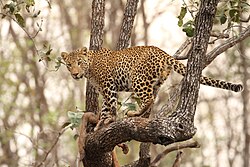
Balance requirements change based on the branch's orientation. On horizontal branches, the risk is tipping sideways. On vertical branches, the danger shifts to pitching backward or slipping downward. Large-diameter branches can actually be more difficult for some animals because they cannot place their forelimbs closer to the center than their hindlimbs.
Managing Inclines and Gravity
Gravity is a constant adversary in the trees. When ascending, animals must exert more energy to raise their body mass, often increasing their gait frequency and grasping with all four limbs. Descending is often more dangerous; to prevent uncontrolled falls, highly arboreal species increase the contact area between their limbs and the branch to maximize friction and braking power.
Crossing Gaps and Overcoming Obstructions
Finding resources often requires moving between separate trees. Depending on the density of the forest, animals use different strategies: some use simple brachiation, while others have evolved the ability to jump long distances or glide through the air.
Obstructions, such as intersecting branches, can hinder limbed animals but often benefit snakes, who use these points as anchors to push themselves forward.
Anatomical Specializations
Evolution has equipped arboreal animals with a variety of specialized tools to handle the mechanical stresses of their environment.
Limbs and Tails
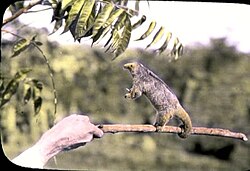
Many animals possess elongated limbs to reach resources or test the firmness of a branch. Conversely, some lizards have reduced limb sizes to avoid getting snagged on cluttered branches. Prehensile tails—tails capable of grasping—are common in howler monkeys, chameleons, and silky anteaters. Some, like the crested gecko and spider monkey, even have adhesive pads or bare patches on their tail tips for extra friction.
Claws, Adhesion, and Gripping
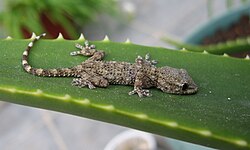
Claws are essential for navigating rough surfaces like bark or rockfaces, though they can be cumbersome on very thin twigs. For smooth surfaces, animals rely on adhesion. Tree frogs use wet adhesion (suction or capillary action), while geckos utilize dry adhesion via van der Waals forces.
Primates use frictional gripping, relying on hairless fingertips to squeeze branches. Other animals, like chameleons, use mitten-like feet, while birds use specialized perching grips.
Size and Stability
Smaller animals have a natural advantage: a lower center of mass and a higher relative branch size, which increases stability. Some animals, such as sloths and bats, achieve passive stability by hanging beneath the branch, effectively removing the risk of tipping or pitching.
Specialized Locomotion Styles
Brachiation
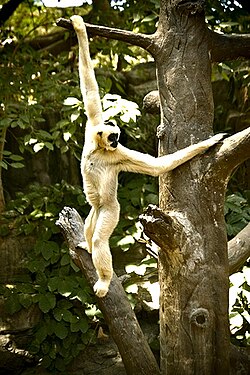
Brachiation is the most specialized form of arboreal movement, involving swinging from one handhold to another. This is seen primarily in primates. Gibbons are the masters of this technique, capable of traveling at speeds up to 56 km/h (35 mph) and covering distances of 15 meters (50 ft) in a single swing.
Gliding and Parachuting
To bridge wide gaps, some animals use patagia (skin membranes) to glide, such as flying squirrels. Others, like certain "flying frogs" (genus Rhacophorus), use toe membranes for parachuting, which slows their descent after a leap.
Limbless Climbing
Snakes utilize two primary methods of movement. On bare branches, they use concertina locomotion (a slow, accordion-like movement). In cluttered environments with secondary branches, they switch to lateral undulation, which is significantly faster.
Summary of Arboreal Adaptations
| Adaptation | Mechanism | Example Species |
|---|---|---|
| Brachiation | Arm-swinging | Gibbons, Spider Monkeys |
| Dry Adhesion | van der Waals forces | Geckos |
| Prehensile Tail | Grasping appendage | Silky Anteaters, Howler Monkeys |
| Gliding | Patagia membranes | Flying Squirrels |
| Concertina | Accordion-like contraction | Arboreal Snakes |
Evolutionary History
The ability to climb is an ancient trait. The earliest known climbing tetrapod is Eoscansor, a varanopid amniote from the Late Carboniferous of North America. Later, during the Late Permian (approximately 260 million years ago), the anomodont synapsid Suminia from Russia also displayed specialized climbing adaptations.
Frequently Asked Questions
What is the difference between scansorial and arboreal animals?
Scansorial animals are those that can climb trees occasionally but do not live in them exclusively. Arboreal animals are those that spend the majority of their lives in the tree canopy.
How do geckos stick to smooth walls?
Geckos use dry adhesion, which relies on van der Waals forces generated by specialized structures on their toes, allowing them to adhere to surfaces as smooth as glass.
What is brachiation?
Brachiation is a form of locomotion used by some primates, such as gibbons, where they move rapidly by swinging from branch to branch using only their arms.
How do snakes move efficiently in trees?
Snakes use concertina locomotion on bare branches and lateral undulation when they can push off secondary branches, making them highly effective in cluttered environments.
Why is a low center of mass important for climbing?
A lower center of mass reduces the likelihood of pitching or toppling over, which is a constant risk when balancing on narrow substrates like tree branches.