Arapaho History: From the Great Lakes to the Great Plains
The history of the Arapaho people is a saga of resilience, adaptation, and strategic alliance. Originally an agricultural society from the western Great Lakes region, the Arapaho transitioned into a powerful nomadic presence on the Great Plains, navigating complex relationships with other Indigenous nations and enduring violent conflicts with the expanding United States.
Early History and Migration
Approximately 3,000 years ago, the ancestral Arapaho-speaking people, known as the Heeteinono'eino', resided along the Red River Valley in present-day Minnesota and Manitoba, Canada. During this era, they were agriculturalists who cultivated crops such as maize. However, the pressures of European colonization in eastern Canada, combined with conflict with the Ojibwe, forced the Arapaho and the early Cheyenne (Hitesiino') to migrate westward toward the eastern Great Plains.
By the early 1700s, the Arapaho had established themselves on the northern plains, spanning from the South Saskatchewan River in Canada south to Montana, Wyoming, and western South Dakota. A pivotal shift in their way of life occurred during this period with the acquisition of horses. Previously dependent on domestic dogs to pull travois (sled-like frames for transporting goods), the introduction of horses allowed the Arapaho to become nomadic. This mobility increased their hunting efficiency and enabled them to transport larger loads across the vast plains.
Expansion and Tribal Alliances
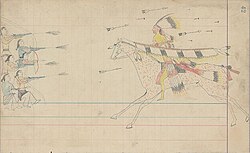
The Arapaho expanded their influence through a combination of trade, warfare, and strategic diplomacy. Around 1811, they formed a powerful alliance with the Cheyenne (Hítesíínoʼ), which significantly expanded their hunting territories. By 1826, this coalition, along with the Lakota and Dakota, pushed the Comanche and Kiowa southward. While initial relations were hostile, the Arapaho and Southern Cheyenne eventually made peace with the Kiowa and Comanche in 1840, turning former enemies into allies.
Despite these alliances, the Arapaho maintained a complex web of rivalries. They fought various groups to the east, including the Pawnee, Omaha, Osage, and Ponca. To the north, they clashed with the Crow, the Blackfoot Confederacy, and the Iron Confederacy. Their western borders saw conflict with the Ute and Shoshone, while occasional skirmishes occurred to the south with the Navajo, Apache, and various Pueblo peoples.
The Sand Creek Massacre
The mid-19th century brought escalating tensions between the Arapaho, Cheyenne, and white settlers. In April 1864, a dispute involving a rancher and 15 warriors led to a skirmish that was reported to Colonel John Chivington as an unprovoked attack. Chivington, fueled by reports of stolen cattle, ordered his troops to "chastise" the Indigenous populations, leading to the burning of villages.
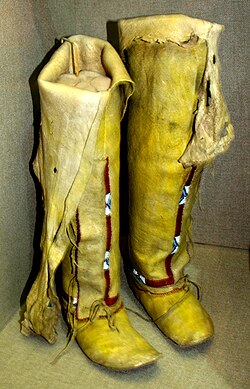
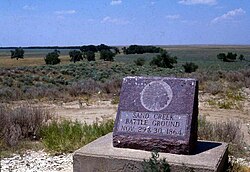
In November 1864, this violence culminated in the Sand Creek Massacre. The Colorado militia, led by Chivington, attacked a small village of Cheyenne and Arapaho. The attack was influenced by Governor Evans' desire for the resource-rich Denver-Boulder area and the marginalization of Chief Left Hand, a linguistically gifted Southern Arapaho leader. Elders, women, and children, who had been denied their traditional wintering grounds and ordered to Fort Lyon for protection, were targeted in the slaughter.
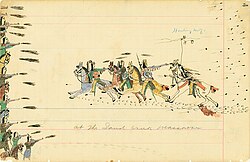
The tragedy was later brought to wider public attention through the work of Cheyenne–Northern Arapaho artist Eugene Ridgely. His children, Gail, Benjamin, and Eugene "Snowball" Ridgely, were instrumental in designating the site as a National Historic Site. In 1999, the family organized a memorial run from Limon, Colorado, to Ethete, Wyoming, to honor those who fled the massacre.
The Indian Wars of the Southern Plains
The atrocities at Sand Creek ignited three decades of warfare, often categorized as the Colorado War and the Comanche Wars. Allied forces of Arapaho, Cheyenne, Kiowa, Comanche, and Plains Apache fought against U.S. forces, often supported by Lakota warriors from the north.
- Battle of Julesburg: A decisive victory for allied Northern Arapaho, Cheyenne, and Lakota forces in retaliation for Sand Creek.
- Battle of Platte Bridge: Another significant victory for the allied tribes, resulting in 29 U.S. soldiers killed.
- Medicine Lodge Treaty (1867): A peace treaty that allotted the Southern Arapaho and Southern Cheyenne a reservation in present-day Oklahoma. Chief Little Raven was among the signatories.
- Battle of Summit Springs: The final major battle on the southern plains, resulting in a U.S. victory and the death of the Cheyenne leader Tall Bull.
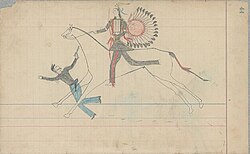
The Powder River Expedition and Red Cloud's War
Following the conflicts in Colorado, many Northern Arapaho, Cheyenne, and Lakota moved to the Powder River country of Wyoming and Montana. Tensions rose as settlers and miners used the Bozeman Trail to reach Montana goldfields, competing with the tribes for food and resources.
The U.S. responded with the Powder River Expedition. While largely inconclusive, it included the Battle of the Tongue River, where U.S. forces and scouts from the Pawnee, Omaha, and Ho-Chunk attacked a camp under Chief Black Bear, killing 63 Arapaho, mostly women and children.
This era also saw Red Cloud's War (1866–1868). The most notable engagement was the Fetterman Fight on December 21, 1866. Captain William J. Fetterman was lured into an ambush by a small group of decoys (including two Arapaho). The resulting hand-to-hand combat led to the death of all 81 U.S. personnel, marking the greatest U.S. military defeat on the Great Plains until the Battle of the Little Bighorn.
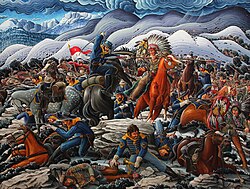
The Great Sioux War and the Battle of the Little Bighorn
The Great Sioux War (1876–77) was triggered by the illegal entry of miners into the sacred Black Hills, violating the Treaty of Fort Laramie. The conflict peaked at the Battle of the Little Bighorn on June 25–26, 1876.
While the battle primarily involved the Lakota and Cheyenne, five Arapaho warriors were present by chance. Four Northern Arapaho (Yellow Eagle, Yellow Fly, Left Hand, and Water Man) and one Southern Arapaho (Well-Knowing One/Green Grass) had been captured by the Sioux and later released by Chief Two Moons. These five warriors fought alongside the alliance, with Water Man claiming to have witnessed the death of George Armstrong Custer.
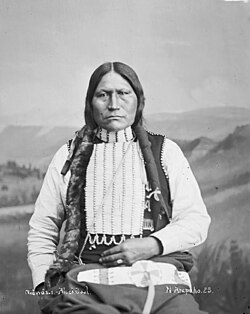
Throughout these conflicts, leaders like Chief Black Coal worked to maintain peace and keep the Arapaho out of the broader Great Sioux War of 1876.
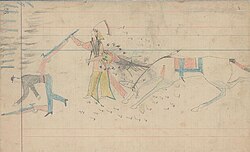
Key Facts
- Ancestral Origins: Originally agriculturalists in the western Great Lakes region (Manitoba and Minnesota).
- Lifestyle Shift: Transitioned from using dog travois to horses in the early 1700s, becoming nomadic hunters.
- Major Alliance: Formed a critical strategic partnership with the Cheyenne around 1811.
- Sand Creek Massacre: A 1864 atrocity by the Colorado militia that sparked decades of war.
- Fetterman Fight: A major victory for the Arapaho, Cheyenne, and Lakota in 1866.
- Little Bighorn: Five Arapaho warriors participated in the defeat of Custer's 7th Cavalry.
| Event | Date | Key Outcome |
|---|---|---|
| Sand Creek Massacre | November 1864 | Massacre of Cheyenne and Arapaho village; sparked 30 years of war. |
| Medicine Lodge Treaty | October 1867 | Established reservation in Indian Territory (Oklahoma). |
| Fetterman Fight | December 1866 | Decisive victory for Indigenous alliance; 81 U.S. soldiers killed. |
| Battle of Little Bighorn | June 1876 | Annihilation of Custer's battalion by Lakota, Cheyenne, and Arapaho. |
Frequently Asked Questions
How did the acquisition of horses change Arapaho society?
Horses replaced domestic dogs as pack animals, allowing the Arapaho to move larger loads and travel further. This transformed them from agriculturalists into nomadic hunters, increasing their success on the Great Plains.
What was the significance of the alliance with the Cheyenne?
The alliance, formed around 1811, provided mutual strength that allowed both tribes to expand their hunting territories and successfully push other groups, such as the Kiowa and Comanche, further south.
Who was Chief Left Hand?
Chief Left Hand was a linguistically gifted Southern Arapaho leader who was marginalized by government trust officials during the execution of treaties regarding the Denver-Boulder area.
What happened during the Fetterman Fight?
Captain William J. Fetterman ignored orders and pursued a small group of decoys into an ambush. Indigenous warriors used hand-to-hand combat with tomahawks and war clubs to kill all 81 U.S. personnel.
Were many Arapaho present at the Battle of the Little Bighorn?
No, only five Arapaho warriors were present by chance. They had been captured by the Sioux and later released by Chief Two Moons to fight alongside the alliance.