Aquilegia hinckleyana: The Rare Golden Columbine of Texas
Deep within the Sierra Vieja mountains of northwestern Presidio County, Texas, grows a botanical treasure known as Aquilegia hinckleyana, or Hinckley's golden columbine. This striking flowering plant is endemic to a very specific location: Capote Falls. While it is critically imperiled in the wild, it has found a second life in gardens across Texas, where it is prized for its vibrant yellow blooms and elegant form.
As a member of the Ranunculaceae (buttercup) family, this plant is a short-lived perennial characterized by its delicate structure and specialized pollination needs. Its discovery and classification have sparked botanical debate, reflecting the complex nature of plant taxonomy.
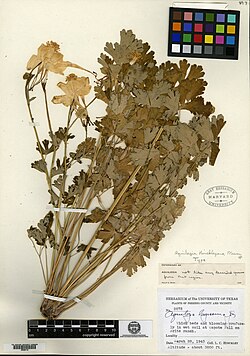
Key Facts
- Scientific Name: Aquilegia hinckleyana (also referred to as Aquilegia chrysantha var. hinckleyana).
- Conservation Status: Critically Imperiled (NatureServe T1).
- Native Range: Endemic to Capote Falls, Presidio County, Texas.
- Distinctive Features: Yellow flowers with long nectar spurs and a height of approximately 60 cm.
- Pollination: Sphingophilous (pollinated by hawkmoths).
- Toxicity: Poisonous to both humans and animals.
Botanical Description
Aquilegia hinckleyana is a compact perennial, typically reaching a height of around 60 centimeters (24 in), with stems generally ranging from 50 to 70 centimeters. The stems are glabrous (smooth and hairless) and glaucous (covered with a grayish-blue waxy coating) below the base.
The plant features basal leaves that are biternately compound—meaning the leaf stalks divide twice, with each final division bearing three leaflets. These leaves typically measure between 20 and 40 centimeters in length, remaining shorter than the plant's stems.
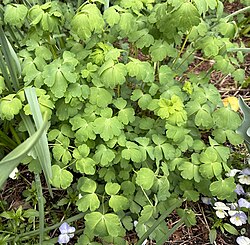
The most striking feature is the yellow flowers, which stand suberect with spreading sepals roughly 25 millimeters long. These flowers possess slender nectar spurs approximately 4 centimeters long, designed to attract specific pollinators. The plant propagates naturally as seeds drop to the ground to replace the parent plants.
Ecology and Pollination
This species is sphingophilous, meaning it has evolved specifically to be pollinated by moths, particularly hawkmoths. This co-adaptation is evident in the plant's pale coloration and its production of nectar during the night. Because of these traits, A. hinckleyana is grouped within the Aquilegia coerulea species complex.
Beyond its relationship with pollinators, the plant serves as a host for the larvae of the columbine duskywing butterfly (Erynnis lucilius).
Taxonomy and Etymology
The plant was first collected on March 28, 1943, by L. C. Hinckley, a resident of Marfa, Texas. It was formally described in 1946 by botanist Philip A. Munz, who named the species in honor of its discoverer.
Taxonomic classification has varied over time. In 1985, Emily J. Lott proposed that A. hinckleyana be reclassified as a variety of Aquilegia chrysantha (A. chrysantha var. hinckleyana). This view is supported by the Lady Bird Johnson Wildflower Center and some commercial nurseries. However, the Royal Botanic Gardens, Kew, and the Flora of North America maintain Munz's original classification of the plant as a distinct species.
The name "columbine" comes from the Latin columbinus ("dove"), referring to the flower's shape. The genus name Aquilegia may derive from aquila ("eagle"), referencing the talon-like petals, or aquam legere ("to collect water").
Distribution and Conservation
In the wild, A. hinckleyana is found exclusively around Capote Falls on the privately held Brite Ranch. It thrives in the moist banks beneath overhanging cliffs, a stark contrast to the generally dry environment of the surrounding region.
Due to its extremely limited range, the species is rated as Critically Imperiled. The Nature Conservancy has identified several primary threats to its survival, including:
- Water diversion
- Overgrazing
- Pollution
Cultivation and Use
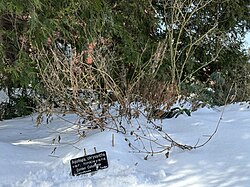
While rare in nature, the plant is popular in Texas horticulture. The 'Texas Gold' cultivar is particularly sought after for its golden-yellow flowers and long spurs. It is a shade-tolerant plant that prefers well-drained soils rich in organic matter. In clay soils, it is best grown in elevated beds to prevent root rot.
Gardeners often plant it near deciduous trees to ensure summer shade and winter sunlight. The plant is resistant to rabbits and deer and attracts bees, butterflies, and hummingbirds. To encourage more blooms, gardeners can remove spent flowers; however, leaving them allows the plant to self-seed.
Historically, the Paiute peoples of the Four Corners region used related columbine species for medicinal purposes, using roots for rheumatism and coughs, and seeds as perfumes. However, it is important to note that Aquilegia hinckleyana is poisonous to humans and animals.
| Feature | Detail |
|---|---|
| Average Height | 60 cm (24 in) |
| Flower Color | Yellow |
| Native Habitat | Capote Falls, Texas |
| Pollinator | Hawkmoths |
| Conservation Status | Critically Imperiled (T1) |
| Key Cultivar | 'Texas Gold' |
Frequently Asked Questions
Is Aquilegia hinckleyana the same as Aquilegia chrysantha?
There is botanical disagreement. Some organizations, like the Lady Bird Johnson Wildflower Center, classify it as a variety (A. chrysantha var. hinckleyana), while others, including the Royal Botanic Gardens, Kew, recognize it as a separate species.
Where can I find this plant in the wild?
It is endemic only to a small area around Capote Falls in northwestern Presidio County, Texas, specifically on the moist banks under overhanging cliffs.
Is the Golden Columbine safe for pets?
No, Aquilegia hinckleyana is poisonous to both humans and animals.
How do I grow 'Texas Gold' columbine in my garden?
Plant it in well-drained, organic-rich soil. If using clay, use an elevated bed. It prefers partial shade, such as under a deciduous tree, and is resistant to deer and rabbits.
Why is this plant considered "sphingophilous"?
It is sphingophilous because it has evolved specific traits—such as pale yellow flowers and nocturnal nectar production—to attract and be pollinated by hawkmoths.