Aquilegia canadensis: A Comprehensive Profile of the Canadian Columbine
The Aquilegia canadensis, commonly known as the Canadian columbine, is a striking herbaceous perennial that brings vibrant color to natural landscapes. As a member of the Ranunculaceae (buttercup) family, this plant is celebrated for its unique, nodding flowers and its ability to thrive in diverse environments. Whether growing in the wild or managed in a garden, the Canadian columbine is a testament to botanical resilience and beauty.
![Illustration from Wild Flowers of New York, 1918[16]](/images/f3/da/f3dad689935394116244a6770cb89a9f185336198139ef61c0493964454df407.jpg)
Key Facts
- Scientific Name: Aquilegia canadensis L.
- Family: Ranunculaceae
- Growth Habit: Herbaceous perennial, 15–90 cm tall (occasionally up to 1 m).
- Flower Characteristics: Nodding flowers with red sepals and yellow nectar-bearing spurs.
- Conservation Status: Secure (NatureServe).
- Hardiness: Can tolerate temperatures from -23 °C to 43 °C.
Botanical Classification and Taxonomy
The Canadian columbine was formally named by Carl Linnaeus in 1753. Within the biological hierarchy, it belongs to the kingdom Plantae, the clade Angiosperms (flowering plants), and the order Ranunculales. While the species is currently recognized without accepted varieties, botanical history shows a complex web of 26 heterotypic synonyms, reflecting various historical classifications of its different forms.
| Rank | Taxon |
|---|---|
| Kingdom | Plantae |
| Clade | Embryophytes |
| Clade | Tracheophytes |
| Clade | Angiosperms |
| Clade | Eudicots |
| Order | Ranunculales |
| Family | Ranunculaceae |
| Genus | Aquilegia |
| Species | A. canadensis |
Physical Description and Morphology
Stem and Root Structure
The plant grows from a substantial caudex, which is a vertically oriented underground stem. From this base, it produces hollow stems that are typically hairless, though some may feature fine, short, erect glandular hairs on the upper sections. Its roots are fibrous and relatively short-lived.
Foliage and Leaves
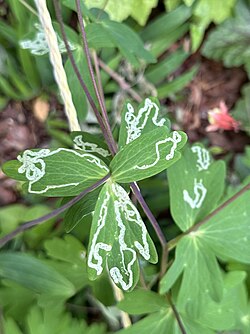
The leaves of the Canadian columbine are two times ternately compound. This means each leaf is divided into three parts, with each part containing three leaflets, totaling nine leaflets per leaf. The leaflets are broadly ovate or egg-shaped with wavy teeth or lobes. While the upper surfaces are hairless, the undersides often possess very fine, short hairs that lend the foliage a pale appearance. The leaves range from green to blue-green and can remain evergreen in specific temperature ranges.
Floral Characteristics
Blooming between March and July, the flowers are highly distinctive. A typical flower features five petals that begin as yellow and elongate into red, nectar-bearing spurs. These alternate with five red, petal-like sepals. While the red and yellow combination is standard, rare wild variations may appear entirely salmon, yellow, or white. The flowers are nodding, hanging downwards with the stamens projecting toward the ground. They typically measure between 2 to 5 cm in total size.
Reproduction and Life Cycle
Following successful pollination, the plant develops upright clusters of five pod-shaped follicles. These follicles, measuring 1.5–3 cm in length, taper into a slender beak. As they mature, they split to release numerous small, shiny, black seeds. These seeds develop rapidly, often reaching maturity just two weeks after the flowering period ends.
Cultivation and Habitat Preferences
In the wild, Canadian columbines thrive in light to moderate shade. They prefer well-drained sandy loams and are often found in limestone-based or circumneutral soils. While they are short-lived perennials, they are excellent self-seeders, which allows populations to persist over many years.
For those growing them in cultivation, keep the following in mind:
- Soil: Avoid soils that are excessively rich or too moist, as this can lead to weak plants and a shorter lifespan.
- Moisture: While mature plants can tolerate drought, consistent moisture promotes the best growth.
- Germination: Seedlings usually flower in their second year. While not required, a cool-moist stratification at 5 °C for three to four weeks can speed up sprouting.
- Storage: Seeds can be stored in bags at 5 to 6 °C for three to four months.
Frequently Asked Questions
What is a caudex?
A caudex is a thickened, vertically oriented underground stem that serves as a storage organ for the plant.
How tall can Canadian columbine grow?
In the wild, they typically grow between 15 and 90 centimeters tall, though they can occasionally reach up to 1 meter.
Can these plants survive extreme temperatures?
Yes, the plant is quite resilient. It can remain evergreen at temperatures as low as −23 °C (−10 °F) and as high as 43 °C (110 °F), entering a dormant state at these extremes.
What do the flowers look like?
The flowers are nodding and showy, featuring red sepals and petals that transition from yellow at the opening into long, red, nectar-bearing spurs.
How long does the blooming period last?
Depending on weather conditions, the flowering period generally lasts for about one month, starting as early as March or as late as July.