Apache Pre-Reservation Culture and Social Traditions
Before the reservation era, the Apache peoples maintained a sophisticated social structure and a deep connection to the diverse landscapes of the American Southwest. Their culture was characterized by a strong emphasis on family lineage, a complex understanding of kinship, and a resourceful approach to survival through hunting, gathering, and spiritual practice.
Social Organization
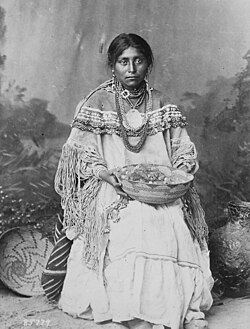
The foundation of Apache society was the extended family unit, or family cluster. These groups typically lived in close proximity, with each nuclear family maintaining its own dwelling. The structure was primarily matrilocal, meaning the extended family was connected through a lineage of women. When a daughter married, a new home was constructed nearby for her and her husband, who would leave his parents' family to join his wife's.
While matrilocal residence was the norm, particularly among the Western Apache, some eldest sons chose to bring their wives to live with their parents. Across all tribes, the practices of sororate and levirate marriages were observed.
Social interactions were often governed by strict rules of avoidance. Among the Chiricahua, this was most evident in the relationship between a son-in-law and his mother-in-law. Men were required to use indirect, polite speech and avoid being within visual sight of their wife's female relatives.
On a broader scale, local groups often merged into bands. This organization was strongest among the Chiricahua and Western Apache, while the Navajo utilized a smaller group called "the outfit." The Western Apache further organized bands into five distinct groups: Northern Tonto, Southern Tonto, Cibecue, San Carlos, and White Mountain. The Jicarilla utilized moieties (social divisions), and both the Navajo and Western Apache employed matrilineal clans and phratries.
Interestingly, the concept of a single "tribe" was weak. Political independence was the rule, and different Apache groups occasionally fought one another, such as the conflict between the Lipan and Mescalero.
Kinship Systems
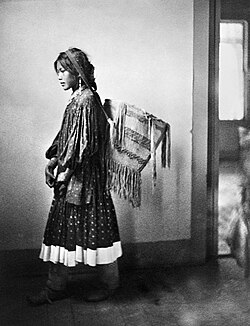
The Apache tribes utilized two primary kinship term systems: the Chiricahua type and the Jicarilla type.
The Chiricahua-Type System
Used by the Chiricahua, Mescalero, and Western Apache, this system is highly specific regarding grandparents. For example, the Chiricahua have four distinct words for grandparents based on whether they are maternal or paternal. These terms are reciprocal; a grandmother calls her grandchild by the same term she is called.
In this system, cousins are not distinguished from siblings. Terms are based on the sex of the speaker: -kʼis for same-sex siblings/cousins and -´-ląh for opposite-sex siblings/cousins. Relationships categorized as -´-ląh required great respect and, in the case of cousins, total avoidance.
The Jicarilla-Type System
Used by the Jicarilla, Navajo, Lipan, and Plains Apache, this system is simpler regarding grandparents, using only two terms based on sex (grandmother and grandfather) regardless of the parental line. Unlike the Chiricahua system, these terms are not reciprocal.
The Jicarilla system distinguishes between parallel-cousins (children of a parent's same-sex sibling) and cross-cousins. It also employs specific terms for siblings based on their age relative to the speaker, such as -ndádéé for an older sister.
Housing and Architecture
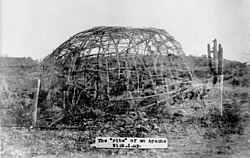
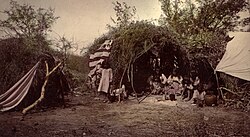
Apache dwellings varied by environment and tribe. In the plains, tipis were common. In the highlands, they built wickiups—eight-foot-tall wooden frames bound with yucca fibers and covered in brush. A wickiup was traditionally burned if a family member passed away.
In the deserts of northern Mexico, the Apache lived in hogans, which were earthen structures designed to keep the interior cool.
Diet and Resource Acquisition
The Apache relied on a combination of hunting, gathering, small-scale cultivation, trade, and raiding. While men primarily handled the hunting, women were the primary gatherers of wild plants.
Hunting Practices
Dietary taboos were common; many Apache groups avoided eating bears, fish, snakes, and owls. However, these varied by tribe; for instance, the Lipan ate black bear, while the Jicarilla considered the bear evil.
- Western Apache: Focused on deer and pronghorns, smoking meat into jerky in late fall.
- Chiricahua: Hunted deer, pronghorn, and various small game like cottontail rabbits and squirrels.
- Mescalero: Primarily hunted deer, as well as bighorn sheep and buffalo.
- Jicarilla: Hunted a wide variety of game, including bighorn sheep, buffalo, and various birds.
- Plains Apache: Focused heavily on buffalo and deer.
Gathering and Ethnobotany
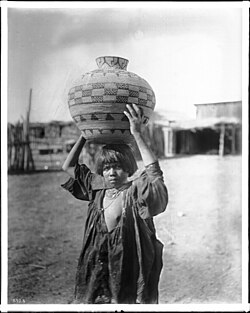
Plants provided essential nutrition and medicine. The Century plant (agave or mescal) was the most critical resource for the Chiricahua and Mescalero; its crowns were baked in underground ovens and dried.
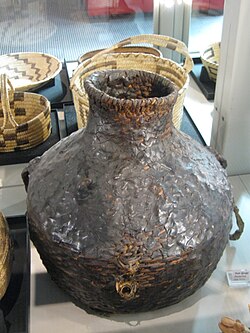
![Various Apache containers: baskets, bowls and jars. Apache women wove yucca, willow leaves, or juniper bark into baskets that could hold heavy loads.[52]](/images/5b/4c/5b4c8f9ba20130e614f4d2a5d0baeda3223cf98520ee5e26d6344d4e10609f47.jpg)
Other gathered foods included pinyon nuts, juniper berries, prickly pear fruit, and various seed grasses. The Navajo practiced the most extensive crop cultivation, while the Plains Apache and some Chiricahua bands grew no crops at all.
Religion and Spirituality
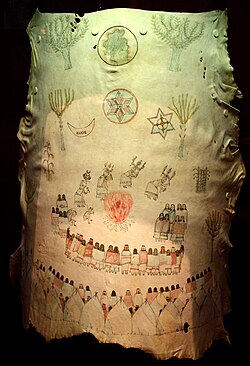
Apache spirituality centered on diyí'—abstract, invisible forces derived from animals, plants, minerals, and meteorological phenomena. These forces could be acquired and used for human purposes through ritual.
Ceremonial practices differed by group. The Chiricahua and Mescalero relied more on personal religious visions, whereas the Jicarilla and Western Apache used standardized rituals. Notable ceremonies include the Sunrise Dance (a puberty ceremony for young women) and the use of sandpainting—temporary sacred art created by healers.
The trickster figure, Coyote, appears frequently in their stories, often overturning social conventions. Many groups also shared an emergence or Creation Story, though this was absent among the Chiricahua and Mescalero.
Key Facts
- Social Structure: Matrilocal extended families where husbands joined the wife's family.
- Housing: Used tipis (plains), wickiups (highlands), and hogans (desert).
- Diet: Heavily dependent on agave (mescal), deer, and buffalo, with strict animal taboos.
- Kinship: Two distinct systems (Chiricahua and Jicarilla) with varying rules for reciprocity and cousin identification.
- Spirituality: Focused on diyí' (natural forces) and standardized rituals like the Sunrise Dance.
| Apache Group | Primary Housing | Key Food Sources |
|---|---|---|
| Plains Apache | Tipi | Buffalo, Deer, Prairie Turnips |
| Chiricahua | Wickiup | Agave, Deer, Pronghorn |
| Western Apache | Wickiup | Deer, Pronghorn, Cultivated Crops |
| Navajo | Hogan / Others | Cultivated Crops, Sheep |
| Mescalero | Wickiup | Agave, Deer, Bighorn Sheep |
Frequently Asked Questions
What is matrilocal residence?
Matrilocal residence is a social system where a married couple lives with or near the wife's parents, centering the extended family around a female lineage.
What was a wickiup?
A wickiup was a traditional highland dwelling consisting of an 8-foot-tall wooden frame bound with yucca fibers and covered with brush.
How did the Chiricahua kinship system differ from the Jicarilla system?
The Chiricahua system used specific, reciprocal terms for maternal and paternal grandparents and did not distinguish cousins from siblings. The Jicarilla system used general terms for grandparents by sex and distinguished between parallel and cross-cousins.
What was the significance of the Century plant?
Also known as agave or mescal, the Century plant was a primary food source for the Chiricahua and Mescalero, with its crowns being baked in underground ovens.
What is the Sunrise Dance?
The Sunrise Dance is a standardized puberty ceremony for young women, particularly among the Western Apache.