Antirrhinum majus: The Science and Cultivation of the Common Snapdragon
The Antirrhinum majus, widely known as the common snapdragon, is a captivating flowering plant prized by gardeners and scientists alike. Belonging to the genus Antirrhinum and the family Plantaginaceae (having been moved from Scrophulariaceae), this species is celebrated for its unique floral structure. Its common name is derived from the flower's "mouth," which snaps open when the sides of the corolla are squeezed, mimicking the jaw of a dragon.
Cultivated since the 15th century, the snapdragon is a versatile ornamental plant used extensively in garden borders and as a cut flower. While naturally a perennial, it is frequently grown as an annual or biennial in colder climates to ensure vibrant blooms each season.
Key Facts
- Scientific Name: Antirrhinum majus
- Native Range: South-central France, eastern Pyrenees, northeastern Spain, and the Balearic Islands.
- Pollinators: Primarily bumblebees, which are strong enough to open the "masked" flower.
- Growth Habit: Herbaceous perennial reaching 0.5 to 1 meter (rarely up to 2 meters).
- Scientific Value: Used as a model organism for studying plant development and genetics.
Botanical Description
The snapdragon is an herbaceous plant characterized by spirally arranged, broadly lanceolate leaves measuring 1–7 cm in length. Its stems are round and can become woody toward the middle. The plant produces flowers on a tall spike, typically containing 8 to 30 short-stalked blossoms.
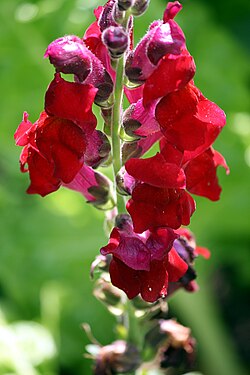
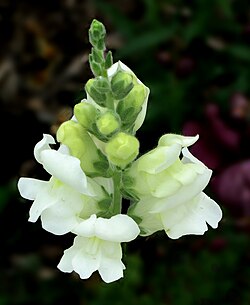
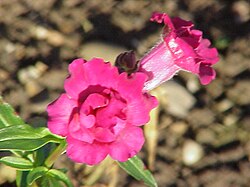
The flowers are zygomorphic (bilaterally symmetrical) and measure 3.5 to 4.5 cm in length. They feature a "masked" corolla tube with two lips that close the opening. While wild varieties are typically pink to purple with yellow lips, cultivated varieties appear in red, pink, orange, yellow, and white.
![Intermediate inheritance of flower colour due to incomplete dominance[5]](/images/38/9c/389c2bbd8a842f533a9e140dc08b7cf640f5132b5927a6e2f3e07214115d9178.png)
The plant's reproductive system includes a circle of four stamens and a hypogynous (superior) ovary. Once pollinated, it produces an ovoid capsule, roughly 10–14 mm in diameter, which bears a striking resemblance to a human skull and contains numerous small seeds.
Cultivation and Varieties
For optimal growth, Antirrhinum majus thrives in temperatures between 17–25 °C (63–77 °F), with nighttime temperatures of 15–17 °C (59–63 °F) promoting stem and apical meristem development. They can be grown from seeds—flowering within 3 to 4 months—or from cuttings.
Gardeners can choose from various forms, including the trailing variety known as A. majus pendula. Some cultivars exhibit peloric flowers, where the standard asymmetrical shape is replaced by a single, large, symmetrical bloom. Notable cultivars recognized by the Royal Horticultural Society include 'Floral Showers Deep Bronze' and 'Montego Pink'.
Pests and Diseases
Despite its resilience, the snapdragon is susceptible to several biological threats. Insects such as aphids and Frankliniella occidentalis (thrips) can damage terminal growth and flower buds. Thrips, in particular, can remove pollen from the anther and are sometimes managed using the predatory mite Neoseiulus.
Fungal infections are the most common diseases affecting the species:
- Anthracnose: Caused by Colletotrichum, resulting in yellow spots with brown borders on leaves and stems.
- Botrytis: Causes wilting and browning of flower spikes, worsening in warm weather.
- Rust: Appears as light-green circles that turn into brown pustules, often leading to premature blooming and decomposition.
- Pythium and Stem Rot: These can cause wilting or cottony growth near the soil line, often requiring the destruction of the infected plant.
The Snapdragon as a Model Organism
In laboratory settings, Antirrhinum majus is a vital model organism for biochemical and developmental genetics. Its diploid inheritance, short generation time, and ease of pollination make it ideal for research. It is particularly famous for the DEFICIENS gene, which contributed the "D" to the MADS-box gene family, essential for plant development.
Researchers have used the snapdragon to study the Tam3 transposon, discovering that low-temperature-dependent transposition causes changes in DNA methylation, rather than methylation controlling the transposition itself. Additionally, studies on the MIXTA locus have helped scientists understand how conical-papillate epidermal cells on petals affect light absorption and pollinator attraction.

Chemical Properties and Uses
The plant contains antirrhinin, an anthocyanin (a type of pigment) that is the 3-rutinoside of cyanidin. Its chemical makeup includes resins, pectin, gallic acid, and mucilages. Historically, these properties have been utilized for various medicinal purposes:
- External: Used as a topical emollient, astringent, and in poultices for erythemas.
- Internal: Used to treat colitis, heartburn, and as a diuretic or hepatic aid.
- Oral: Employed in gargles to treat ulcerations of the oral cavity.
| Feature | Details |
|---|---|
| Growth Height | 0.5–1 m (up to 2 m) |
| Flower Colors | Red, Pink, Orange, Yellow, White |
| Ideal Temperature | 17–25 °C (63–77 °F) |
| Primary Pollinator | Bumblebees |
| Key Gene | DEFICIENS (MADS-box) |
Frequently Asked Questions
Why is it called a snapdragon?
The name comes from the flower's unique structure; when the sides of the flower are squeezed, the mouth snaps open and shut, resembling the mouth of a dragon.
Is the snapdragon a perennial or an annual?
Botanically, it is a perennial plant. However, in many colder regions, it is cultivated as an annual or biennial because it may not survive the winter frost.
What is a peloric snapdragon?
A peloric snapdragon is a cultivar that produces a symmetrical flower instead of the typical zygomorphic (bilateral) shape found in the species.
How do bumblebees pollinate snapdragons?
Because the flower's mouth is "masked" or closed, only strong pollinators like bumblebees can force the flower open to enter and exit, collecting pollen in the process.
What is the scientific importance of the DEFICIENS gene?
The DEFICIENS gene in Antirrhinum majus is a key part of the MADS-box family of genes, which are critical for the developmental processes of plants.