Annie Oakley: The Life and Legacy of America's First Female Star
Annie Oakley remains one of the most iconic figures of the American West, a woman whose unparalleled skill with a rifle shattered gender norms and catapulted her to international fame. From her humble beginnings to her status as a global celebrity, Oakley's journey is a story of precision, perseverance, and the pursuit of excellence.
The Fateful Match and Marriage
Annie's rise to prominence began with a high-stakes challenge. In the late 19th century, Frank E. Butler, an Irish immigrant and professional marksman, bet $100 (approximately $2,900 in 2025) that he could outshoot any local marksman in Cincinnati. The match pitted Butler against a fifteen-year-old Annie. The contest involved shooting live pigeons released from traps; Butler ultimately lost the bet after missing his 25th shot.
While some accounts date this event to 1875, modern research suggests it may have occurred in 1881 near Greenville or North Fairmount. Following the match, Butler began courting Annie, and the two eventually married. Although various sources cite different dates, a certificate from the Archives of Ontario confirms they were wed on June 20, 1882, in Windsor, Ontario.
The couple began performing together as the Baughman & Butler shooting act, signing with Sells Brothers Circus in 1881. It was during this time that Annie adopted the stage name Oakley, likely derived from the Cincinnati neighborhood where they lived.
Rise to Global Stardom with Buffalo Bill
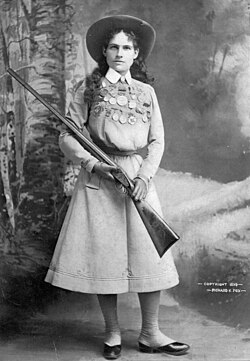
In 1885, Annie and Frank joined Buffalo Bill's Wild West, a massive touring spectacle. It was here that Sitting Bull gave her the nickname "Watanya Cicilla," which was translated for the public as "Little Sure Shot."
Oakley's path to the top was not without rivalry. In 1886, she faced professional competition from Lillian Smith, a sharpshooter eleven years her junior. This rivalry may have prompted Oakley to publicly claim she was five or six years younger than her actual age to remain competitive in the press. After a brief departure, Oakley returned for the 1889 Paris Exposition, a tour that established her as America's first female star. She became the highest-paid performer in the show, second only to Buffalo Bill himself.
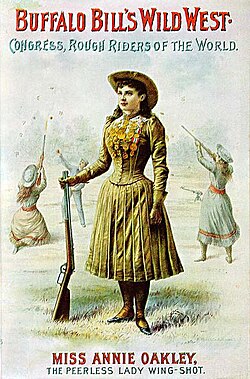
Her fame extended to European royalty, performing for Queen Victoria of the United Kingdom, King Umberto I of Italy, and President Marie François Sadi Carnot of France. One of her most legendary feats involved shooting the ashes off a cigarette held by the German Kaiser Wilhelm II.
Cultural Impact and "Annie Oakleys"
Oakley's influence permeated the theater industry. Complimentary tickets became known as "Annie Oakleys" because they were punched with holes to prevent resale, mimicking the playing cards Oakley famously shot through during her performances.
Advocacy, Adversity, and Later Years
Beyond the stage, Annie Oakley was a staunch advocate for women's empowerment. She believed firearms training provided essential physical and mental exercise and was vital for self-defense. Throughout her career, she is credited with teaching more than 15,000 women how to use a gun.
Her patriotism was equally evident. In 1898, she wrote to President William McKinley offering a company of 50 "lady sharpshooters" to serve in the Spanish-American War. While the government did not accept her offer, Theodore Roosevelt later named his volunteer cavalry the "Rough Riders" after the Buffalo Bill show's "Congress of Rough Riders of the World."
In 1901, a severe train accident left Oakley temporarily paralyzed and required five spinal operations. Following her recovery, she transitioned to a less physically demanding career in acting, starring in the play The Western Girl as Nancy Berry.
Early Film and Legal Battles
Oakley was an early pioneer of cinema. On November 1, 1894, she and Butler were filmed by William Heise in Thomas Edison's Black Maria studio. The resulting 21-second Kinetoscope film, titled Annie Oakley (or "Little Sure Shot of the Wild West"), captured her shooting stationary and moving objects.
Her later years were marked by a fight for her reputation. In 1904, William Randolph Hearst published a false story claiming Oakley had been arrested for theft to support a cocaine habit. The arrest had actually involved a burlesque performer who shared her name. While most papers apologized, Hearst attempted to dig up dirt on Oakley to avoid paying damages. Oakley spent the next six years filing 55 libel lawsuits, winning all but one.
Key Facts
- Nickname: "Little Sure Shot" (Watanya Cicilla).
- Career Peak: Highest-paid performer in Buffalo Bill's Wild West, second only to Buffalo Bill.
- Advocacy: Taught over 15,000 women how to handle firearms for self-defense.
- Film History: Featured in a 1894 Kinetoscope film by Thomas Edison.
- Legal Victory: Won 54 out of 55 libel lawsuits against newspapers following false cocaine allegations.
| Category | Details |
|---|---|
| Spouse | Frank E. Butler (Married June 20, 1882) |
| Major Affiliation | Buffalo Bill's Wild West |
| Notable Performance | 1889 Paris Exposition |
| Key Achievement | First American female global superstar |
| Later Career | Stage acting in "The Western Girl" |
Frequently Asked Questions
How did Annie Oakley meet her husband, Frank Butler?
They met during a shooting match in Cincinnati where Butler had bet he could beat any local shooter. Annie, then fifteen, won the match after Butler missed his 25th shot.
Why did Annie Oakley change her age in public records?
It is believed she claimed to be five or six years younger to maintain her status as a young prodigy, particularly after the arrival of the younger sharpshooter Lillian Smith in 1886.
What is the origin of the term "Annie Oakley" for complimentary tickets?
The term refers to complimentary tickets that had holes punched in them to prevent resale, resembling the playing cards Annie shot through during her act.
Did Annie Oakley ever serve in the military?
No, although she offered a company of 50 lady sharpshooters to President William McKinley for the Spanish-American War, the offer was not accepted.
How did Annie Oakley handle the false cocaine allegations?
She fought back through the legal system, filing 55 libel lawsuits against the newspapers that printed the false story, winning nearly all of them.