Anglo-Australian Telescope: A History of International Astronomical Collaboration
Following World War II, optical observational astronomy in the United Kingdom faced significant challenges due to outdated infrastructure. A critical gap existed in the Southern Hemisphere, where the lack of large telescopes hindered the study of some of the universe's most intriguing objects, including the Magellanic Clouds (satellite galaxies of the Milky Way) and the Galactic Center.
To address this, Richard Woolley—who served as the Director of Mount Stromlo Observatory from 1939 to 1956 and later as Astronomer Royal from 1956 to 1971—proposed the construction of a major telescope in Australia during the 1950s.
The Path to Construction
The early 1960s saw a series of technical discussions between British and Australian scientists to determine the specifications and a viable location for the instrument. In July 1965, a formal proposal was submitted to the governments of both nations. By April 1967, an agreement was reached to build the Anglo-Australian Telescope (AAT), a 150-inch instrument.
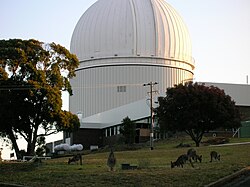
The chosen site was Siding Spring Mountain in the Warrumbungles, land owned by the Australian National University (ANU) that already hosted existing infrastructure.
To manage the early stages, the Joint Policy Committee was established in 1967. This interim body included prominent scientists Edward Bowen, Olin Eggen, Richard Woolley, and Jim Hosie. Operating from a project office in Canberra, the committee finalized the designs for the telescope, its mounting, and the building. They leveraged the expertise of staff who had previously worked on the Parkes radio telescope to secure worldwide contracts.
Governance and the Birth of the Observatory
The formal Anglo-Australian Telescope Agreement was signed on September 25, 1969, and officially took effect on February 22, 1971. This led to the replacement of the Joint Policy Committee with the Anglo-Australian Telescope Board (AATB), a legal entity under Australian law responsible for the telescope's operation.
However, the project faced internal conflict regarding its management. Olin Eggen (Director of Mount Stromlo and Siding Spring Observatories) and John Crawford (Vice-Chancellor of the ANU) argued that the telescope should fall under the existing control of the Mount Stromlo and Siding Spring Director, with staff provided by the ANU.
British astronomers, supported by Australian state university astronomers, disagreed. They feared losing their status as equal partners and campaigned for a separate director and staff who reported exclusively to the AATB. This dispute was resolved in June 1973 when the Australian government supported the AATB's decision to establish independent staff. This decision marked the official birth of the Anglo-Australian Observatory.
Joe Wampler became the first director in September 1974, and the institution has been led by five directors to date.
Key Facts
- Telescope Aperture: 150 inches.
- Location: Siding Spring Mountain, Warrumbungles, Australia.
- Key Proponents: Richard Woolley, Edward Bowen, Olin Eggen, and Jim Hosie.
- Governing Body: Anglo-Australian Telescope Board (AATB).
- First Director: Joe Wampler (appointed September 1974).
- Primary Goal: To enable high-quality optical observation of the Southern Hemisphere sky.
| Milestone | Date/Period | Details |
|---|---|---|
| Initial Proposal | 1950s | Suggested by Richard Woolley |
| Government Agreement | April 1967 | Agreement to build a 150" telescope |
| Formal Agreement Signed | September 25, 1969 | Anglo-Australian Telescope Agreement |
| Agreement Effective Date | February 22, 1971 | AATB takes over oversight |
| Observatory Established | June 1973 | Decision for independent staff and director |
Frequently Asked Questions
Why was the telescope built in Australia?
The telescope was placed in Australia to provide access to the Southern Hemisphere sky, allowing astronomers to study objects like the Galactic Center and the Magellanic Clouds, which are not visible or best studied from Northern latitudes.
Who was responsible for the initial design and contracting?
The Joint Policy Committee, based in Canberra, finalized the designs and specifications. They utilized the experience of staff involved in the construction of the Parkes radio telescope to manage worldwide contracts.
What was the main source of conflict during the AAT's establishment?
The conflict centered on management: whether the telescope should be controlled by the Director of Mount Stromlo and Siding Spring Observatories via the ANU, or managed by an independent director and staff answerable to the AATB.
When did the Anglo-Australian Observatory officially begin?
The observatory was effectively born in June 1973 following the Australian government's endorsement of an independent staff structure, with its first director taking office in September 1974.