Andean Cock-of-the-Rock: The Vibrant Icon of the Cloud Forest
Deep within the mist-shrouded cloud forests of South America lives one of the most visually striking birds in the world: the Andean cock-of-the-rock (Rupicola peruvianus). Known in Quechua as the tunki, this large passerine (perching bird) is not only a marvel of nature but also holds the prestigious title of the national bird of Peru.
Belonging to the cotinga family (Cotingidae), this species is renowned for its extreme sexual dimorphism—a biological phenomenon where males and females of the same species exhibit vastly different physical characteristics. While the males are famous for their brilliant colors, the females are masters of camouflage, allowing them to survive and raise their young in the dense Andean wilderness.
Key Facts
- Scientific Name: Rupicola peruvianus
- National Status: National bird of Peru
- Conservation Status: Least Concern (IUCN 3.1)
- Habitat: Andean cloud forests (500 to 2,400 m elevation)
- Diet: Primarily frugivorous (fruit-eating)
- Range: Approximately 260,000 km² across five South American countries
Taxonomy and Classification
The Andean cock-of-the-rock was first described by English ornithologist John Latham in 1790. It is one of only two species in the genus Rupicola, with its closest relative being the Guianan cock-of-the-rock. The genus name is derived from the Latin rupes (rock) and cola (inhabiting), referring to the bird's habit of nesting in rock walls.
There are four recognized subspecies of the Andean cock-of-the-rock:
- R. p. peruvianus: The nominate subspecies found in Central Peru.
- R. p. aequatorialis: The most widespread, ranging from East Colombia to West Venezuela, East Ecuador, and East Peru.
- R. p. sanguinolentus: Found in West Colombia and Northwest Ecuador.
- R. p. saturatus: Located across Southeast Peru and West Bolivia.
Physical Description
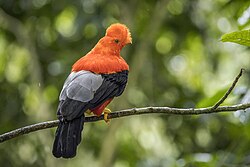
Measuring approximately 32 cm (13 in) in length and weighing between 265 and 300 grams, the Andean cock-of-the-rock is a substantial passerine. The most striking feature of the male is his large, disk-like crest and brilliant scarlet or orange plumage, contrasted by black wings and tail. His bill is typically yellowish.
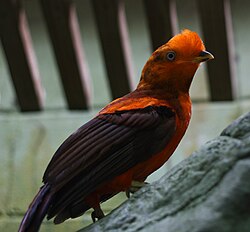
In contrast, the female is significantly drabber and browner, possessing a less prominent crest and a dark bill with a small yellow tip. This difference in appearance is vital for the female's protection while nesting. Iris colors vary by sex and subspecies, ranging from red, orange, and yellow to bluish-white in males, and whitish to brown in females.
Distribution and Habitat
These birds inhabit the montane cloud forests of Venezuela, Colombia, Ecuador, Peru, and Bolivia. They are typically found in ravines and forested streams at elevations between 500 and 2,400 meters. While they generally stay in the lower and middle forest levels, they will ascend higher to reach fruiting trees.
The species is generally shy and inconspicuous, often spotted only briefly when flushed out or seen flying swiftly through a valley.
Behavior and Diet
Feeding Habits
The Andean cock-of-the-rock is primarily frugivorous, consuming fruits from the Lauraceae, Annonaceae, and Rubiaceae plant families. To supplement this diet, they eat insects, amphibians, reptiles, and small mice. Interestingly, they have been observed following army ants to capture displaced prey.
The Lek Breeding System
Males are polygamous and engage in elaborate courtship rituals in communal areas called leks. In these arenas, males compete for the attention of females by bobbing, hopping, and performing "confrontation displays"—which include bowing, jumping, flapping wings, and snapping their bills accompanied by squawking and grunting calls.
Once mating occurs, the male's role ends. The female is solely responsible for nesting and rearing the young.
Nesting and Parental Care
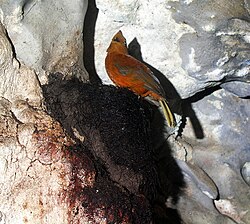
The female builds a concave, cup-shaped nest using a mixture of mud, vegetable matter, and her own saliva, which she plasters to rocky outcrops or cave entrances. She typically lays two white eggs, which she incubates for 25 to 28 days.
Ecological Impact and Conservation
These birds play a crucial role in their ecosystem through seed dispersal. By depositing seeds around lek and nesting sites, they increase the diversity of flora in those specific areas. Additionally, other species, such as the white-capped dipper, have been known to reuse abandoned cock-of-the-rock nests.
Despite the ongoing destruction of their habitat, the Andean cock-of-the-rock is currently classified as Least Concern by the IUCN. Its vast range across the Andes provides a sufficient buffer to maintain a stable population, although it is listed under CITES Appendix II to regulate trade.
| Feature | Male | Female |
|---|---|---|
| Plumage Color | Scarlet or Brilliant Orange | Dull Brown |
| Crest | Large, disk-like | Less prominent |
| Bill Color | Yellowish | Dark with yellow tip |
| Parental Role | Courtship and mating only | Nest building, incubation, rearing |
Frequently Asked Questions
Why are the males so much brighter than the females?
This is due to sexual dimorphism. Males use their brilliant colors to attract mates during competitive displays at leks, while females need drabber plumage to remain camouflaged from predators while nesting.
What is a lek?
A lek is a communal gathering area where males perform competitive displays to attract females. The males do not defend territories for resources, but rather for the right to mate.
What do Andean cocks-of-the-rock eat?
Their diet consists mainly of fruits from families like Lauraceae and Rubiaceae, supplemented by insects, frogs, lizards, and occasionally small mice.
Are they an endangered species?
No, they are currently classified as Least Concern by the IUCN. While habitat loss is a threat, their wide distribution across the Andes helps sustain the population.
Where can they be found in the wild?
They are native to the cloud forests of the Andes mountains, spanning Venezuela, Colombia, Ecuador, Peru, and Bolivia.